
HSBC has a crack at AI.
Back in early 2023, we had a first stab at the impact of AI on the labour market, and much of that early analysis holds true today.
However, we’re seeing more signs of the impact that the rapid developments in AI could have on various jobs across the economy–with improving capabilities bringing more jobs into the spectrum of being at risk from these technological innovations.
A wide-reaching piece of research from the IMF suggested that almost 40% of global employment is exposed to AI, with developed markets more exposed (60% of jobs) to the shock given the structure of the labour market.
This is an important early distinction–while automation (such as with robotics) has typically affected the demand for in-person work, AI will play a much bigger role in the future of work in services, with those ‘higher-skill’ roles potentially more at risk.
As a result, the impact of AI is, for now, more likely to be evident in developed economies.
To think about the impact that AI will have on workers, a few things need to be considered–both how exposed the nature of work is to the scope of AI skills, but also how complementary the work is to these same skills.
So, some jobs may be impacted by AI, but the impact is likely to be more positive, while others could see a much more negative impact.
On top of this, we need to see reorganisation of businesses to make the most of these potential productivity gains.
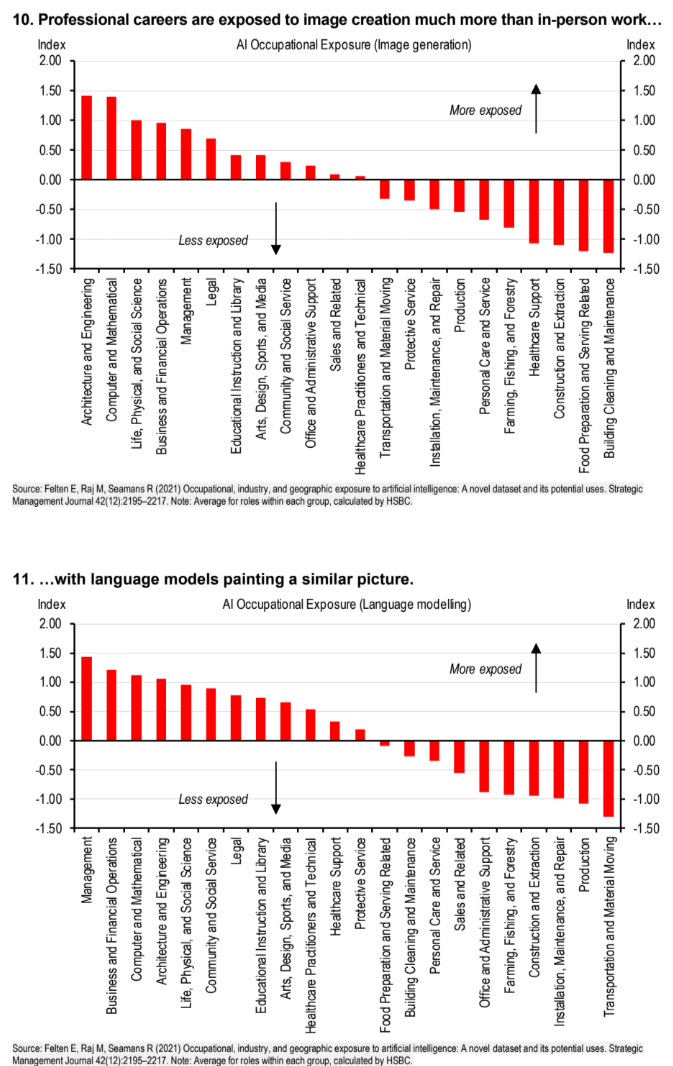
As a starting point, the widely cited work by Felten, Raj, and Seamans involved creating a dataset to assess how exposed different roles are to the evolution of AI–looking at both the exposure to large language models (LLMs) and image generation.
While there is some crossover between the two charts (10and11) below, it’s important to remember that different types of AI capabilities will have different impacts on the labour market.
The data illustrate how exposed different occupations are relative to average–with some jobs being clearly more or less exposed than others.
But, this is where a lot of the early work on AI’s impact on the labour market fell short, only looking at the exposure to AI, rather than the deeper impact of it on labour demand.
A range of papers produced over the past year or so have aimed to look at AI as a complement or substitute of labour in more detail.
For example, an IMF Working Paper released in 2023 finds that due to the nature of work in many developed markets, roughly half of the jobs impacted by AI see strong complementarity and therefore a much smaller impact on employment levels.
There are other ways that the analysis needs to be considered.
Work from OpenAI, the creators of ChatGPT, find that LLMs have the potential to impact 15% of tasks, with those being able to be completed more quickly with this support.
The findings suggest that “around 80% of the U.S. workforce could have at least 10% of their work tasks affected by the introduction of LLMs, while approximately 19% of workers may see at least 50% of their tasks impacted”.
Using AI in some of work tasks may have productivity gains.
The distinction here between tasks and employment is key, particularly given some of the headlines around AI and job losses, with headline grabbing statements such as “AI ‘apocalypse’ could take away almost 8m jobs in UK, says report”.
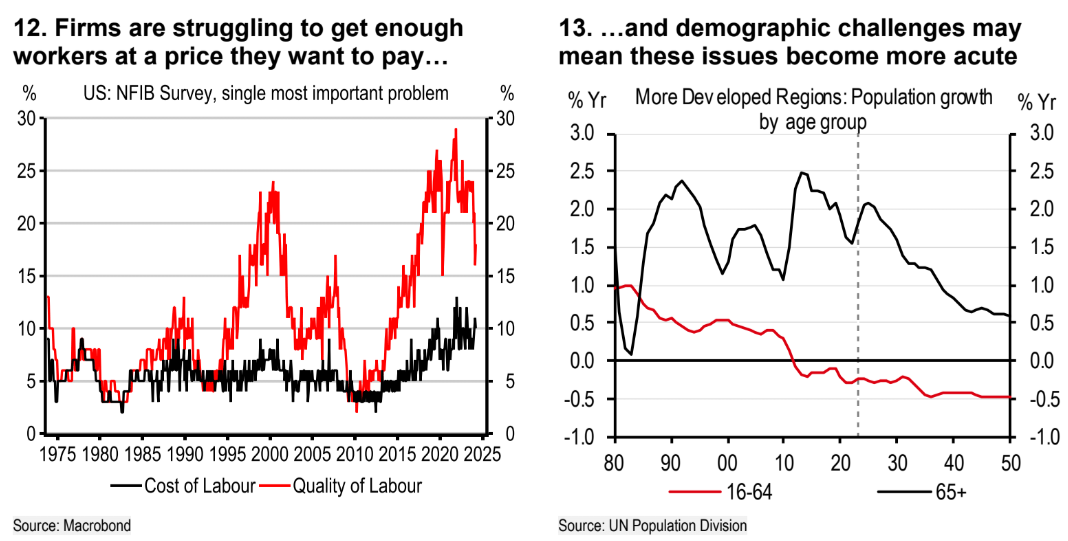
It’s also worth flagging that, while headlines are often written through the lens of large-scale job losses due to AI, this is happening at a time where the demand for workers is outstripping supply in developed markets.
Some of this is cyclical, with business surveys across the world (such as chart 12) highlighting that firms are struggling to get either enough workers or they feel like they are having to pay above and beyond for the workers they can get.
Structurally, changes in the makeup of populations means that most developed economies look set to see the number of would-be workers fall unless migration rates pick up materially, as they did in 2023.
There is a brilliant complementarity between an aging population and rising AI.
Not so if AI rises within an immigration-led labour market expansion economy.
It will be good to the extent that AI helps backfill capital shallowing and productivity, helping lift stagnant national income.
However, the distributional impact will be disastrous if AI is a net negative for job creation amid a permanent foreign labour supply shock.
All the benefits will accrue to capital, and wage growth will suffer even greater headwinds as unemployment rises.
If the government of the day responds with even more immigration to bandaid the hole in domestic demand and house prices, as it is doing right now, then AI becomes a labour doom loop.
Add autonomous cars and trucks, which will displace huge slices of the gig economy over a slightly longer timeframe, and the immigration-led labour market growth model collapses.
