
Advertisement
From the ABS:
| Nov 23 (no.) | Monthly change (%) | Yearly change (%) | ||
|---|---|---|---|---|
| Seasonally adjusted | ||||
| Total dwelling units approved | 14,529 | 1.6 | -4.6 | |
| Private sector houses | 8,506 | -1.7 | -6.2 | |
| Private sector dwellings excluding houses | 5,856 | 6.7 | 0.8 | |
| Trend | ||||
| Total dwelling units approved | 14,101 | 0.3 | -8.3 | |
| Private sector houses | 8,589 | 0.6 | -4.3 | |
| Private sector dwellings excluding houses | 5,341 | 0.5 | -12.4 | |
It appears approvals have at least bottomed even if lofty five year targets are a a joke at this point:
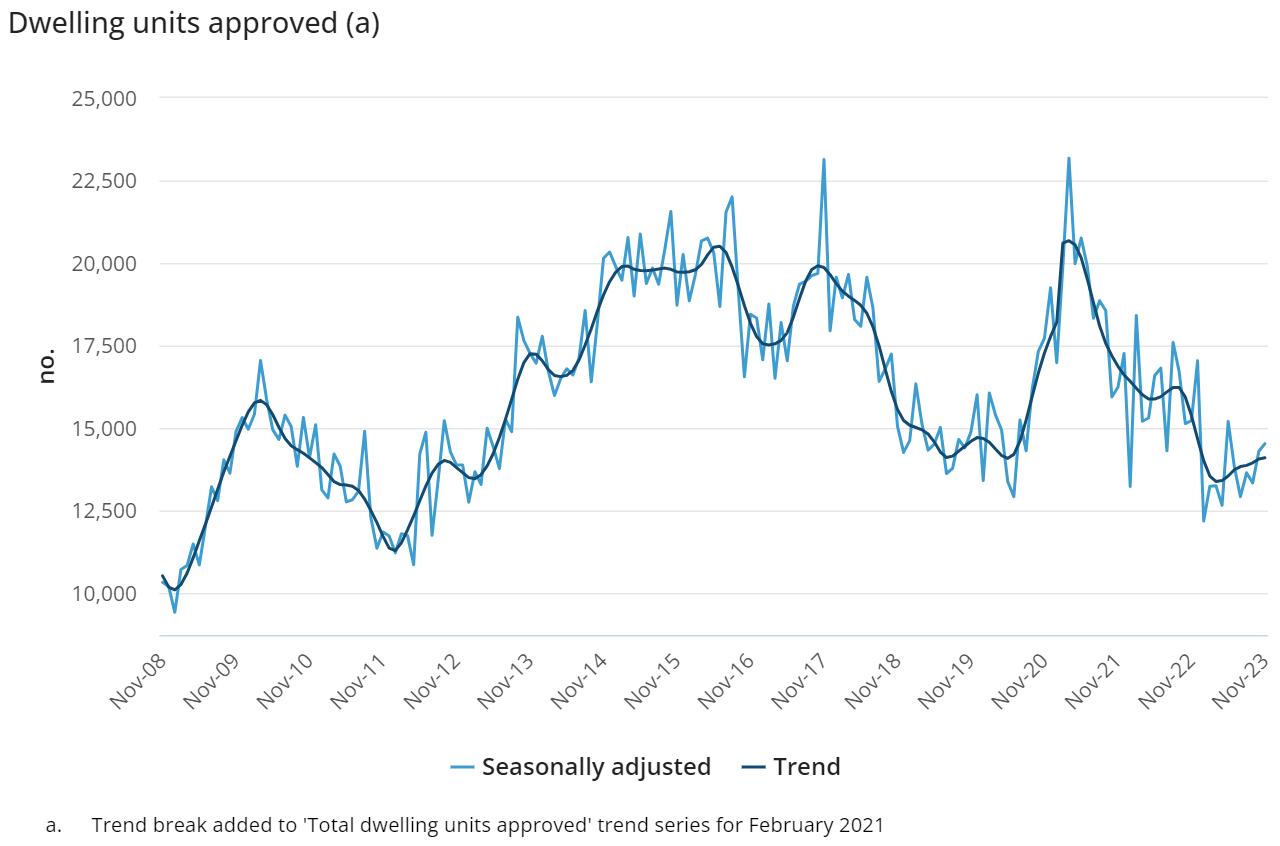
But that is not the problem. There are significant queues of approvals not being built because the projects are uneconomic amid the Alboflation of building input costs.
Advertisement
The answer is to slash energy prices and immigration levels so that building input costs can fall.
About the author

David Llewellyn-Smith is Chief Strategist at the MB Fund and MB Super. David is the founding publisher and editor of MacroBusiness and was the founding publisher and global economy editor of The Diplomat, the Asia Pacific's leading geo-politics and economics portal.
He is also a former gold trader and economic commentator at The Sydney Morning Herald, The Age, the ABC and Business Spectator. He is the co-author of The Great Crash of 2008 with Ross Garnaut and was the editor of the second Garnaut Climate Change Review.
Advertisement