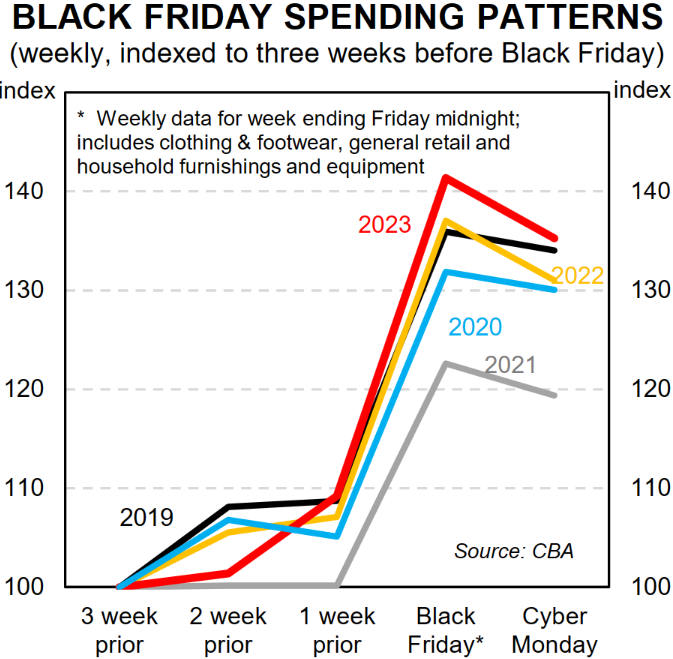
This week, CBA released its Household Spending Indicator (HSI), which showed that Australians temporarily splurged during the Black Friday and Cyber Monday sales period:
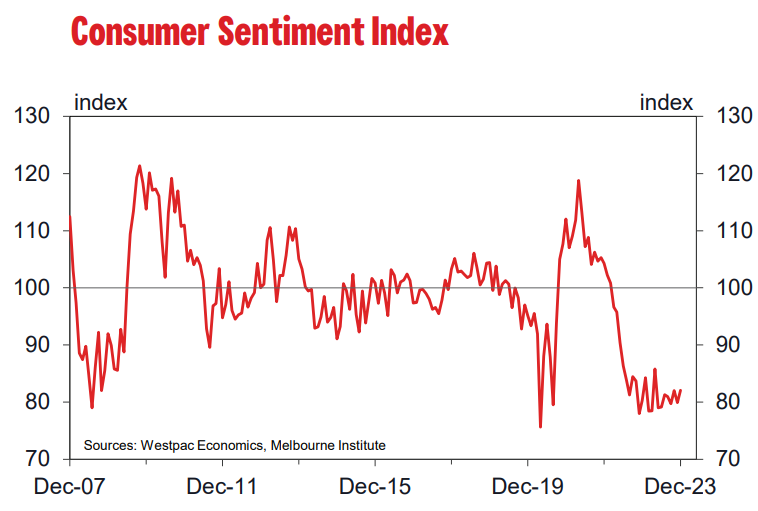
But consumer sentiment remains at recessionary levels following the collapse in household disposable income, and soaring cost-of-living, mortgage repayments, and rents:
Accordingly, the Westpac Card Tracker Index shows that Australian consumers have subsequently retreated back into their caves, with the index falling 5.9pts over the two weeks to December 9, unwinding all of the Black Friday boost in late November.
Below is Westpac’s report.
The Westpac Card Tracker Index* fell 5.9pts over the two weeks to December 9, unwinding all of the Black Friday boost in late November.
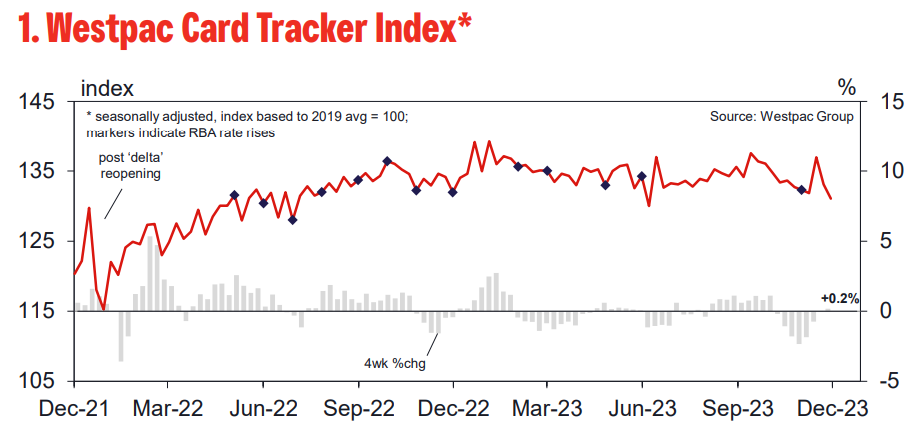
At 131.1 the latest index read is the second lowest seen since July 2022.
The Index is showing a clearer loss of momentum. Even with the Black Friday boost, the quarterly pace of growth has almost stalled flat in early December.
Much still depends on the remaining lead-in to Christmas and subsequent Boxing Day sales.
However, the weekly profile to date suggests much of the initial strength may have been due to consumers bringing forward purchases to take advantage of price discounts and that we are now starting to see the corresponding drop off.
That would in turn be entirely consistent with a consumer facing intense income pressures.
The detail continues to show weakness centred on discretionary services spend, and in NSW and Victoria. Non-food discretionary card activity during ‘Cyber-week’ was down slightly on the same week in 2022.
However, the detail shows online retailers still posted a small gain and picked up market share.
Any lingering doubts about conditions across Australia’s consumer sector were dispelled by the Q3 national accounts.
Spending flat-lined in the quarter in real, inflation-adjusted terms, annual growth dropping to just 0.4%yr. Incomes also came in weaker than expected, with households drawing more heavily on savings just to hold the line on spending, a dynamic that now has less scope to continue.
The Westpac card data suggests Q4 is not looking any better and may instead end up being worse spending-wise.
Chart 2 shows the Westpac Card Tracker’s quarterly growth pace alongside nominal spending growth from the national accounts.
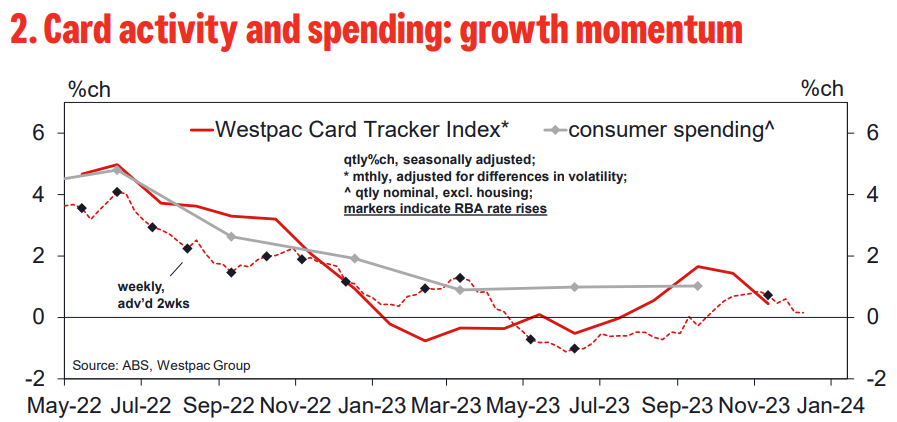
After dipping into negative mid year, the growth pulse lifted through Aug-Sep, sustaining into Oct but falling away again since. Latest weekly reads have quarterly momentum in the 0-0.25%qtr range. With price inflation tracking around 0.7%qtr, this points to a material decline in spending in real, inflation adjusted terms.
With population growth also tracking at 0.7%qtr, the per capita decline is over 1%qtr.
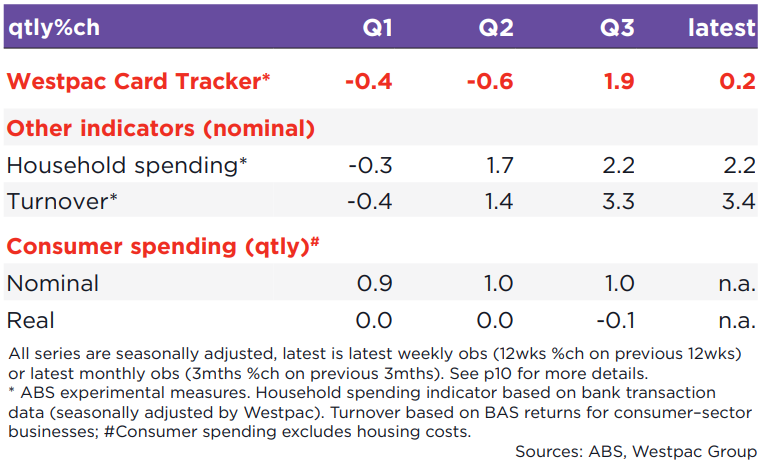
As noted, the Q3 national accounts showed real spending flat in the quarter and only up 0.4%yr (the table below shows spending excluding housing costs).
Oct updates of the ABS’s household spending and turnover indicators were broadly in line with the Westpac Card Tracker. Nov updates are due mid-to-late Jan.