
CBA published the below chart in August showing the annual change in savings and spending among age cohorts in Australia:
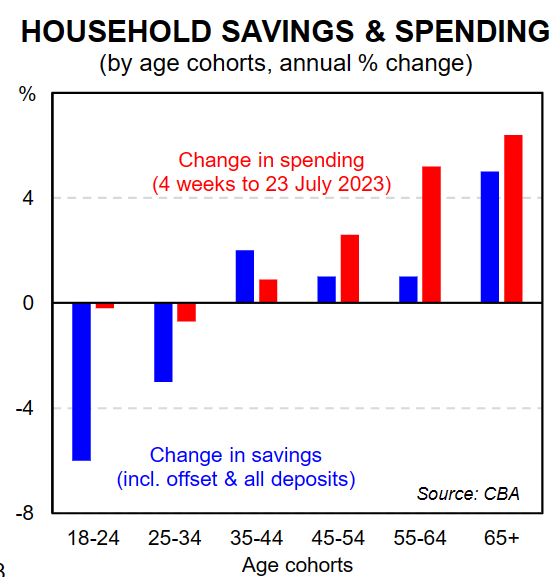
As you can see, younger Australians’ savings have plummeted in tandem with their consumption expenditure.
By contrast, older Australians saw an increase in both savings and spending over the year. This effect has been especially noticeable in people over the age of 65.
Separate data presented as part of the CBA’s investor pack demonstrated how the Reserve Bank of Australia’s (RBA) 4.0% rate hikes have harmed younger Australians while helping older Australians:
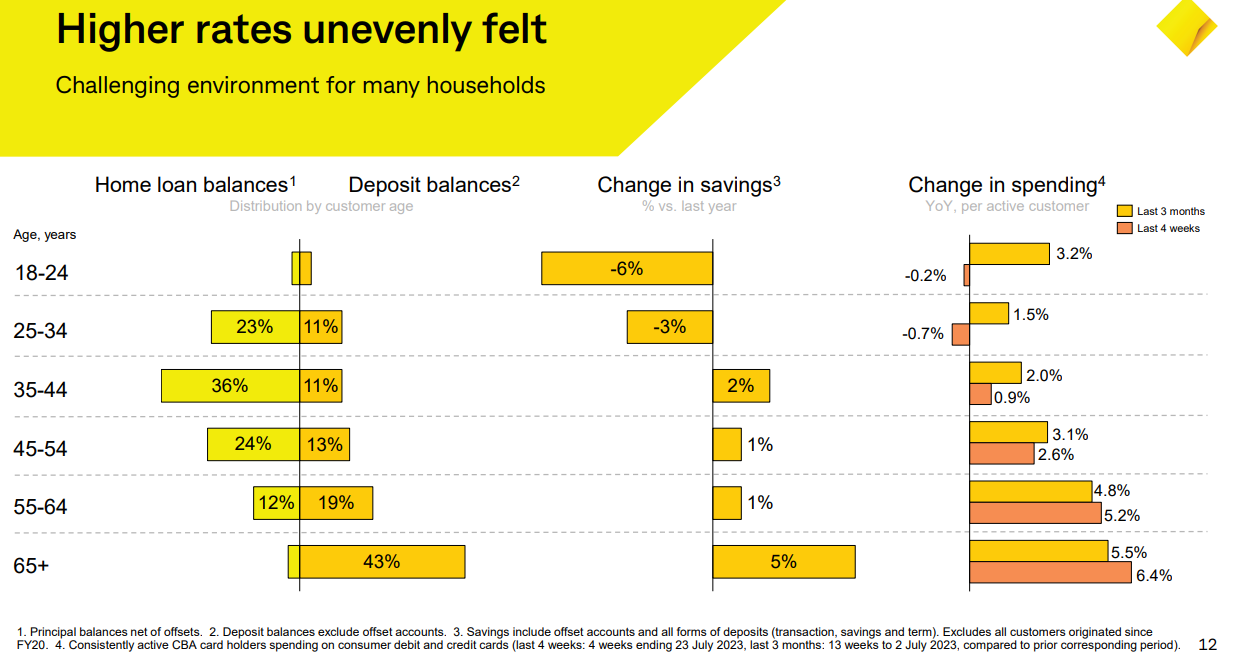
People over the age of 65 have little mortgage debt and account for 43% of total CBA savings.
Households aged 25 to 54, on the other hand, have the greatest amount of mortgage debt and the least amount of savings.
Savings have also increased the most for Australians aged 65 and over (+5%), while savings for those aged 34 and under have fallen.
Finally, compared to the previous year, households aged 65 and up increased their spending the most in the prior four weeks (+6.4%) and the last three months (+5.5%).
Younger households, on the other hand, have witnessed substantially smaller spending increases, with households aged 18 to 34 actually cutting expenditure over the last four weeks compared to the previous year.
The data shows how the RBA’s rate hikes exacerbate intergenerational equity. Younger households with mortgages lose, while older households with savings and wealth win.
This intergenerational inequity extends to government subsidies and hand-outs.
Justin Fabo from Macquarie Group has undertaken an analysis of all subsidies provided by all levels of government as measured in the ABS national accounts:
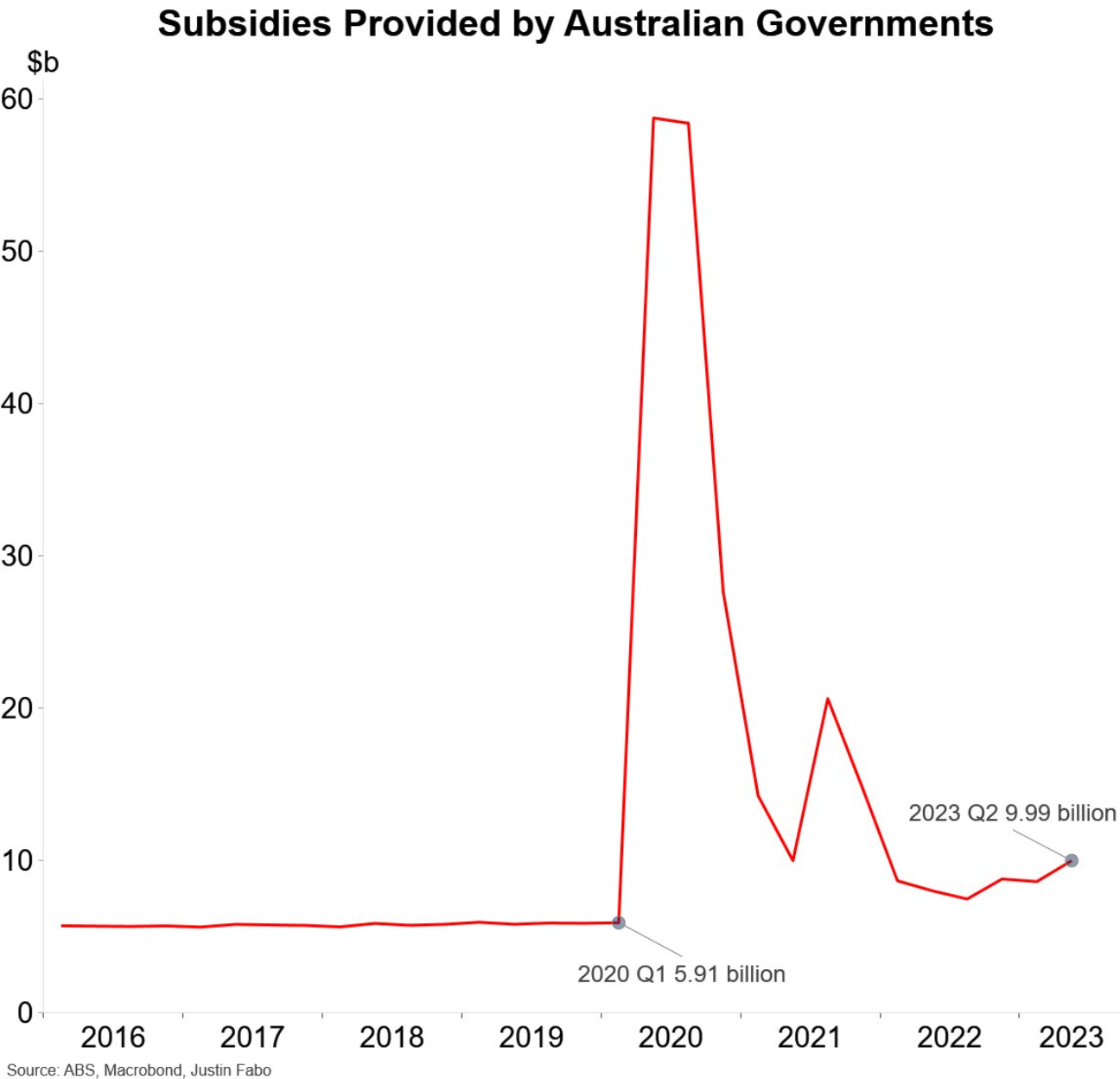
“Australian governments continue to provide significantly larger subsidies than they did pre-COVID – about $4 billion per quarter more”, notes Fabo.
However, the lion’s share of the ‘excess’ subisdies have gone to Australians aged 65 and over:
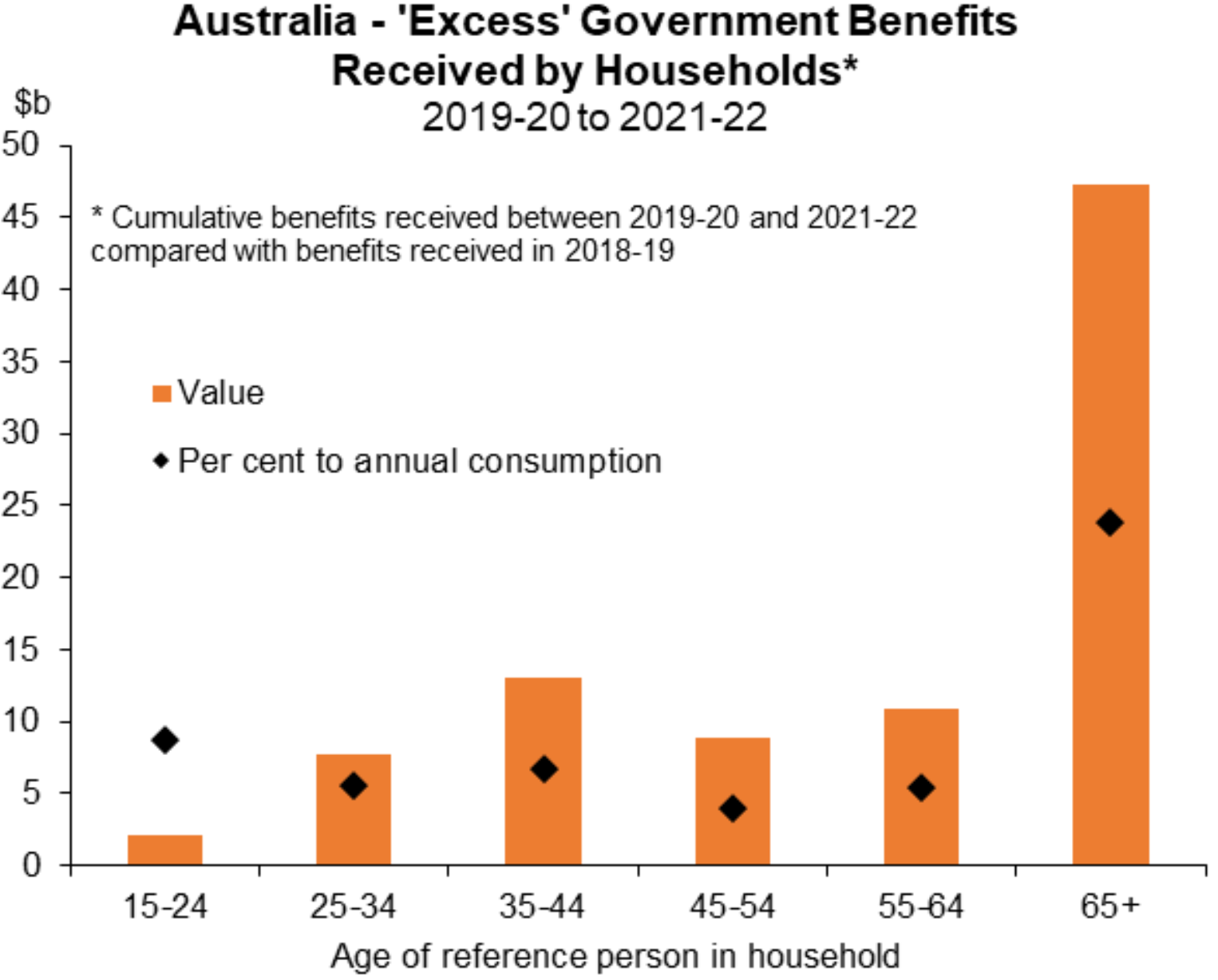
“Of the $85-90 billion in ‘excess’ government benefits paid to Aussie households over the 3 years to 2021-22, more than half went to households where the head was 65+ years old”, notes Fabo.
“Relative to what these households spend each year, it was huge”.
Some of this increase in subsidies to seniors would be the increase in eligibility for the Commonwealth Seniors and healthcare cards following the 2022 election.
For example, an extra 50,000 seniors, including self-funded retirees, were given access to $6.80 prescription medicines and other discounts via the Commonwealth Seniors Health Card.
The singles income test threshold for the card was increased from $57,761 to about $90,000, while the threshold for couples was increase from $92,416 to $144,000.
The healthcare card now provides cheaper fuel in NSW, an electricity discount, discount on public transport, free Gp visits, etc.
There was also an extra tourism discount for ‘pensioners’ during the pandemic in NSW, and public transport fares are still frozen for them.
Unlike working Australians, most wealthy retirees own their homes outright and are not supporting children.
They are largely unaffected by the surge in both rents and mortgage rates and have gotten much wealthier over the pandemic.
The baby boomer generation is also driving the nation’s household consumption, which has forced the RBA to respond with higher interest rates to slow the economy, which negatively impacts younger Australians.
The baby boomers do not deserve greater taxpayer support than households paying mortgages, rents, raising children, and earning lower incomes.
The success of controlling inflation also hinges, in part, on curbing the spending excesses of the baby boomers.
