
The housing crisis keeps getting worse.
The number of homes for rent and rental vacancy rates are at record lows across Australia.
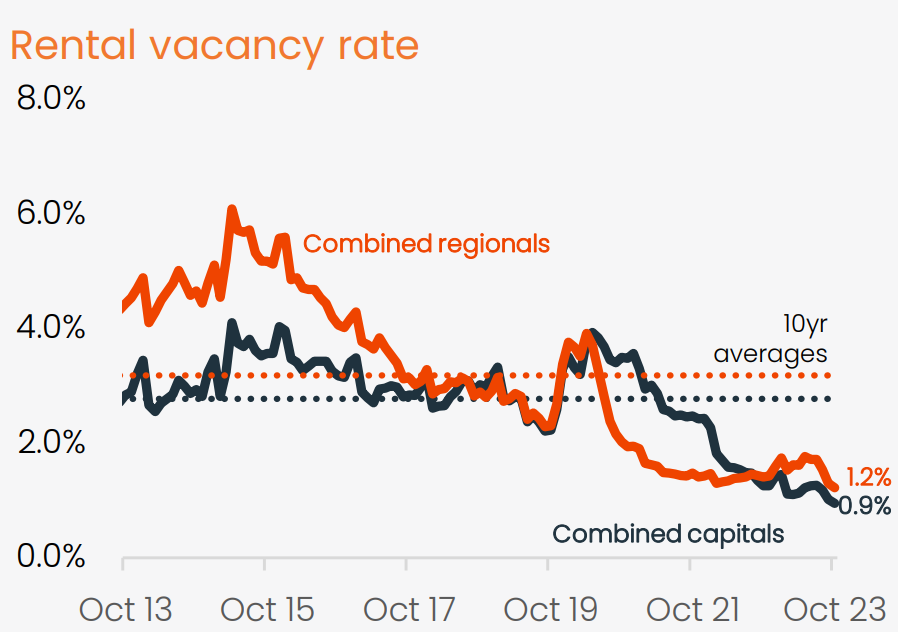
Source: CoreLogic
The latest housing supply data is also disastrous.
According to the Australian Bureau of Statistics’ (ABS) dwelling stock data, Australia added only 170,000 net homes in the 2022-23 financial year against a population increase of 626,000.
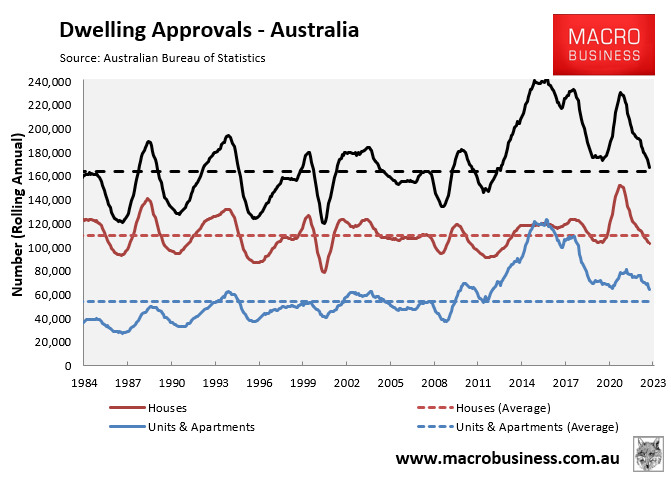
Worse, the forward-looking indicators – housing approvals, housing starts, and new home sales – are all tracking around decade lows, suggesting housing supply will continue to fall.
For example, only around 164,000 dwellings were approved in the year to September, which is around 75,000 less than the federal government’s housing target, which requires 240,000 homes to be delivered each year.
A survey of 11 economists and analysts conducted before Tuesday’s rate hike found a general consensus that Australia’s residential construction will continue to fall.
Jarden’s chief economist, Carlos Cacho, expects housing starts to total just 154,00 in 2023-24, down from 172,000 in the previous financial year. Construction would then only recover to 166,000 in the 2024-24 financial year.
Cacho says some residential projects that are in the pipeline may not be completed due to factors such as rising interest rates and high construction costs.
“The record rate of construction failures likely means potential buyers will remain cautious when considering new housing and mean that despite solid underlying demand, new housing sales remain subdued”, Cacho said.
“We also see an elevated risk that not all of the current $76 billion of residential work reaches completion, given high construction costs and interest rates could see elevated cancellations”.
SQM Research managing director, Louis Christoper, likewise warned that residential construction “is bottoming out as we speak”.
“The federal government’s push for 1.2 million dwellings is creating some confidence, along with a fall in raw material costs. But what is in the pipeline now will still fall well short of long-term averages”, he said.
Shane Oliver of AMP in turn warned that “solvency in the sector is likely to remain an issue over the next year and could even worsen if interest rates rise further and the economy slows”.
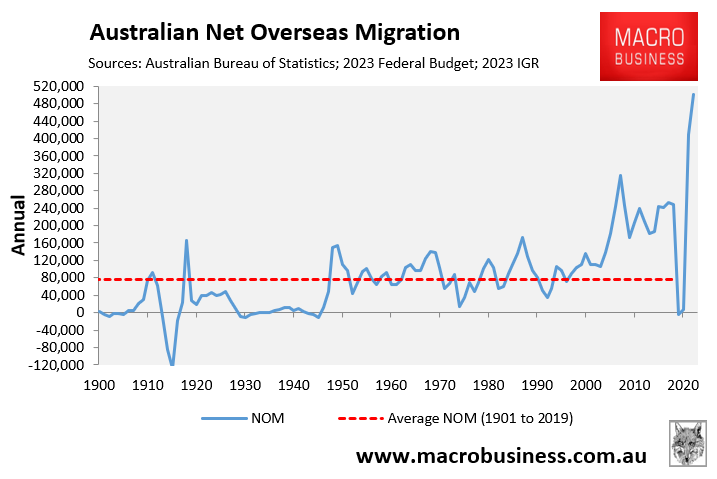
With the Albanese government bringing in record numbers of migrants into Australia, the collapse in housing construction can mean only one thing.
Australia’s housing crisis will continue to worsen, pushing more Australians into group housing, rough sleeping, and homelessness.
The Albanese government desperately needs to moderate net overseas migration to a level that is below the nation’s ability to supply housing and infrastructure.
It needs to stop making the housing situation worse.
