
The Reserve Bank of Australia’s (RBA) Assistant Governor (Financial Markets), Christopher Kent, gave an Address to Bloomberg on Wednesday where he expressed why the RBA is reluctant to lift the official cash rate further.
Basically, the RBA expects further impacts on the economy as the lagged effects of the 4.0% of monetary tightening delivered over the past 18 months flows through:
“The lags of transmission mean that some further effects of rate increases to date are still to be felt through the economy, which will provide further impetus to lower inflation in the period ahead”.
Kent showed the below chart of policy rate hikes and average mortgage rates across developed nations:
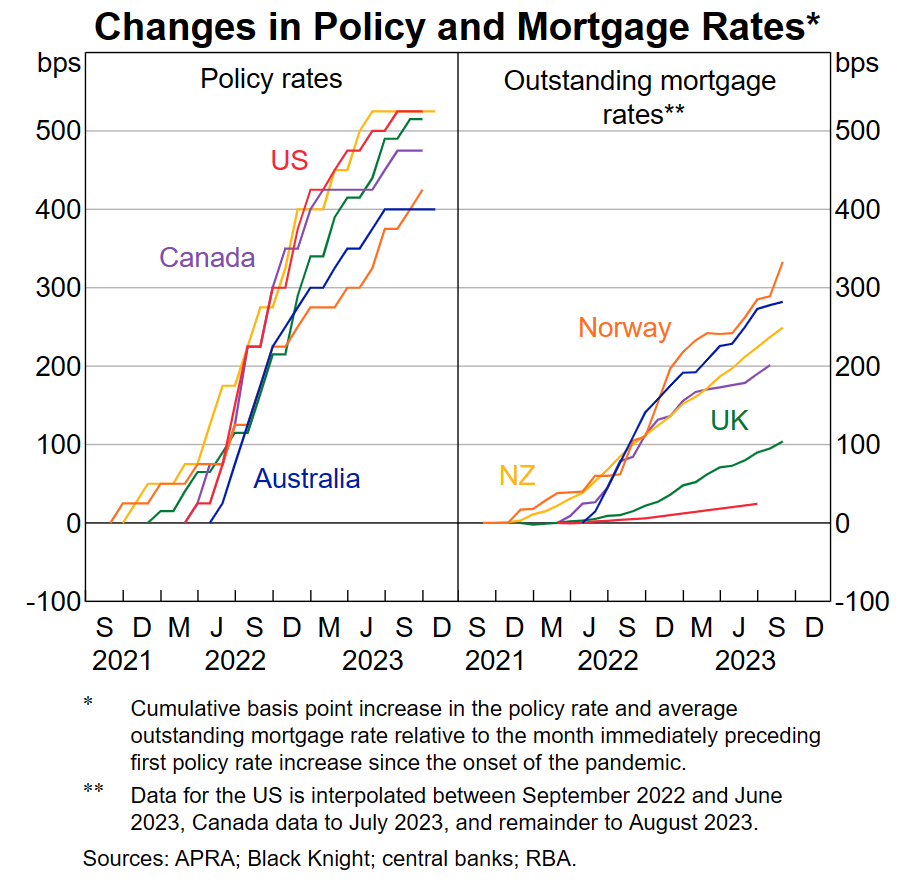
While the RBA has hiked official interest rates by less than most other developed nations, Australians have experienced one of the sharpest increases in outstanding mortgage rates. This reflects the fact that a much higher share of Australian households carry variable rate mortgages.
As explained by Kent: “The cash-flow channel is less prominent in economies where most debt is locked in at fixed rates for lengthy periods. In the United States, mortgages are typically fixed for 30 years”.
Australians are also more indebted than their peers, which also makes us far more sensitive to interest rate rises, as illustrated in the below chart of debt repayments to income from the Bank for International Settlements:
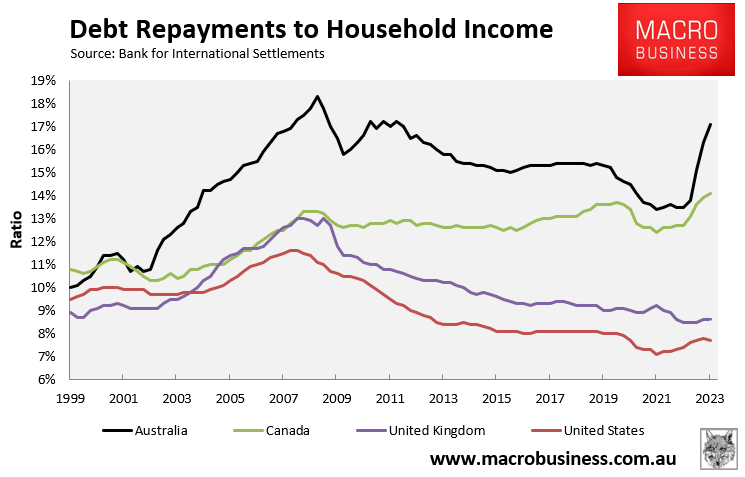
Kent also warned that Australian households will pay a record share of their incomes on debt repayments once the fixed rate mortgage reset runs its course next year:
“Compared with earlier episodes of rising interest rates, this channel has been operating with a slight delay given the high initial share of fixed-rate loans”.
“But around half of all loans that were fixed at a low rate have now rolled off, and most of the rest will do so over the next 12 months”.
“Required mortgage payments are at a record share of household disposable income and will rise further as more fixed-rate loans expire”.
The next chart from CBA shows that by mid-2024, households in aggregate will be paying just over 10% of their disposable incomes on servicing their mortgages:
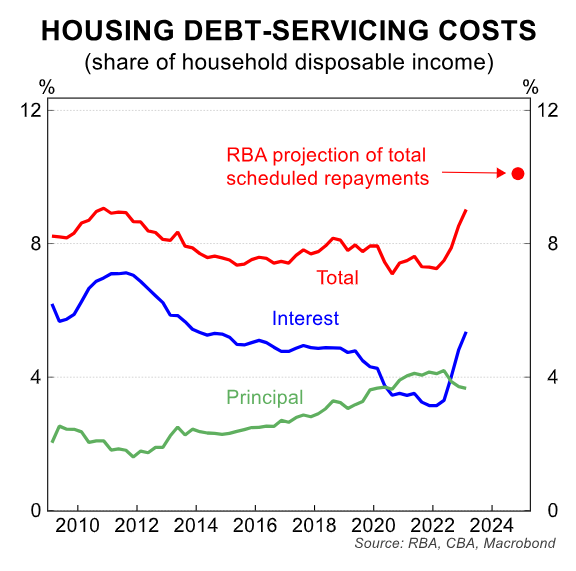
This ‘built in’ monetary tightening in Australia is why the RBA is reluctant to lift the official cash rate further.
Australia’s monetary system will tighten on its own as more pandemic era fixed rate mortgages reset from rates of around 2% to variable rates of more than 6%.
