Roy Morgan and the Australian Retailers Association have released retail sales forecasts for the upcoming Christmas period.
The top-line forecasts are for overall pre-Christmas retail sales of $78 billion (up 0.4% on a year ago) and a seasonally adjusted forecast of $66.8 billion (up 0.1%), virtually unchanged spending on a year ago.
The results are a shocker given annual inflation is forecast to be between 4% to 5%, alongside circa 2.5% population growth.
It would mean that retail sales would have fallen heavily in real per capita terms.
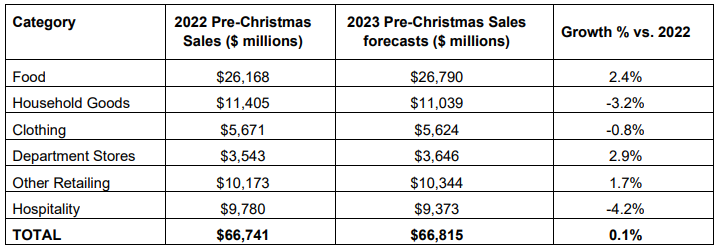
The below table shows the retail sales forecasts by broad category:
Source: Roy Morgan and ARA
Food spending is expected to rise 2.4%, owing primarily to increases in supply input prices.
As cost-of-living pressures continue to bite, the categories of Hospitality (down 4.2%), Household Goods (down 3.2%), and Clothing (down 0.8%) are preparing for a softening of spending in the run-up to Christmas 2023.
Department stores (up 2.9%) and other retailing (up 1.7%), which includes categories such as recreational goods, books, and cosmetics, are on track to outperform last year in terms of sales growth.
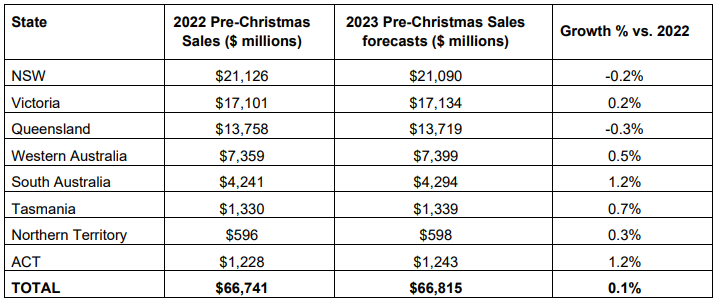
The next table shows expected retail sales by jurisdiction:
Source: Roy Morgan and ARA
South Australia and the ACT are expected to have the highest sales increase (up 1.2%), followed by Tasmania (up 0.7%), Western Australia (up 0.5%), the Northern Territory (up 0.3%), and Victoria (up 0.2%).
Spending is expected to fall in Queensland (down 0.3%) and New South Wales (down 0.2%).
Commenting on the results, ARA CEO Paul Zahra said that “the marginal increase in spending this year is being inflated by supply chain price increases, particularly in food, and an overall increase in Australia’s population”.
“If you exclude these factors, overall Christmas spending is in decline”.
“For many discretionary retailers, up to two-thirds of their profit is made during the all-important Christmas trading period, so it is shaping up to be a period of business uncertainty this year”.
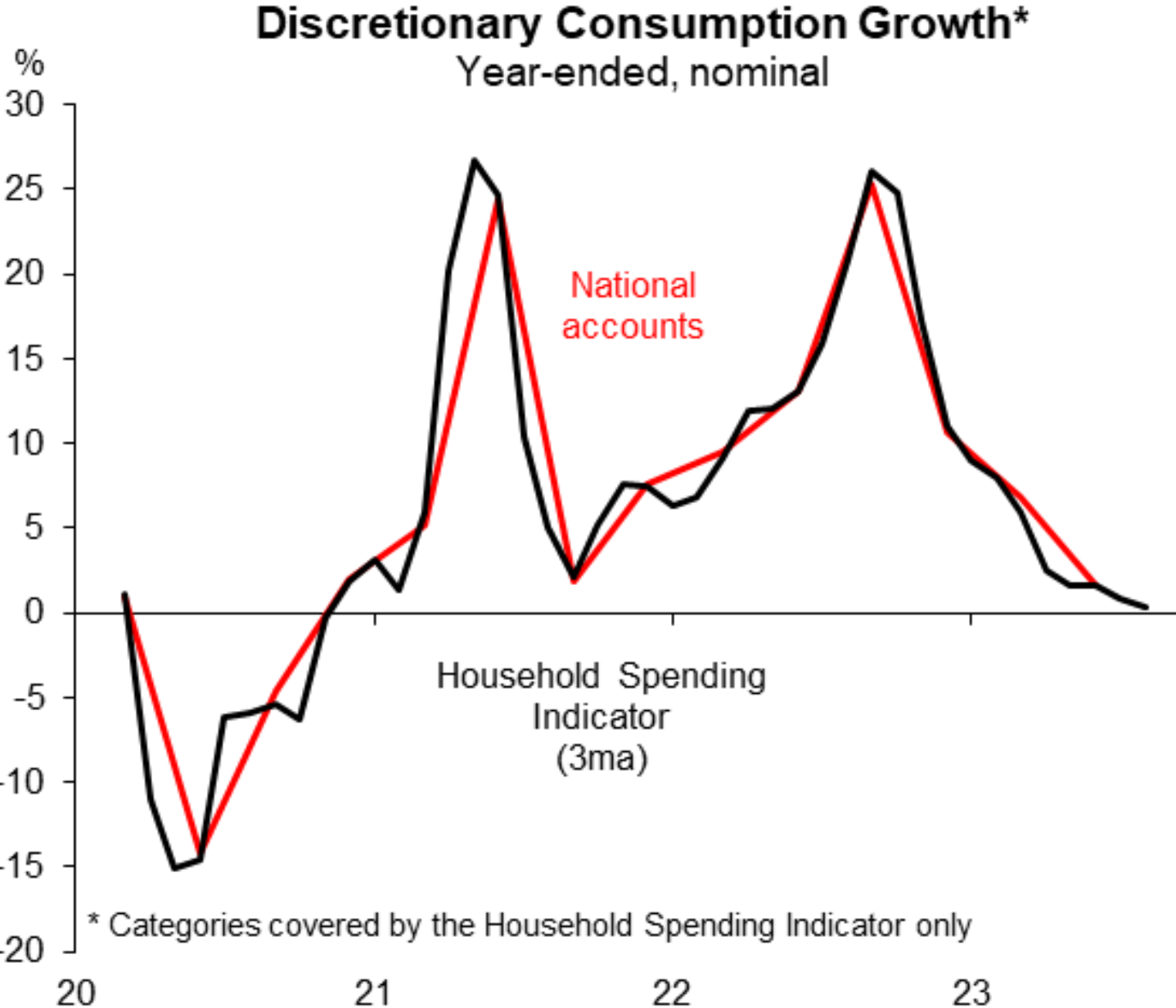
The below chart from Justin Fabo at Macquarie Group shows the sharp deceleration in discretionary nominal household consumption, as measured by the quarterly ABS national accounts and the more timely ABS Household Spending Indicator:
Source: Justin Fabo (Macquarie Group)
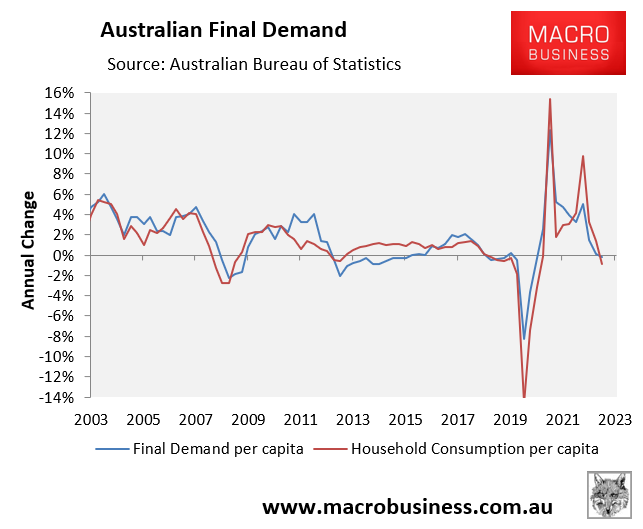
The forecast decline in real retail sales is reflective of the Australian economy, which was already in a per capita recession in the June quarter of 2023:
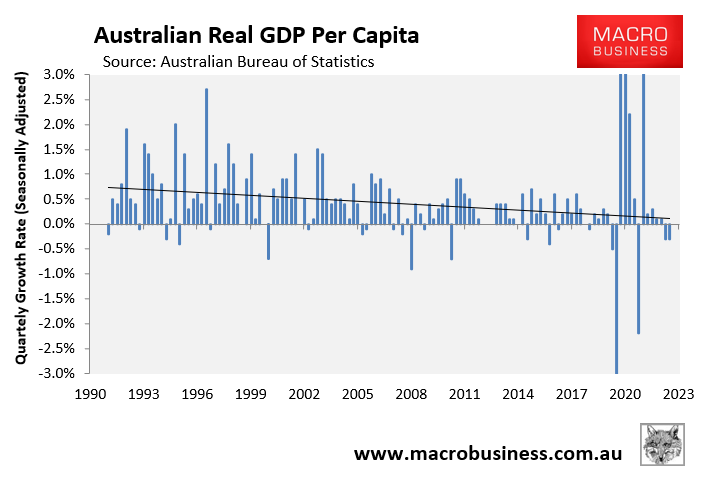
This per capita recession has been driven by a 0.2% decline in real household consumption per capita in the year to June:
The only thing holding up retail sales and the nation’s GDP is the Albanese Government’s record immigration program.
This extreme population growth is inflating nation’s economic pie. However, everyone’s share of the pie is shrinking while actual living standards collapse.