
Advertisement
By Stephen Halmarick, Chief Economist at CBA:
Key Points:
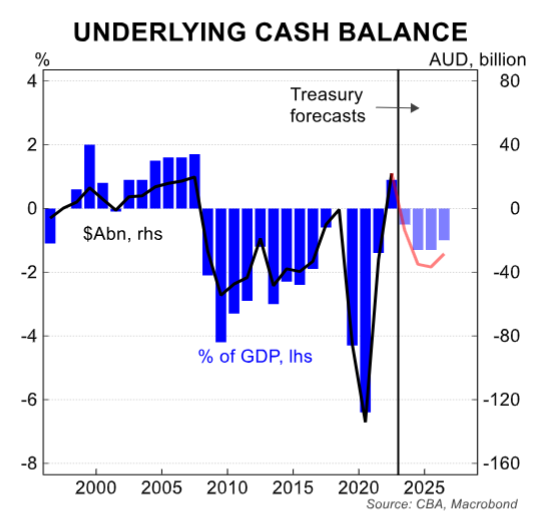
- The 2022/23 budget position has come in much stronger than previously estimated, as widely expected. For 2022/23 the budget was in surplus by $A22.1bn (+0.9% of GDP), a substantial improvement on the October 2022 estimate of a deficit of $A36.9bn (-1.5% of GDP) and the more recent May 2023 estimate of a $A4.2bn (+0.2% of GDP) surplus.
- The improvement in 2022/23 came mostly from the revenue side. Total revenue is up $A13.9bn relative to the May 2023 estimate, jumping to 25.7% of GDP from an previous estimate of 25.0% -thanks largely to higher company tax receipts. In contrast, spending for the 2022/23 year was $A4bn lower than the May estimate.
- While the benefits to the budget from the stronger-than-expected economy are likely to fade as we progress through 2023/24, the chances are high that the budget will remain in surplus this year and outperform the most recent estimate of a $A13.9bn (-0.5% of GDP) deficit.
- The stronger budget position has lowered Australia’s net debt position and has positive implications for the AOFM’s borrowing task.At 19.4% of GDP as at June 2023, Australia’s net debt is at its lowest level since 2018/19.
- Thetightening of fiscal policy that has been occurring through 2022/23 and pushing into 2023/24 will assist the RBA in getting inflation back into the 2%-3% target range,which we expect to see in H2 2024.
Bigger surplus in 2022/23
Advertisement
As widely expected, the final outcome for the 2022/23 Budget position showed a significant improvement on the estimates contained in the May 2023 Budget as well as the government’s October 2022 re-do on the budget for the last year.
The full text of this article is available to MacroBusiness subscribers
Cancel at any time through our billing provider, Stripe
About the author

Leith van Onselen is Chief Economist at the MB Fund and MB Super. He is also a co-founder of MacroBusiness.
Leith has previously worked at the Australian Treasury, Victorian Treasury and Goldman Sachs.
Advertisement