
By Stephen Halmarick, Chief Economist at CBA:
Key Points:
We expect the new RBA Governor and Board to leave monetary policy unchanged at the October Board meeting, holding the cash rate steady at 4.1%.
The RBA is expected to retain its tightening bias and be alert to the inflation and wages data over the final months of 2023. But given the recent mixed data flow and our view that inflation will trend towards the 2%-3% target range in 2024 we hold to the view that the hurdle to another rate hike is high.
However, we shift our base case for the start of the monetary policy easing cycle to May 2024 (previously March 2024). This will give the RBA more time to be confident that inflation is on the right path. The May 2024 Board meeting also has the advantage of being a Statement on Monetary Policy meeting that will afford the RBA the opportunity to update their full set of forecasts.
October RBA Board meeting
The 3 October Reserve Bank of Australia (RBA) Board meeting will be the first for Michele Bullock as Governor –although of course she has attended each Board meeting since being appointed Deputy Governor in early 2022.
The task for the new Governor and Board will be, as always, to assess recent data points and the outlook for the economy and inflation and decide if the current state of monetary policy is the appropriate one. It is also worth noting that the RBA Board will also have the opportunity next week to discuss the latest six-monthly Financial Stability Review, which will be published on 6 October.
In our view, when looking at the data flow since the September meeting and the path ahead (see below for details) the best course of action for the RBA will be to continue the pause seen in the cash rate since the June Board meeting, maintaining a rate of 4.1%.
The RBA’s forward guidance is, however, likely to continue to signal that the balance of risks is for a further rate hike in the near-term. The sentence used in September, namely “some further tightening of monetary policy may be required to ensure that inflation returns to target in a reasonable timeframe” is likely to be used again next week.
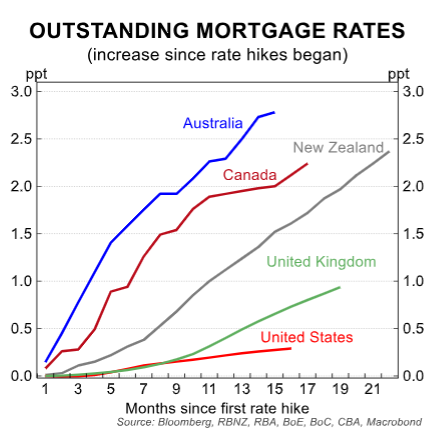
However, it is worth highlighting that the Minutes of the September Board meeting shifted the RBA’s data-dependent qualifier on the policy outlook from “depend(ing) on the data and the evolving assessment of the risks” to a more explicit “should inflation prove more persistent than expected.”
Our view remains that the hurdle for another rate hike is high and that Australia is likely to see an extended period of no change in the 4.1% cash rate.
The risks to that view over the remainder of 2023 is, however, to the upside. This is especially so given the recent substantial increases in the cost of oil will feed into the CPI in coming months and there is uncertainty as to what extent the Q3 23 Wage Price Index data (due 15 Nov) will show an acceleration in both the quarterly and annual pace of wages growth given the recent National Wage case, higher public sector pay rises and some increases in key Enterprise Agreements will all feed into the data.

Conversely, by the time we get to the November and December RBA Board meetings we expect to see a further weakening in domestic consumer spending and a slowdown in the pace of global economic growth; keeping the RBA on hold into 2024.
As detailed below, however, we have now pushed our expectation for the first monetary policy easing by the RBA from the March Board meeting to the May 2024 Board meeting.
Data flow since September
Q1 23 National Accounts: Showed a modest pace of real GDP growth of 0.4%/qtr and 2.1%/yr, driven largely by business investment and net exports.
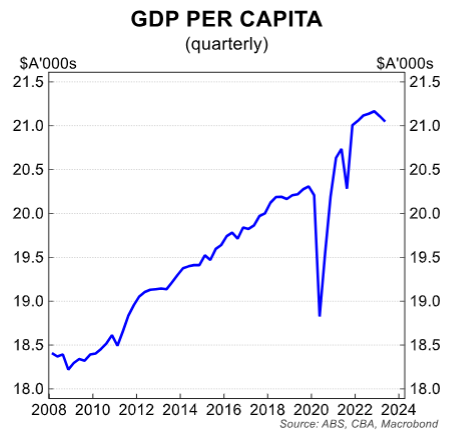
Importantly, the data showed a further decline in per capita consumption, with real GDP per capita falling for the third quarter in a row.
A further slowing in the annual pace of real GDP growth is expected into year-end 2023.
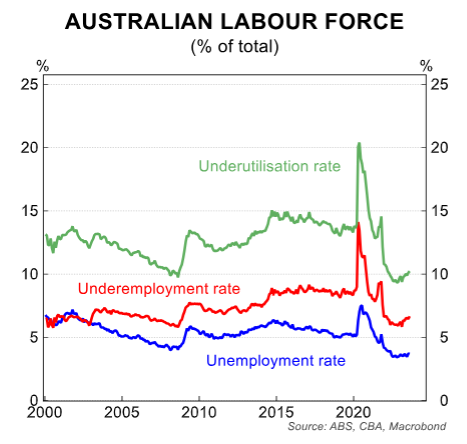
August labour force: Showed a strong rise in employment after some holiday-affected weakness in July. The unemployment rate was unchanged at 3.7%, up from the cyclical low of 3.4% seen in October 2022.
Other indicators of the labour market (ie. job ads and job applications) are showing some softening in the labour market.
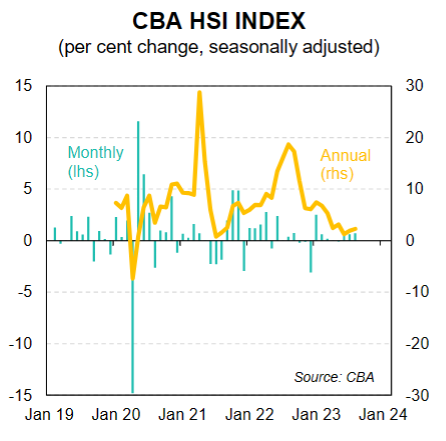
CommBank HSI: The Household Spending Insights (HSI) index rose 0.7%/mth in August, seasonally adjusted, but was driven higher on the month by increased spending on Education (international students), Transport (higher petrol prices) and Recreation (FIFA Women’s World Cup).
In the year to August the HSI index was up 2.3%/yr, a small acceleration from 1.9%/yr in July, led higher by increased spending on Education(+14.7%/yr), Insurance (+13.5%/yr) and Recreation (+8.4%/yr).
In contrast, spending in Household goods (-3.6%/yr) and Household services (-8.4%/yr) both fell in the year to August.
Within the HSI index we can also breakdown spending between Retail and Non-retail. Importantly, the Retail component rose just 0.2%/mth in August, to be up a very modest 0.9%/yr to August.
As detailed below, this also fits in with the soft retail trade reading from the ABS in August.
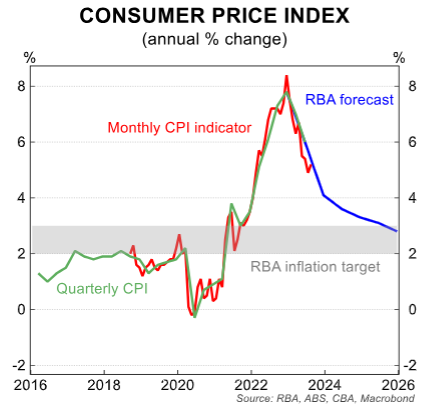
August CPI Indicator: Rose by 0.8%/mth in August(seasonally adjusted), taking the annual inflation rate up to 5.2%/yr from 4.9%/yr in July. As detailed in Stephen Wu’s note, “the rebound in inflation in August was entirely expected. Higher automotive fuel prices across August and September compared to our earlier forecasts will mechanically add about 0.2 percentage points to Q3 23 headline CPI inflation, all else equal (data due 25 October). The exclusion-based measures of core inflation continued to ease in annual terms. CPI excluding holiday travel and volatile items (fruit & veg and fuel) eased to 5.5%/yr from 5.8%/yr”.
“The annual trimmed mean series was unchanged at 5.6%/yr. We view the uptick in inflation in August as a temporary hump in the downward trend in train since December last year. We think the RBA will be inclined to see it that way too when it meets next Tuesday for the October rate decision. We don’t anticipate the August CPI will alter their view the current cash rate of 4.1% is restrictive enough to pull inflation back inside the target band.”
August retail trade: Rose by just 0.2%/mth, splitting the difference between our forecast of a 0.1%/mth gain (as guided by our HSI Index data) and the market consensus looking for a 0.3%/mth increase.
The ABS also reported that “in trend terms, retail turnover rose 0.1%/mth, and was up only 1.3% compared to August 2022 – the smallest trend growth over 12 months in the history of the series. Considering how high inflation and strong population growth has added to retail turnover in the past year, the historically low trend growth highlights just how much consumers have pulled back in response to cost-of-living pressures.”
Also consistent with the CommBank HSI data, the ABS noted that “spending was again boosted by the 2023 FIFA Women’s World Cup with strong demand for fan gear and increased spending across cafes, restaurants and takeaway food outlets as large crowds attended matches and live sites across the country. Household goods retailing recorded a third consecutive fall (-0.4%/mth), and the ninth monthly fall in turnover in the past 12 months.”
Clearly both the CommBank HSI data and ABS retail trade data is showing a slowdown in consumer spending as the RBA’s interest rate hikes take effect.
Monetary policy outlook
In a note on 22 August, my colleague Belinda Allen laid out the risks to our cash rate outlook – which at the time was for a monetary policy easing cycle from the RBA to get underway in March 2024.
The key focus for the monetary policy outlook was on the evolution of prices, wages, the labour market and consumer spending. To that we can also add global factors.
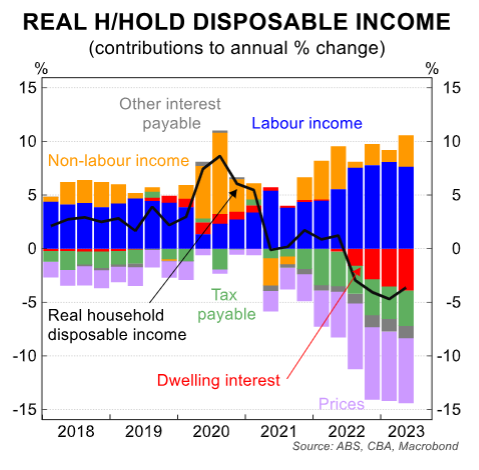
Weighing up the recent data flow and global developments (ie. higher energy prices and central bank rhetoric), we have shifted our base case to expect the monetary policy easing cycle by the RBA to get underway at the 6-7 May 2024 Board meeting.
Apart from giving the RBA Board more time, the May Board meeting has the advantage of also being a Statement on Monetary Policy meeting, allowing Governor Bullock the opportunity to update the RBA’s economic forecasts and use those updates to layout the groundwork for policy easing.
As with all RBA Board meetings in 2024, the Governor will also hold a press conference after the Board meeting decision is announced.
By May 2024, the RBA will have in hand a number of data points that will support the start of a modest easing cycle.
The Q4 23 GDP data, to be released early March, is expected to show annual GDP growth of just 1.1%/yr (although this is an upward revision to our previous forecast of 0.7%/yr). In addition, we would expect to see further weakness in consumer spending (including as measured by the CommBank Household Spending Insights (HSI) Index and some softness in the labour market, ie. a further drift higher in the unemployment rate.
Most importantly, we are forecasting both the headline and underlying inflation rate to move towards 3.0%/yr in H1 24,and back into the RBA’s 2%-3% target range by H2 24.
The Q1 24 CPI data will be released in late April and will be a key determinant into the May Board meetings deliberations. Also of note, we continue to expect the US Federal Reserve to begin easing monetary policy at the 21 March FOMC meeting.
A rate cut by the US Fed in March will be an important data point for the RBA Board when it meets in May, as it will signal an improved outlook for global inflationary pressures.
We hold to the view, however, that after the first rate cut in May that the cash rate will be lowered by a total of 100bp in 2024, down to 3.1% by year-end.
After the expected May rate cut, of 25bp, this would imply three more 25bp rate cuts over the course of the remaining five Board meetings in 2024 (ie. 17-18 June, 5-6 August, 23-24 September, 4-5 November and 9-10 December).
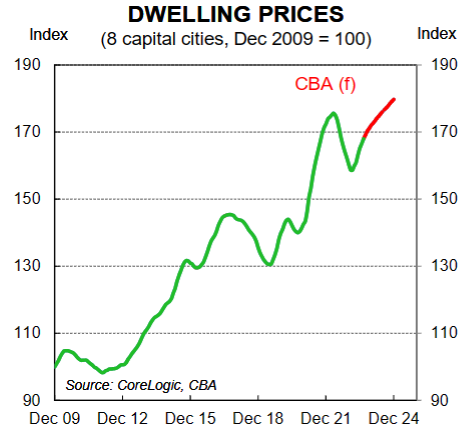
At this stage we would favour moves at the two Statement on Monetary Policy meetings, ie. August and November, with another move in one of the other meetings, with a December move favoured at this stage.
