The Centre for Future Work at The Australia Institute has released a report arguing that corporate profits have continued to soar in Australia, which is fueling inflation and lowering workers’ real wages.
Below is the Summary and Conclusion of the report alongside key charts and tables.
Summary
In the two years since global inflation started to accelerate after the COVID pandemic and subsequent economic reopening, a significant body of original research has been published by economists around the industrial word investigating the causes and distributional consequences of this inflation.
Most of this research has noted that wages and labour costs have not been a leading cause of this inflation, contrary to the conventional assumptions of orthodox monetary theory and policy. Instead, unit labour costs have been muted compared to previous inflationary episodes, and real wages have fallen significantly in most industrial countries.
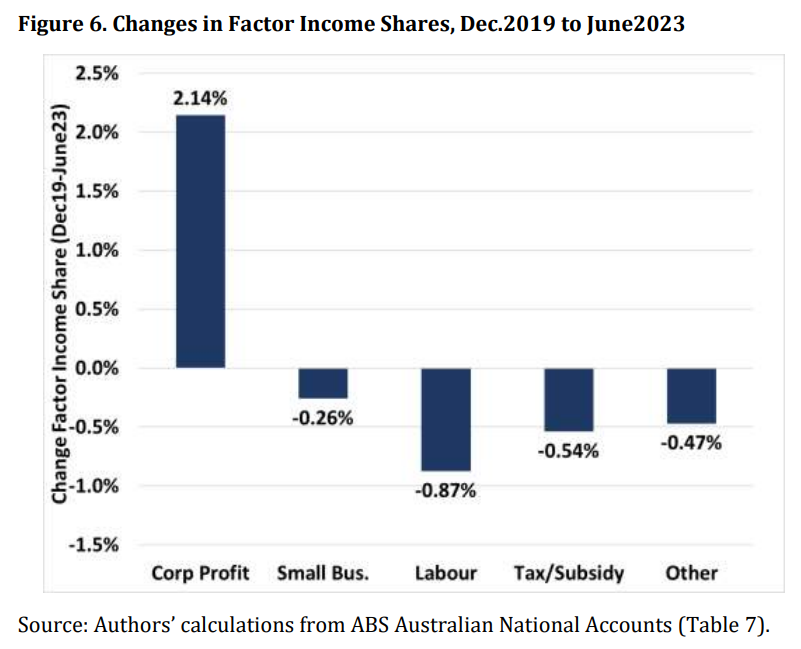
In contrast, corporate profits increased coincident with this inflation to historic highs in many industrial countries (including Australia).
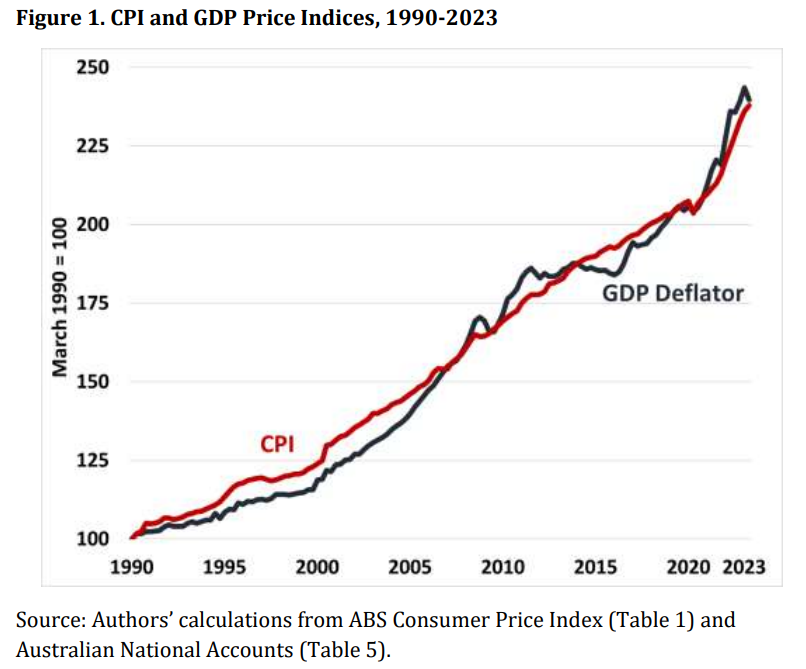
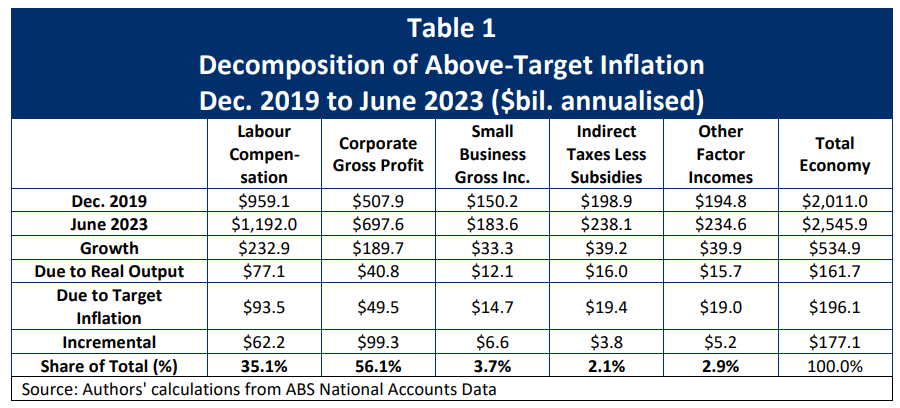
Much of this new research used empirical techniques to decompose increases in economy-wide prices into factor incomes (on the basis of standard national income accounting practices).
The implications for macroeconomic and monetary policy of these findings are important: if labour costs were not the source of inflationary pressure, then conventional anti-inflation policy (typically aimed at weakening labour demand and thus wage growth through monetary tightening) might be misplaced.
Instead, measures to more directly control price increases, foster more competition in key industries, limit the growth of unit profits, and/or redistribute unusually high profits might be more relevant.
In Australia, several reports regarding the causes of inflation, with methodology and findings consistent with this growing body of international literature, were published by the Australia Institute and its Centre for Future Work.
The reaction to this research from certain segments of the business media, orthodox economics, and federal macroeconomic officialdom was hostile. Whereas in other countries these findings have sparked dialogue and further inquiry, in Australia some critics suggested these reports were illegitimate, flawed, and should even be retracted.
These critics identified no quantitative errors in our research. Rather, they simply denied the relevance of our methodology and findings to the Australian situation.
This briefing paper presents a comprehensive bibliography of recent international research (and a few other Australian reports) on the role of elevated profits in post-pandemic inflation. We review over 35 different published works which have decomposed inflation (most using methodology similar to that used in our reports), and found that historically high profits have played an important role in recent inflation.
This paper also describes theoretical approaches that help to illuminate the role of profits in determining inflation. The methodology of our research on profit-led inflation is founded on conventional national income accounting, and has been widely used by international economists (including several overseas central banks, and international organizations such as the OECD, the IMF, the Bank for International Settlements, and the European Commission).
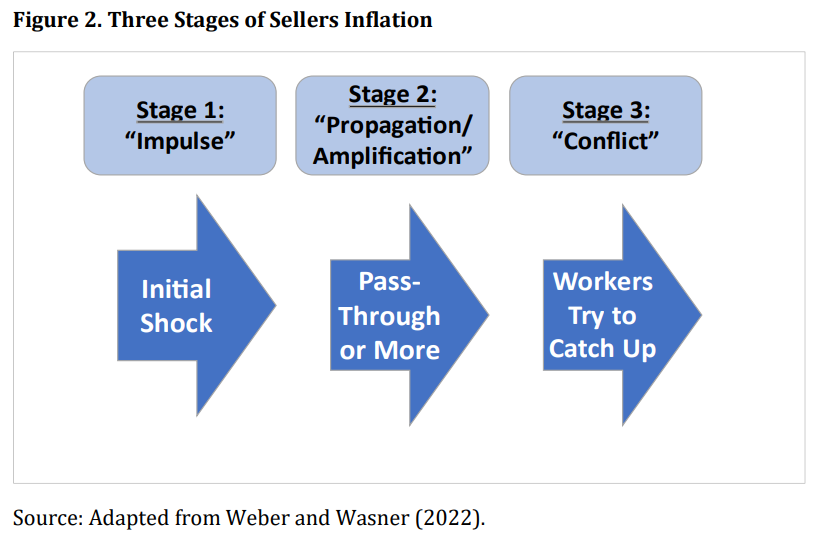
The global literature on profit-led inflation is growing rapidly, as other researchers further investigate the impact of distributional shifts between wages and profits on evolving macroeconomic and inflation conditions.
Our general finding that record-high profits in Australia (like many other industrial countries) account for the lion’s share of the surge in economy-wide price levels in the first years after the COVID pandemic is undeniable.

Research continues to further elucidate and understand the specific channels and mechanisms linking record profits (in Australia and elsewhere) to inflation, and considering how these distributional issues are likely to evolve in coming years (in particular, as workers struggle to repair real wages deeply damaged by higher prices).
Exploring these important questions theoretically and empirically is an important priority for open-minded macroeconomists to pursue. Others, with vested interests in a status quo policy orientation that accepts record profits as natural and inevitable, and triers to shift the burden of disinflation onto those who did not cause the problem, will continue to deny the legitimacy of this research agenda.
The policy implications of this growing international body of research for anti-inflation policy are immediate and important.
First, the analysis throws into question the wisdom, efficiency, and fairness of using continued monetary tightening to suppress domestic demand, employment, and wages. This strategy, even though it misses the true sources of post-pandemic inflation, might eventually succeed in bringing inflation down – but only at great cost to the economy, and to working households in particular.
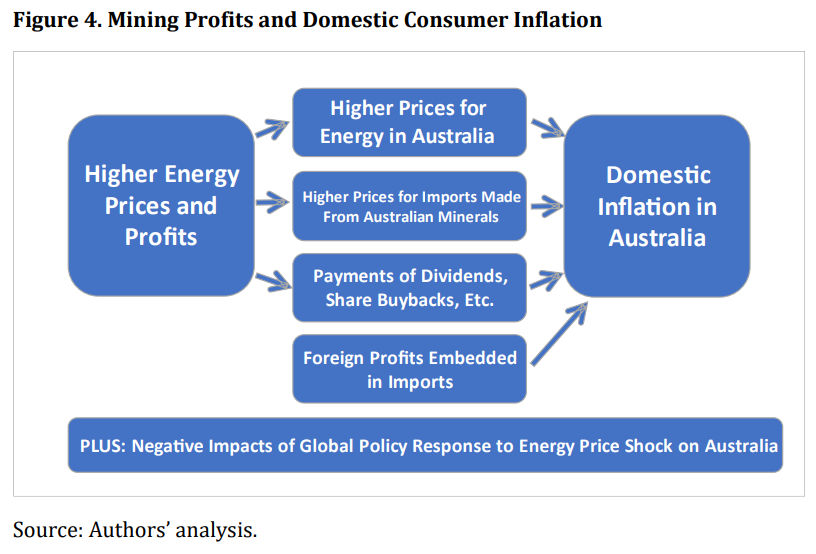
It would be more effective to seek other ways of short-circuiting or reversing the chain of profit-led inflation that corresponds so tightly to recent inflation.
Policy options in this regard, explored further in this paper, include:
- Price regulations on strategically important commodities to forestall the initial price shocks that set the inflationary cascade in motion in the first place (including in key sectors like energy, housing, and transportation).
- Redistributive fiscal measures to offset the economic and distributional consequences of profit-led inflation where it has occurred. A combination of incremental profit taxes in sectors which particularly benefited from profit-led inflation, with transfers to households hardest-hit by that inflation, can ameliorate the maldistribution resulting from profit-led inflation. If designed thoughtfully, these measures can also directly reduce recorded inflation.
- Competition policy reforms to immediately prohibit especially exploitive pricing practices, and also improve the level of competition in the long run (by preventing further corporate concentration, or breaking up current monopolistic or oligopolistic business structures). The ACTU’s Price-Gouging Inquiry, by documenting the extent and consequences of abusive pricing, will make a constructive contribution to this thread of policy development.
- Real wages in Australia have fallen, on average, by 6% since the advent of this post-pandemic inflationary surge. To repair that damage to mass living standards, wages in future will need to grow significantly faster than inflation, for a sustained period of time. The RBA’s efforts to prevent this (by raising interest rates and deliberately in order to undermine workers’ bargaining position and suppress wage growth) are misguided and unfair.
- The recovery of real wages (followed by subsequent real wage progress in line with productivity growth) is possible coincident with moderating inflation, but only if current historically high profit margins are reduced. Some progress in this regard has already been achieved: gross corporate profits in Australia declined 7% in the most recent quarter, coincident with a noted moderation of inflation. Both on the way up, and on the way down, the close link between corporate profits and domestic inflation is clear. This normalisation of profits must continue, and companies must be prevented from passing on costs associated with the recovery of real wages to consumers (through a flexible mix of the policies noted above).
Conclusion
The claim that “all Australians are hurt by inflation” has been disproven by exhaustive data on the accumulation of record profits by Australian business, coincident with accelerating prices and falling real incomes for workers. This maldistribution alone should force a rethink of conventional anti-inflation policies.
And it sheds light on why business interests are so determined to reject any alternative to standard, wage-suppressing responses to the current inflation problem.
There has been an ideologically-motivated effort to deny the relevance of record high profits in Australia for understanding recent macroeconomic outcomes (including inflation and income distribution).
Business groups, echoed by some orthodox policy-makers at the RBA and Treasury, would prefer to keep the spotlight on wages and labour costs as the main culprits for inflation.
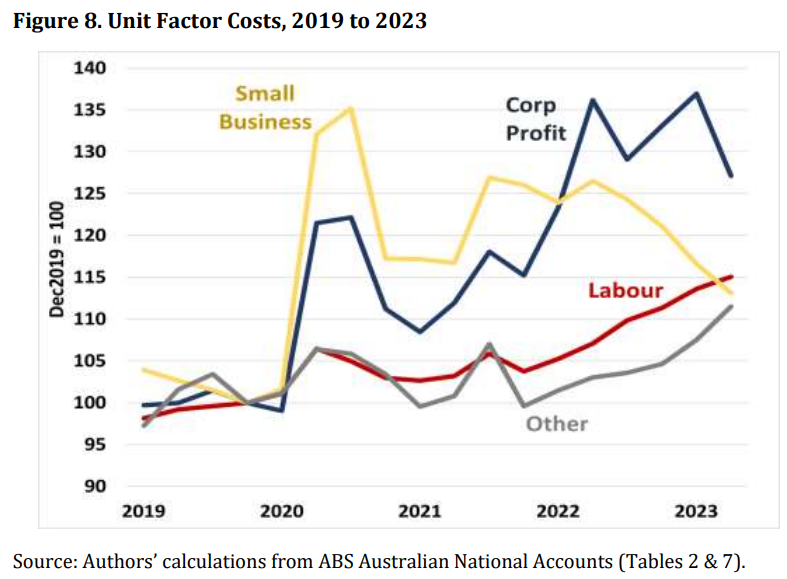
Despite a deep and (so far) sustained reduction in real wages, they continue to argue that wage growth must continue to be suppressed (via an engineered increase in unemployment) as the central strategy for reducing future inflation.
Our research suggests that focus is misplaced, and will be both ineffective and unfair. A more open-minded understanding of the causes of post-pandemic inflation is required, in order to inform more balanced and effective strategies for controlling it.
In particular, the role of undue increases in prices, far above costs of production, implemented pro-actively by companies taking advantage of the unique and painful disruptions caused by the COVID pandemic, must be acknowledged.
This casts doubt on the necessity and effectiveness of conventional monetary tightening as the sole response to inflation. It also invites policy-makers to consider other responses, aimed more logically and effectively at the true underlying sources of post-pandemic inflation.