
Everybody knows that the Albanese Government’s pledge to build 1.2 million homes over five years is a fantasy.
Developers and industry participants at last week’s AFR Housing Summit scoffed at the target, admitting that it is wildly unrealistic:
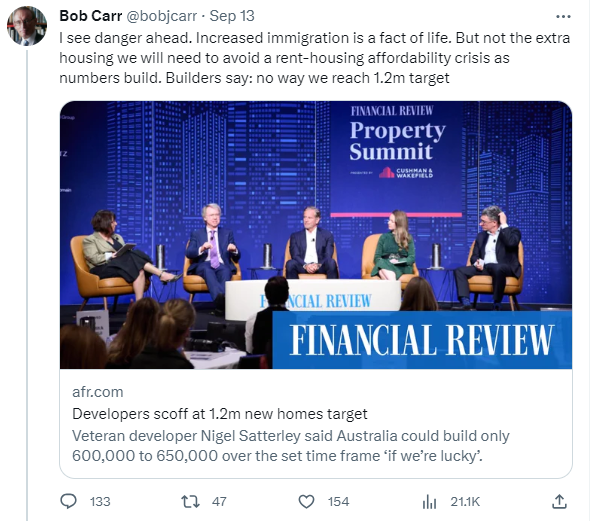
Developer Nigel Satterley told the Summit that only half of those homes would be finished – between 600,000 and 650,000, “if we’re lucky”.
Fellow developer Tim Gurner agreed, saying “I think we are going to have a housing crisis like we’ve never seen before coming”.
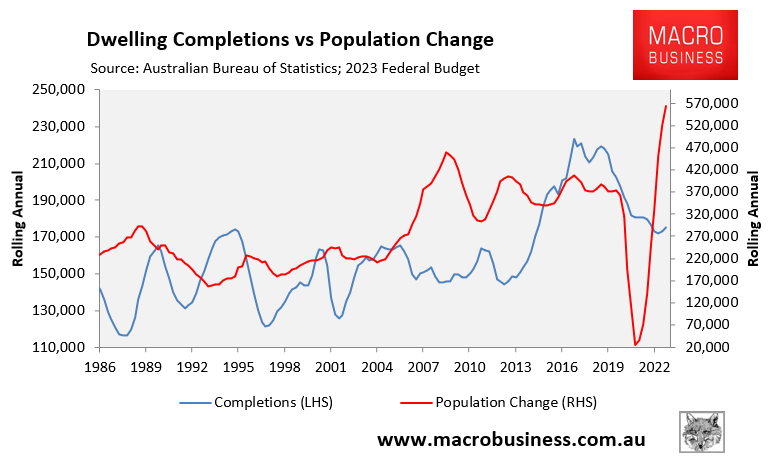
The data is stark. Dwelling completions collapsed to just 175,000 in the year to March 2023 against a population increase of 563,000:
To add insult to injury, the June quarter national accounts suggested that Australia’s population rose further to 626,000 over the 2022-23 financial year amid record net overseas migration:
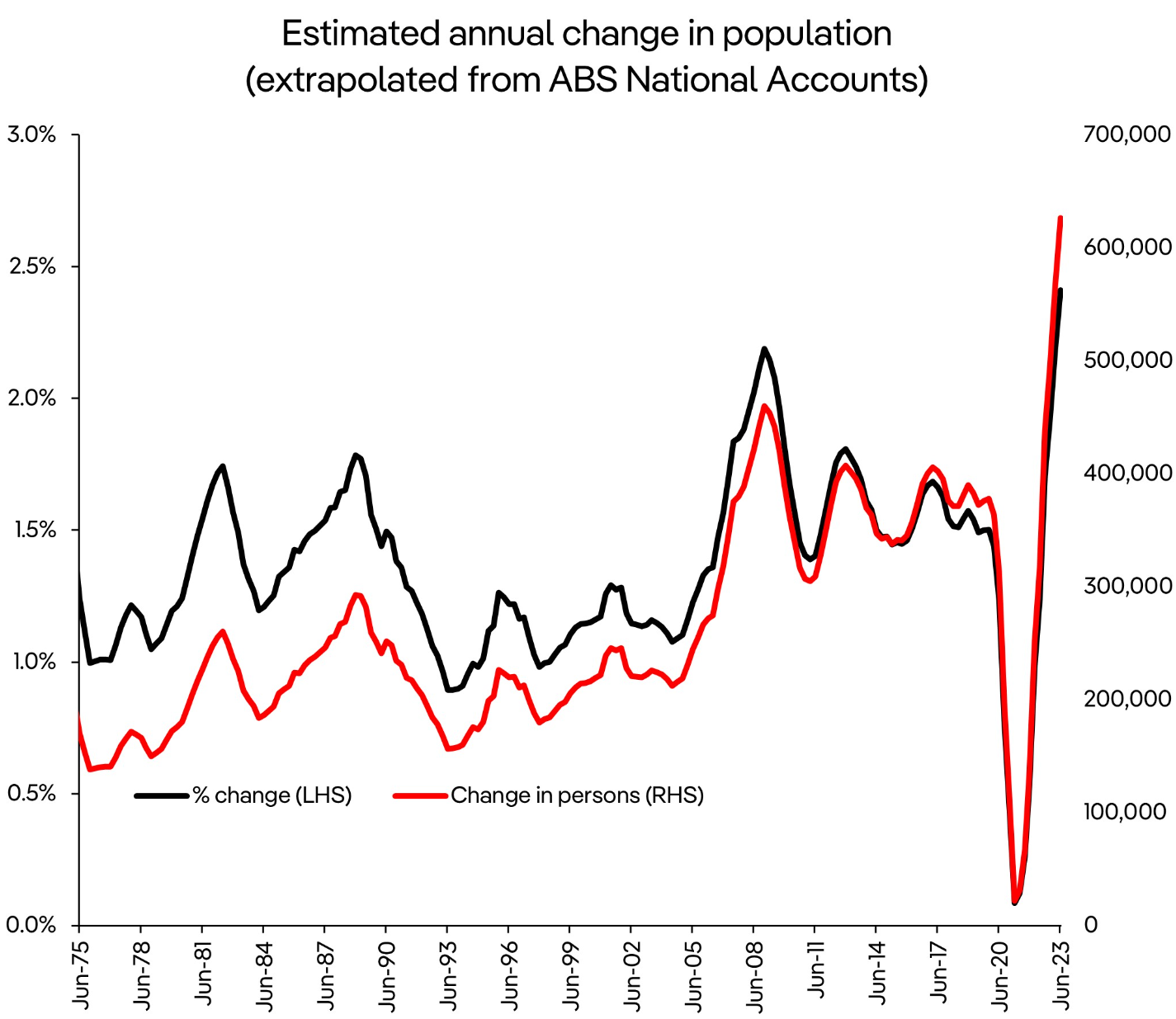
Source: Cameron Kusher (PropTrack)
New data from the Housing Industry Association (HIA) highlights the downturn in the nation’s residential construction sector.
The latest HIA-Colorbond Steel Housing 100 Report shows that dwelling starts plunged to a decade low 57,830 in 2022-23, which is almost 23% lower than previously.
Insolvencies also soared 73% across the sector amid rising costs and delays, combined with fixed price contracts.
The HIA’s chief economist Tim Reardon said “a drop-off in activity was reported by three quarters of the businesses on the list, with the lower numbers reflecting the challenging conditions facing the industry”.
“Market confidence remains subdued in most markets”, he said.
Consumers have yet to return, with new home sales falling for the past year on a rolling 12 month basis.
“Sydney and Melbourne have seen the most downturn in market confidence, which is not surprising as they’re more exposed to the cash rate than other markets”, Reardon said.
“Because it costs more to build a home in these areas, customers need a greater deposit than they do in other regions”.
“While there has been a heavy focus on the impact of higher borrowing rates on households with mortgages and the effect on demand for new homes, the higher borrowing costs also put further pressure on business margins during the year”, Reardon said.
NXT managing director Andrew Helmers warned “the industry is still facing labour challenges across a number of trades including scaffolding, plasterboard and tiling. While some suppliers are still struggling to deliver materials”.
Let’s be honest here: Australia has zero chance of meeting the Albanese Government’s mythical 1.2 million homes target.
The most dwellings Australia has ever built in a single year was 223,500 in 2017. And this was with low interest rates.
Therefore, building 240,000 homes for five consecutive years will be an impossible task when interest rates are high, hundreds of building firms have collapsed, materials prices are elevated, and there are shortages across everything.
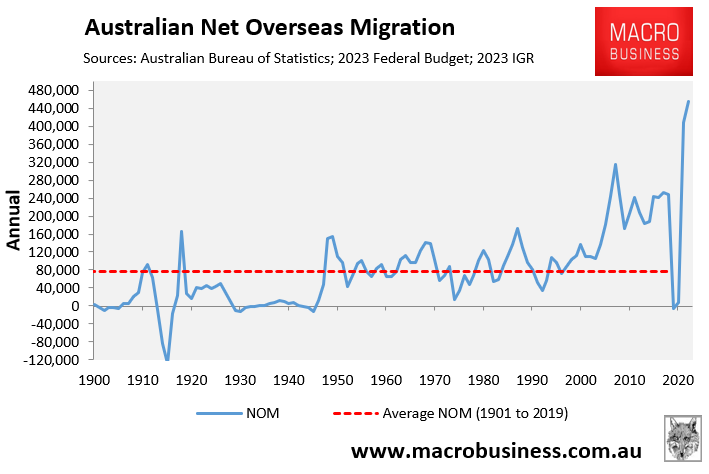
The best way to solve the housing shortage is to dramatically cut immigration demand instead. Otherwise, the shortage will continue to worsen.
