
Wednesday’s national accounts confirmed that Australia has plunged into a per capita recession following two consecutive quarters of negative per capita GDP growth:
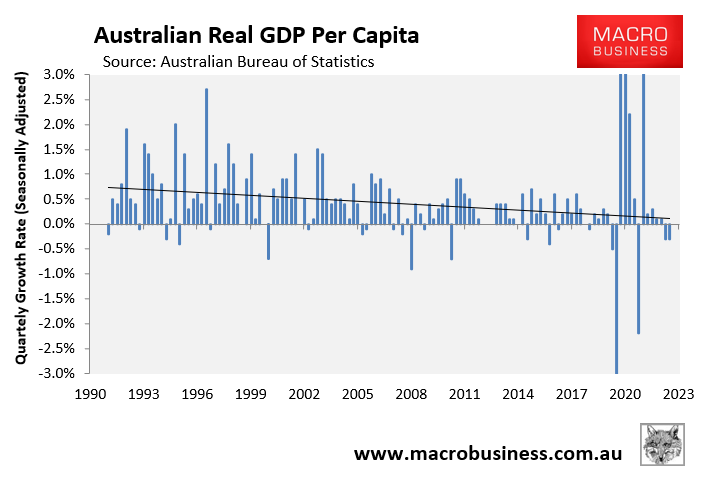
CBA’s economics team tipped that Australia would plunge deeper into per capita recession as aggregate GDP growth falls below 1% while population growth remains above 2%:
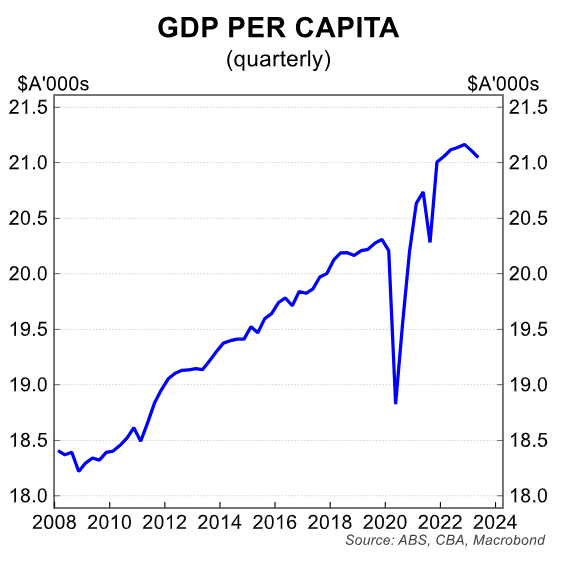
“Real GDP per capita declined by 0.3% in the quarter, following the same decline in Q1 23. Real GDP per capita is 0.6% below its peak in Q4 22 and 0.3% lower over the year”.
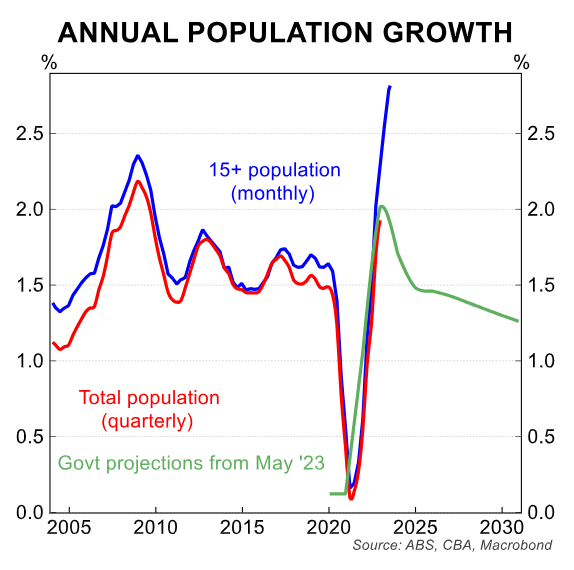
“Population growth (2.4%/yrto Q2 23) has been driven by rapid growth in net overseas migration”.
“Population growth has been much stronger than anticipated by policymakers. Working-age population has increased by 2.8%/yrin July. The increase in population is supporting overall GDP, but the economy is contracting on a per capita basis”.
“We continue to expect the pace of growth of the Australian economy to slow from here under the weight of restrictive interest rates”.
“We expect GDP growth to slow below 1% in Q4 23, before slowly recovering in 2024, the timing of which will depend on the timing of the RBA’s rate cut cycle”.
As expected, the pre capita recession has been caused by a large reduction in household consumption, which is the main driver of the economy.
Households are struggling under the weight of soaring mortgage costs, rising rents and negative real wage growth:
“Household budgets are under pressure from inflation and rising interest rates”.
“Household consumption growth continued to ease, down to just 0.1% in the quarter from 0.3% (revised up from 0.2%/qtr previously). But per capita household spending declined again. The population grew by 0.7% in the quarter while total consumption rose by just 0.1%”.
“Discretionary spending fell by 0.5%, the third consecutive quarterly decline”.
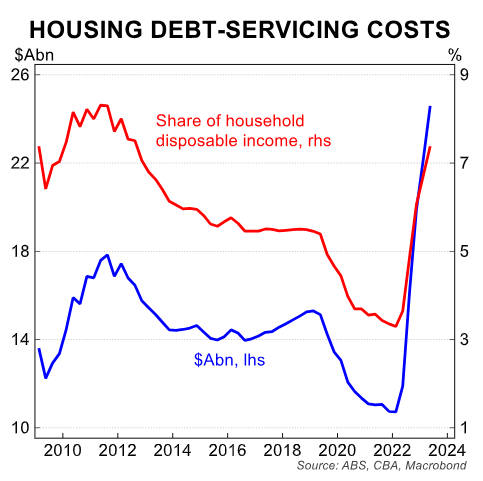
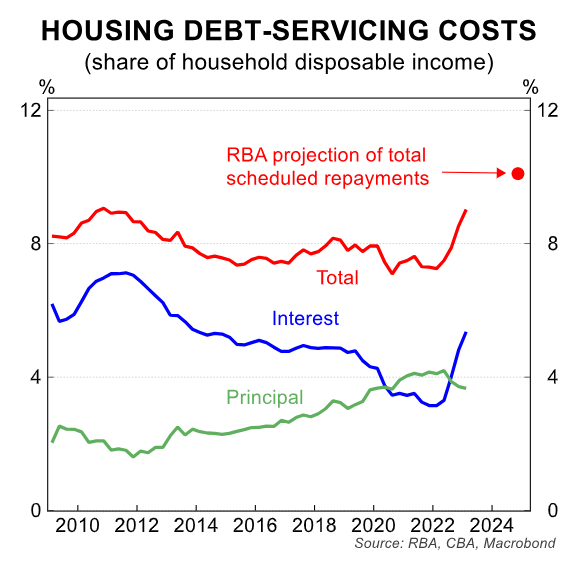
“Housing debt servicing costs increased in dollar terms and as a share of household disposable income. Dwelling interest payable rose by a further 10.9%/qtr, and up by a massive 129.4% from its pandemic lows”.
“The RBA last hiked the cash rate in June. But the lag on the pass-through to variable rate mortgage repayments, and also the fixed rate expiry schedule, means that interest costs will continue to rise despite the RBA on hold. Debt servicing costs as a share of income will reach record highs by the end of this year”.
“We expect the consumer to weaken further over the second half of 2023, as the impact of higher interest rates continues to bite”.
“The delays in the transmission to variable rate mortgages and the roll off of fixed rate mortgages mean the impact will continue to be felt into 2024”.
“This will take housing debt servicing costs as a share of income to record highs later this year”.
“Consumers have already shifted spending habits and we expect this to continue. Our internal CBA data show younger age groups are winding back spending more than the older cohorts”.
That’s a horrible set of numbers for Australian households, whose living standards are declining at a record pace.
