
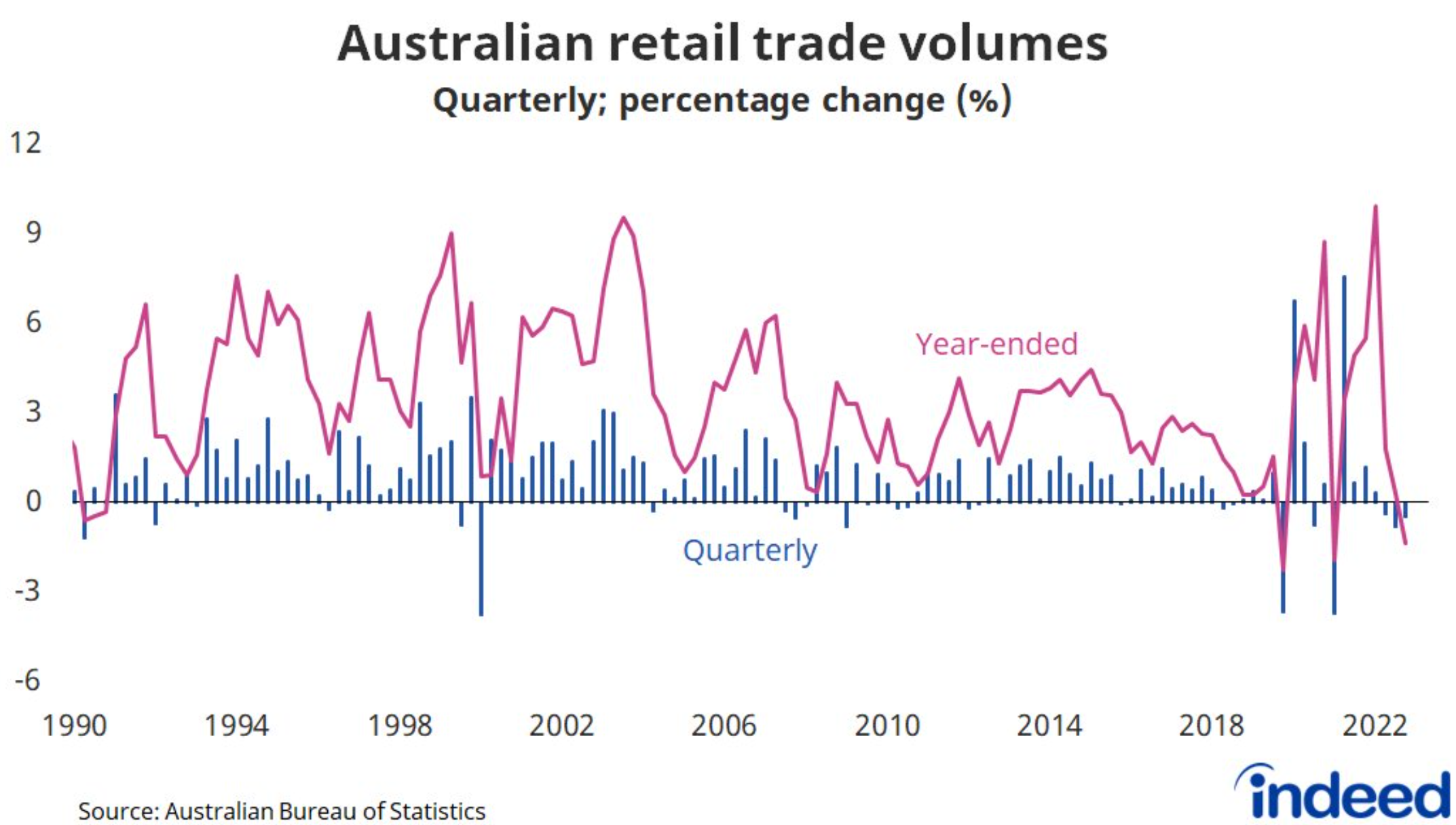
Last month, the Australian Bureau of Statistics (ABS) released data showing that retail sales volumes fell for the third consecutive quarter – the first time that’s happened since 2008.
Retail volumes are down 1.4% over the past year – the first time annual retail volumes have declined since 1990 (ex. pandemic):
On Monday, the ABS released its Household Spending Indicator for July, with spending down 0.7% year-on-year, despite CPI inflation of 4.9% over the same period:
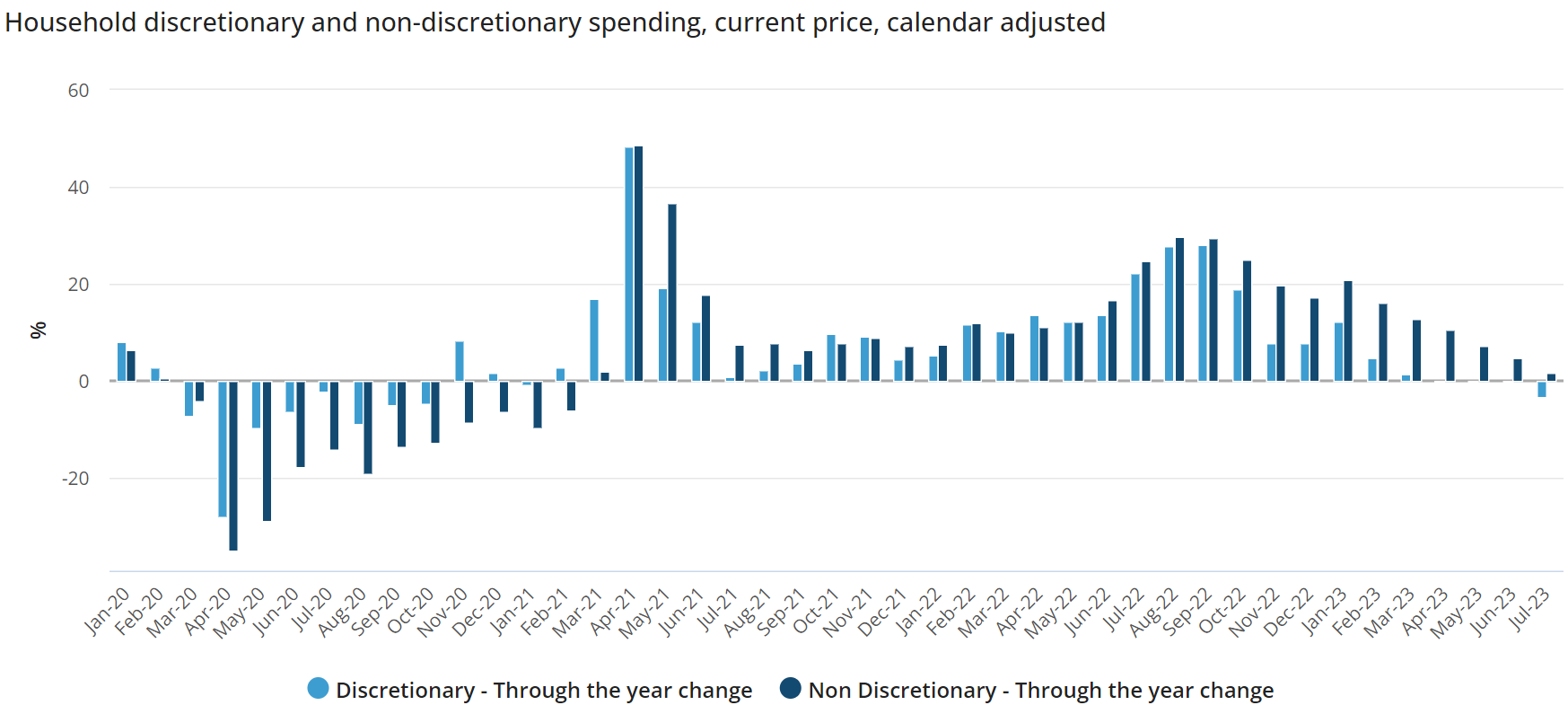
“This is the first time since February 2021 that the spending indicator has fallen”, noted Robert Ewing, ABS head of business statistics.
“Spending on discretionary goods and services was down for the fourth straight month. It fell 3.3% over the year, as households adapt to cost of living pressures”.
“Non-discretionary spending rose 1.7%, which is the lowest growth rate since early 2021”.
What makes these results more remarkable is that spending has fallen in spite of a 2% rise in the population on the back of record levels of net overseas migration.
Thus, per capita retail sales and household spending has fallen even more sharply.
This is obviously bad news for the economy, considering that household consumption accounts for roughly 55% of average economic growth:
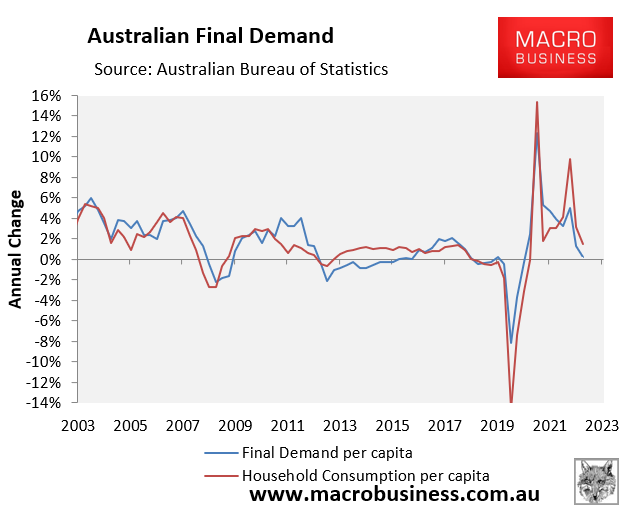
Where household consumption goes, the economy tends to follow, as shown above.
The Albanese Government’s record immigration program is the only thing keeping Australia from entering a “technical recession” – that is, two consecutive quarters of negative economic growth.
Even if a “technical recession” is avoided, everyone’s slice of the nation’s economic pie will shrink.
Furthermore, record levels of immigration will crush-load everything in its path, including the rental market, further reducing living standards.
