
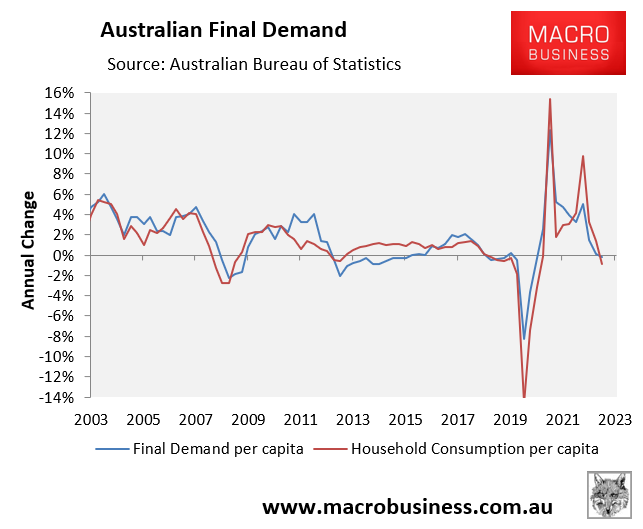
Last week’s national accounts release for the June quarter showed that the Australian economy plunged into a per capita recession amid falling real household consumption:
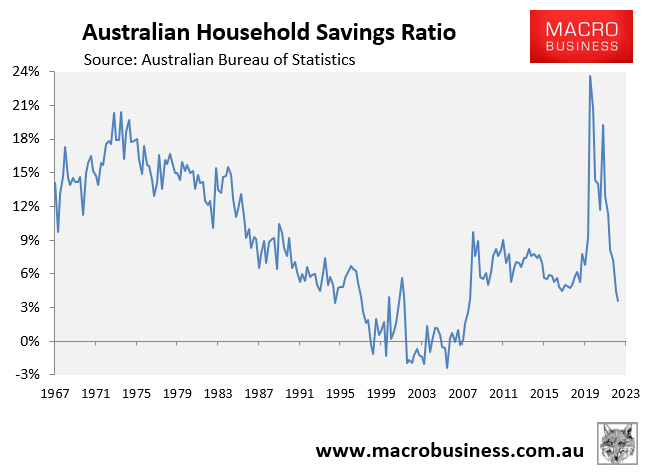
The decline in household consumption came despite the household savings rate falling to its lowest level since June 2008 just prior to the onset of the Global Financial Crisis:
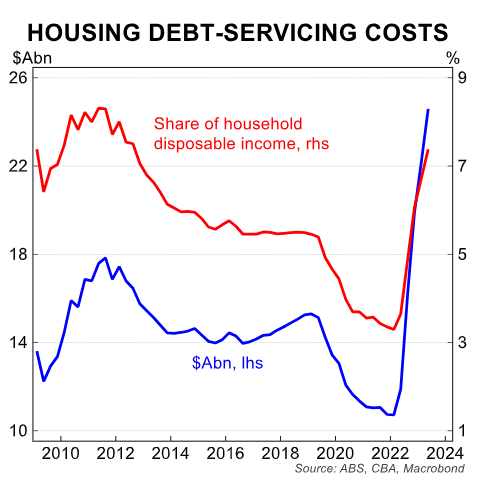
Australian households are feeling the pinch of the steepest rise in debt repayments on record:
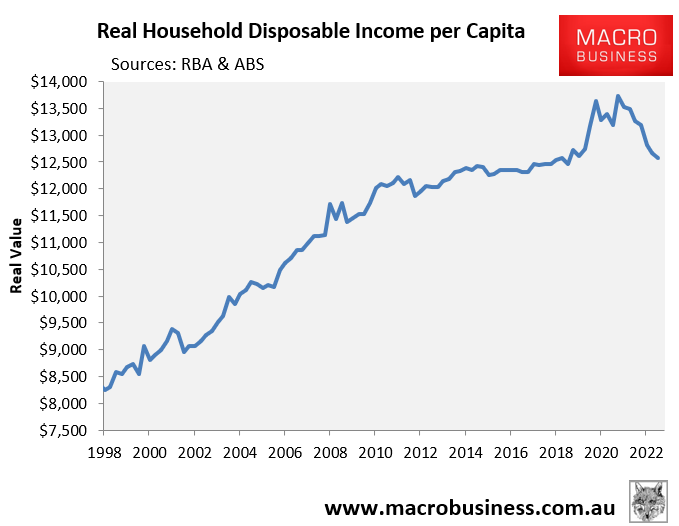
Households have also suffered a record decline in their real income:
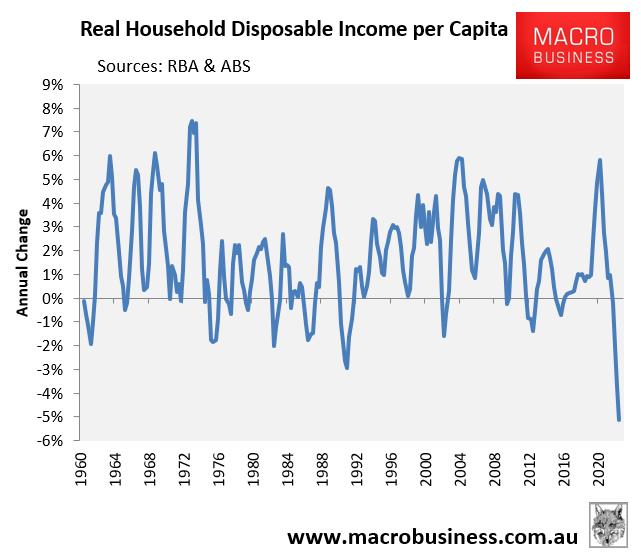
This meant that per capita household disposable income has shown barely any growth since 2010:
Not surprisingly, Australian retailers are now beginning to feel the pinch.
Roy Morgan’s ‘always on’ retail sales forecast engine predicts a decline in real inflation-adjusted retail sales of 1.4% in 2023:
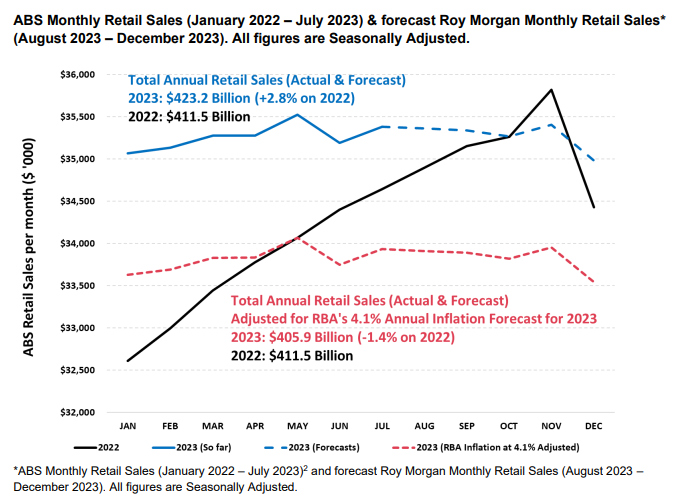
The Roy Morgan Retail Sales forecasting model is updated every month with the latest data inputs available, including the latest monthly Australian Bureau of Statistics Retail Sales data, which allow for the continual adjustment of the Roy Morgan Retail Sales forecast figures.
Roy Morgan says that rising mortgage stress and ongoing recessionary consumer confidence are behind the expected decline in retail sales.
“‘Mortgage stress’ has increased to its highest for 15 years since August 2008 with 29.2% of mortgage holders now ‘At Risk’ according to the Roy Morgan Mortgage Stress Indicator”.
“The number of Australians ‘At Risk’ of mortgage stress has increased by 642,000 over the last year as the RBA delivered twelve interest rate rises”.
“In addition, Consumer Confidence remains at record lows”.
“At 78.7, the ANZ-Roy Morgan Consumer Confidence weekly index has now spent 27 straight weeks below 80 – the longest period under 80 since the Index was first tracked weekly in 2008”.
“A fall in retail volumes and month-on-month spending demonstrates that consumers have started to rein in their spending, however right now the much feared ’spending cliff’ is looking more like a softening or a correction within the context of the bumper retail sales experienced in 2022”.
Retailers enjoyed booming conditions over the pandemic amid record stimulus from the federal government and rock bottom interest rates.
Now the bust has arrived amid the steepest rise in interest rates on record and falling real incomes.
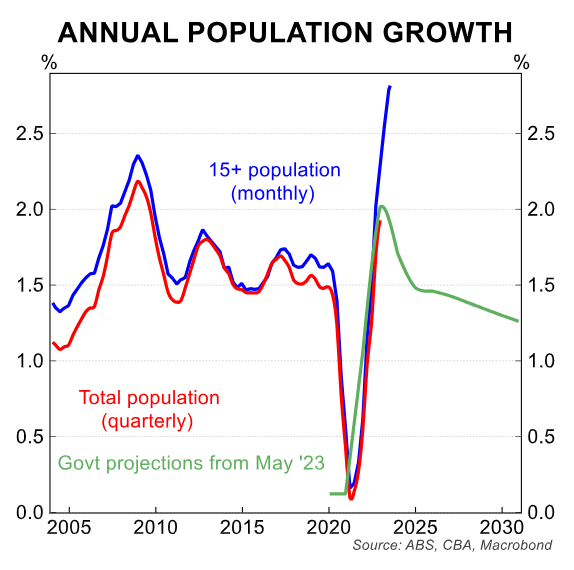
The only thing currently supporting retail sales is the federal government’s record breaking population growth.
