
Aussies punished the most by higher interest rates
Last week, Justin Fabo from Macquarie Group posted the below chart showing how average mortgage rates have risen by more in Australia than other English-speaking nations:
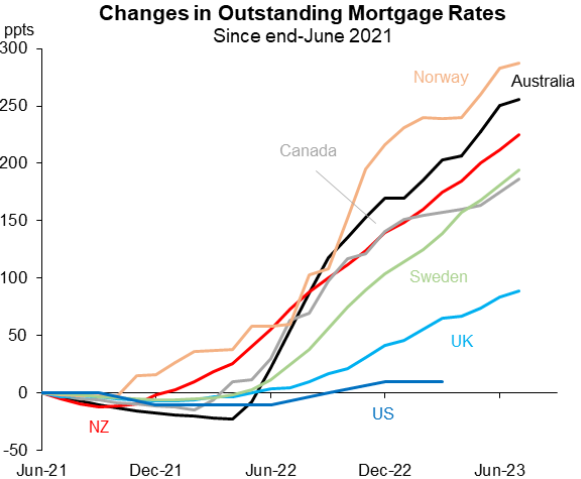
Source: Justin Fabo (Macquarie)
This comes despite the Reserve Bank of Australia (RBA) lifting rates by less than most other nations:
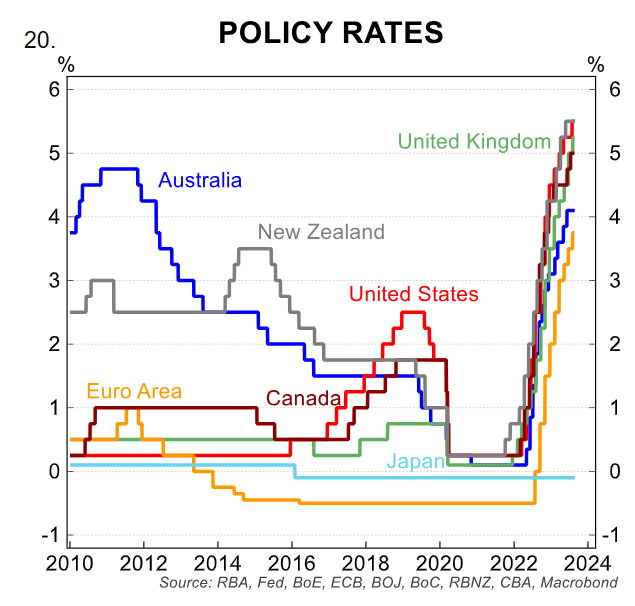
New data released by the Bank for International Settlements (BIS) supports this view.
At end-March 2023, Australian households paid 17.1% in debt repayments (principal and interest) on average. This was well above Canada (14.1%), the United Kingdom (8.6%) and the USA (7.7%):
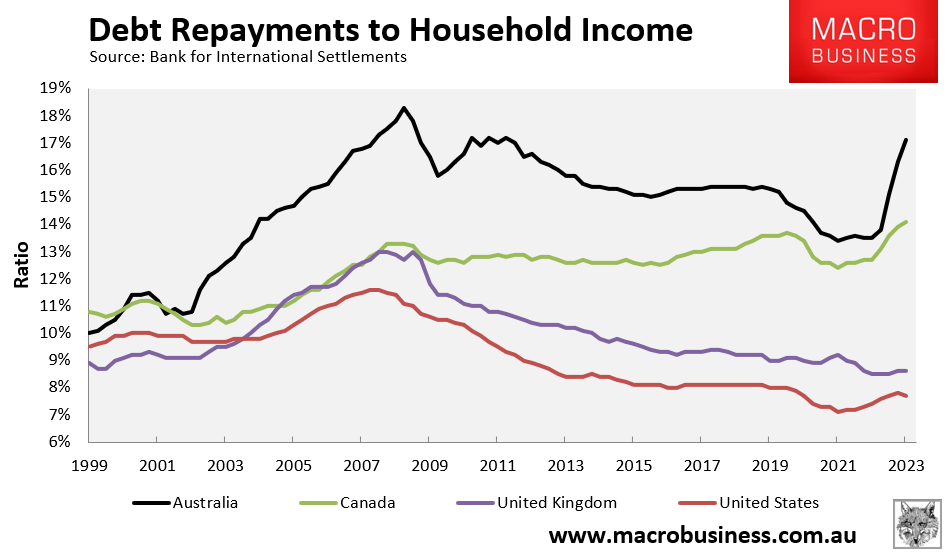
There are two key reasons why Australia’s household debt burden is significantly higher than other countries.
First, Australia has the world’s second largest stock of household debt compared to GDP (after Switzerland).
Second, Australia has a far larger proportion of variable rate mortgages than most other countries, as well as a higher proportion of short-term fixed rates. This means that interest rate increases are passed on to Australian borrowers more swiftly than abroad.
As of 31 March 2023, the official Australian cash rate was 3.60%.
As a result, the above figure excludes an additional 0.50% increase in the official cash rate, which has increased debt repayments further but is not represented above.
To make matters worse, after the pipeline of cheap pandemic fixed-rate mortgages expire in 2024, scheduled mortgage repayments will reach an all-time high share of household income:
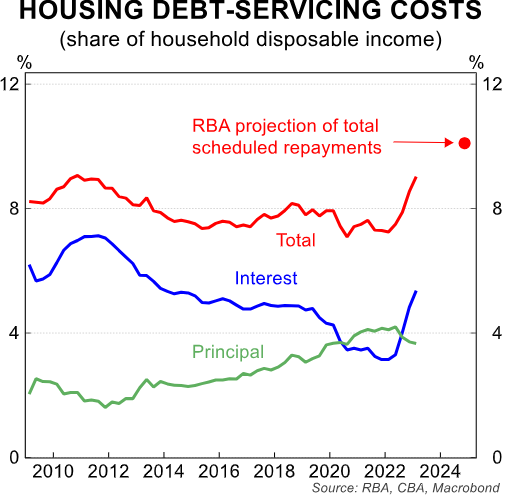
Even if the RBA does not raise interest rates further, there is significant tightening ‘built-in’ to Australian monetary policy due to low-interest fixed-rate mortgages expiring.
Regardless, it is clear that Australia is the very worst place in the world to have a mortgage.
