
Westpac’s latest Housing Pulse includes the below assessment of Australia’s rental market.
The bad news is that Westpac believes the rental “squeeze has longer to run”, with immigration-driven demand continuing to run well ahead of supply.
Rental markets provide a vivid depiction of how the collision of surging physical demand and insufficient supply is affecting Australia’s housing sector.
Record low rental vacancy rates and double-digit growth in asking rents speak to the intensity of pressures. Unfortunately, most indicators suggest the squeeze has longer to run with additional supply unlikely to come onto the rental market anytime soon.
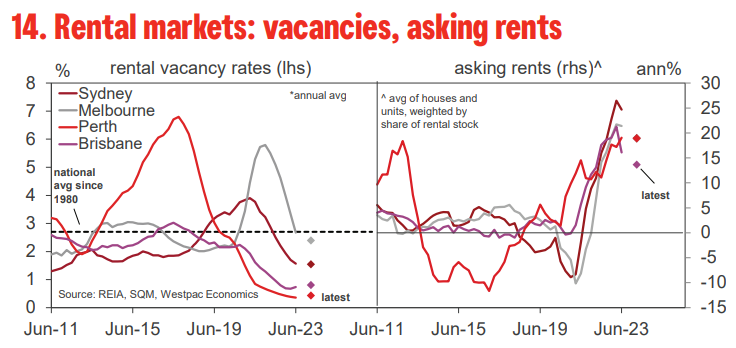
Rental vacancy rates have declined materially since mid-2022, to ‘frictional’ levels in many markets, i.e. barely enough to cover the regular churn of tenants moving.
On a weighted-average basis, vacancies across the five major capital cities look to be below 1.5%, almost certainly a record low on figures going back to 1980.
However, it’s a different story for smaller capital cities and regional areas, most of which have seen a lift in vacancy rates over the last year, the difference in conditions clearly linked to differing population flows.
Rents have continued to surge strongly, average asking rents rising by around 20%yr over the year to Jun across the major capital cities. Gains have been more modest for units, especially in smaller capital cities.
The latest weekly data also suggests the pace may have moderated a touch since mid-year. Growth has been much more subdued across the smaller capitals, asking rents holding about flat in Canberra and Hobart.
The surge in rents has significantly outstripped dwelling price growth, producing a significant lift in gross rental yields (annual rental return as % of dwelling price).
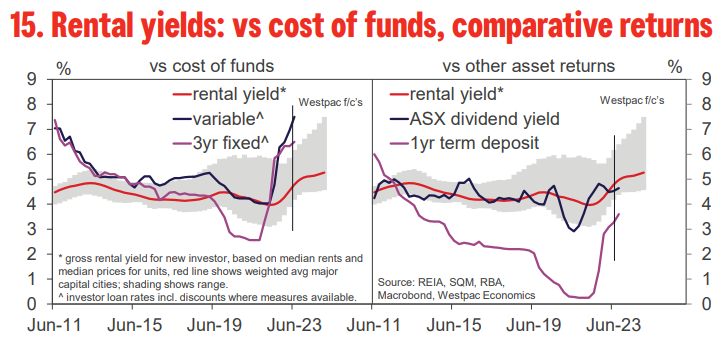
On a weighted average basis, yields on units have risen from around 4% to 4.8%, the top end of the range seen since the early 2000s. Gross rental yields range up to above 6% in some markets.
Despite this, rental returns alone are not particularly appealing compared both to the cost of funds and income returns on other assets.
The left panel of Chart 15 shows the average rental yield alongside benchmark rates for investor loans (variable and 3yr fixed rates). The gap is around decade-long wides.
The right panel of Chart 15 compares the average rental yield to the average dividend yield across the ASX and the average 1yr term deposit rate. Rental returns are on a par with the average income return on Australian equities, with the pick-up compared to term deposits about the smallest its been a decade.
Of course, rental returns take a back seat to capital gains for many prospective investors. As such, the lift in prices, and price expectations might be expected to be a bigger positive.
Sentiment-wise, the picture here looks fairly mixed. Chart 16 shows housing-related sentiment amongst consumers with investment properties. While price expectations are positive, they are not markedly more positive amongst investors.
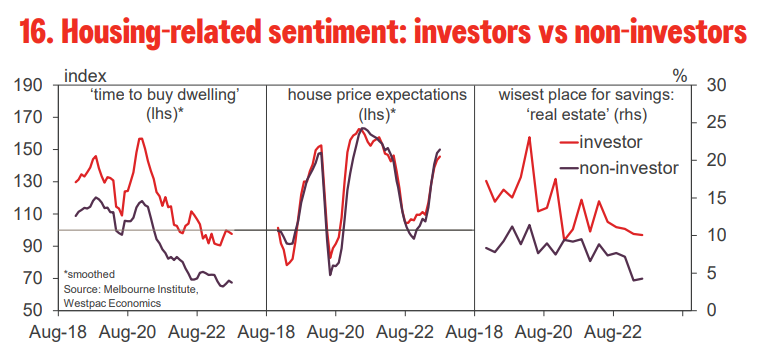
Meanwhile, assessments of ‘time to buy a dwelling’ and real estate as the ‘wisest place for savings’ are still around historical lows, albeit higher than non-investors.
To date, the firming in rental yields and return to positive price growth does not look to be enough of a draw-card for investors.
Lastly, it is worth considering the extent to which rising rents may be driving more renters to become owners. The scope here looks to be very limited.
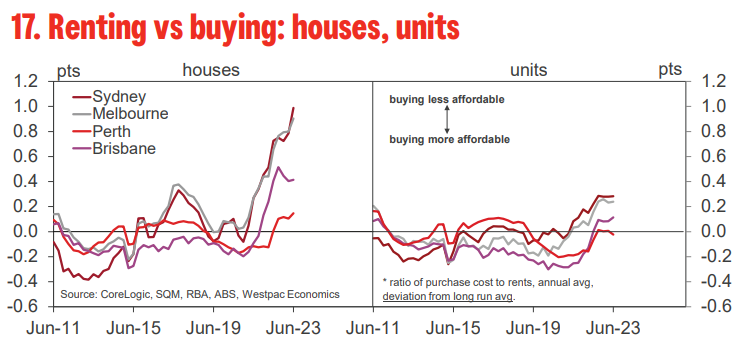
Chart 17 shows measures of the buy vs rent decision for the major capital cities, split by houses and units and expressed as a deviation from long run averages.
While the cost of renting has risen rapidly, the cost of purchases have risen by even more due to higher mortgage interest rates, especially for houses.
Compared to history, switching from renting to owning is a bigger stretch than usual, Perth units being about the only exception.
