
Yellow Brick Road Home Loans Executive Chairman Mark Bouris appeared on Sky News on Wednesday where he blamed a lack of “supply” for Australia’s housing crisis:
“How are we going to get increased the supply of new dwellings to match up the population increase… as a result of the new immigration policies?”
“Well the issue is supply. And I don’t know whether it’s a federal government problem or a state government problem or a council problem”.
“If you talk to any property developer, they’ll tell you: apart from the fact that interest or funding costs them a lot more today than it has done in the past, generally speaking. Any property developer who started a property development say five years ago to supply today, they’ll tell you the biggest problem that they have is getting their plans approved”
“The approval process is the thing that’s holding it up. Because everybody’s got an objection”.
“As a result of that, we don’t get enough new developments and or new dwellings. [And] all of a sudden [they] hit us with a huge immigration increase”.
“How come house prices have gone up so much? Property prices have gone up so much because we’ve got a lack of supply”.
“How come I can’t rent a place? We can’t rent a place because property supply is not there”.
“Who’s in charge of property supply? Developers would love to supply the market – I tell you who it is, it’s the governments, either local, state and to some extent, federal too”.
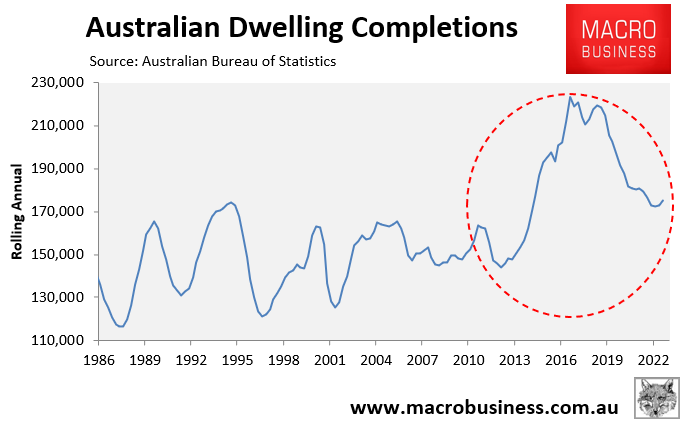
Take a look at the next chart. Does it look like Australia hasn’t been building enough homes?
Australia has had one of the highest rates of housing construction in the developed world:
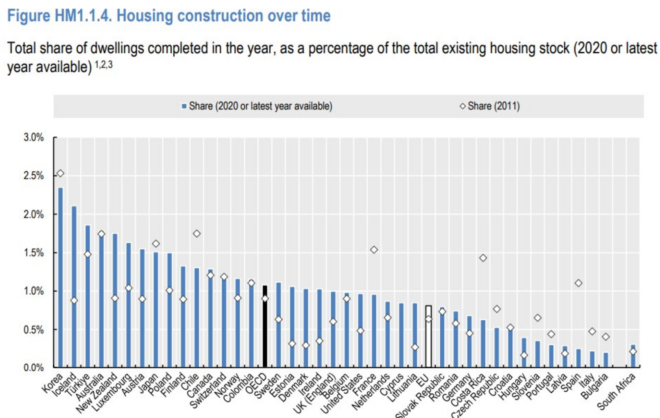
Source: OECD Affordable Housing Database
We also have one of the highest numbers of construction workers per capita in the OECD:
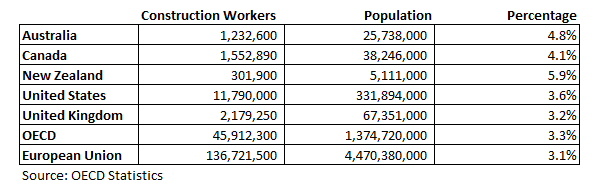
So why has Australia experienced a worsening housing shortage?
Because the federal government has decided to ramp immigration to unprecedented levels:
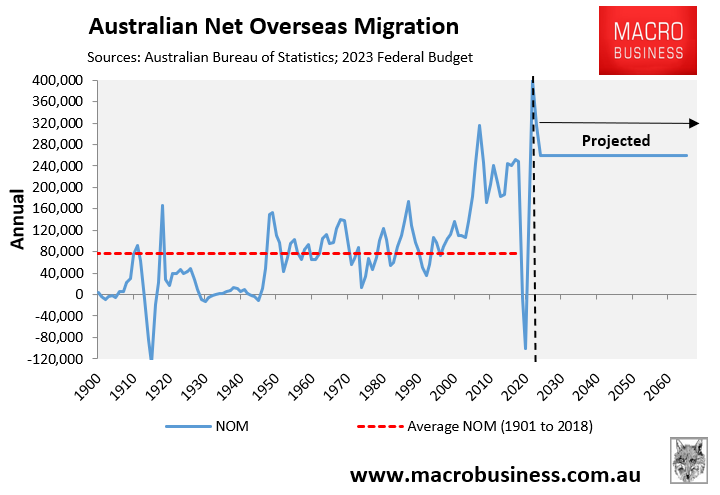
Australia’s net overseas migration (NOM) jumped from an average of 90,500 between 1991 and 2004 to an average of 219,000 between 2005 and 2019 – representing an annual average increase in immigration of 140%.
The 2021 Intergenerational Report (IGR) projected that Australia would add 13.1 million people (a 50% increase) over the next 40 years, driven by net overseas migration of 235,000 people per year.
The 2023 federal budget then increased the net overseas migration projection to a record high 400,000 in 2022-23, 315,000 in 2023-24, and then 260,000 from 2024-25 – i.e. 25,000 higher than the IGR projected.
Accordingly, Australia’s population is now set to grow even faster than the 13.1 million increase projected in the 2021 IGR.
The result will be permanent housing shortages for Australia as housing demand (via immigration) forever outruns supply:
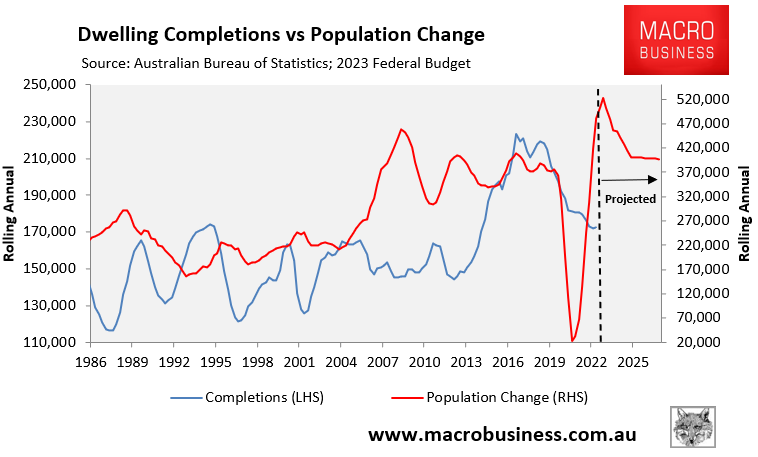
Let’s stop the gaslighting. Extreme levels of immigration is driving Australia’s housing shortage, not a purported decrease in construction, which actually rose substantially over the past decade – see first chart above.
The first best solution is to reduce net overseas migration to levels consistent with the country’s ability to deliver new housing, infrastructure, and services.
Net overseas migration should be reduced to historic levels of roughly 100,000 people per year.
