
RBA on hold, but mortgage pain has just begun
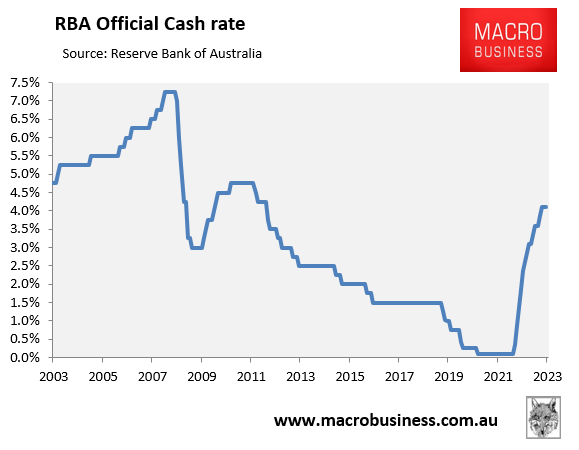
The Reserve Bank of Australia (RBA) decided on Tuesday to leave the official cash rate (OCR) at 4.10% for the second month in a row.
The decision follows the fastest increase in interest rates on record, which has driven the OCR to its highest level since April 2012:
In the statement accompanying the decision, RBA Governor Phil Lowe said the rapid interest rate rises “are working to establish a more sustainable balance between supply and demand in the economy and will continue to do so”.
Lowe also reiterated the RBA’s forecast that Australia’s CPI inflation “will continue to decline, to be around 3.5% by the end of 2024 and to be back within the 2–3% target range in late 2025″.
However, Lowe also warned that while “recent data are consistent with inflation returning to the 2–3% target range over the forecast horizon… some further tightening of monetary policy may be required to ensure that inflation returns to target in a reasonable timeframe, but that will depend upon the data and the evolving assessment of risks”.
So basically, the RBA will keep the OCR on hold unless economic data comes in stronger than expected.
RBA was right to keep rates on hold:
Most key macroeconomic data on the Australian economy has printed weaker than expected since the previous monetary policy meeting in July.
The June quarter Consumer Price Index (CPI) revealed that inflation in Australia was falling at a little faster rate than predicted in the RBA’s most recent Statement on Monetary Policy.
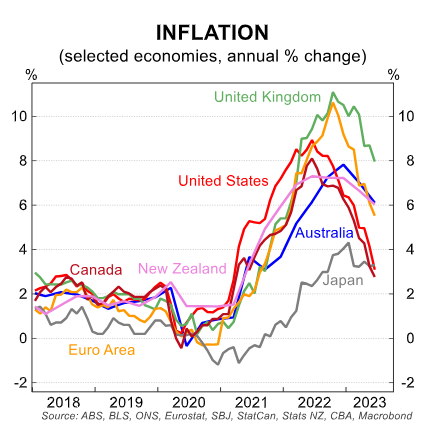
With supply chains loosening, inflation is currently declining throughout the developed world, and Australia’s inflation is likely to follow suit.
June retail sales in Australia fell 0.8%, owing to significant decreases in discretionary goods purchases. After adjusting for price rises (inflation), the volume of retail goods sold also declined by 0.5% over the June quarter.
Private sector credit growth fell to 0.2% in June, a significant slowdown from the 0.6% pace in April and the 0.4% pace in May.
The one data item that offset the aforementioned softness was Australia’s unemployment rate, which remained below expectations at 3.5% in May and June, indicating that the labour market remains tight and wage pressures may grow.
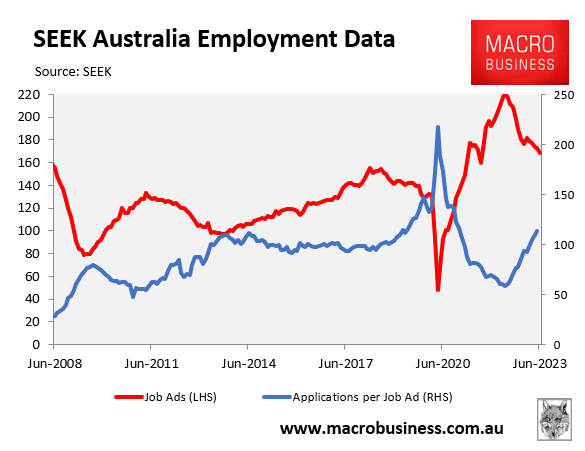
However, the majority of leading indicators for the labour market are deteriorating, including job ads, the number of applications per job ad, and unemployment expectations.
With Australia currently seeing record levels of net overseas migration, the economy needs to generate roughly 35,000 new jobs per month just to maintain the unemployment rate at a constant level.
Amid a slowing economy, this appears to be an impossible feat.
Accordingly, whenever the pipeline of job vacancies returns to normal levels later this year (see above chart), Australia’s unemployment rate will launch. Indeed, the RBA predicts a 1% increase in unemployment by the end of 2024.
Finally, the main reason for interest rates being unchanged is that only about two-thirds of the RBA’s rate hikes have been felt by households, owing to normal lags in monetary policy as well as a higher-than-usual number of people on fixed-rate mortgages.
This situation will change over the next nine months as a large number of low-interest fixed-rate mortgages reset from ultra-low rates of about 2% to variable rates exceeding 6%.
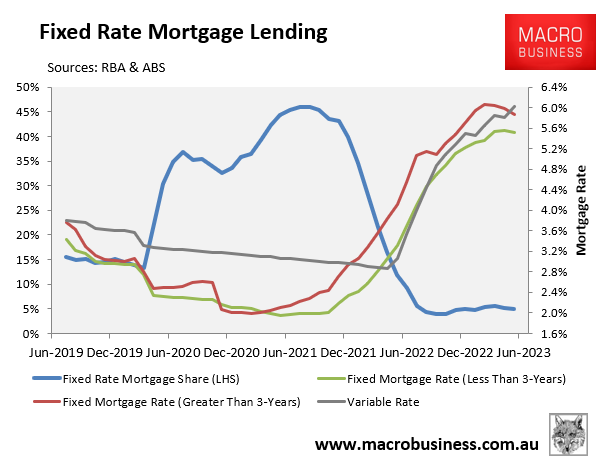
As a result, even if the RBA holds the OCR at current levels, monetary conditions in Australia will continue to tighten.
This lessens the need for the RBA to raise interest rates in order to slow the economy.
The mortgage pain has only begun:
The RBA said in its statement accompanying last week’s interest rate decision that the impact of rate increases on Australian households is uneven:
“Many households are experiencing a painful squeeze on their finances, while some are benefiting from rising housing prices, substantial savings buffers and higher interest income”.
“In aggregate, consumption growth has slowed substantially due to the combination of cost-of-living pressures and higher interest rates”.
Those with mortgages are obviously the households most vulnerable to the RBA’s rapid interest rate tightening.
Variable mortgage rates have more than doubled since the RBA began raising interest rates in May 2022, resulting in a 50% increase in principal and interest mortgage repayments.
According to Roy Morgan’s most recent mortgage stress survey, 28.7% of owner-occupied mortgage families are now stressed, the highest level since May 2008, when the OCR was 7.25%:
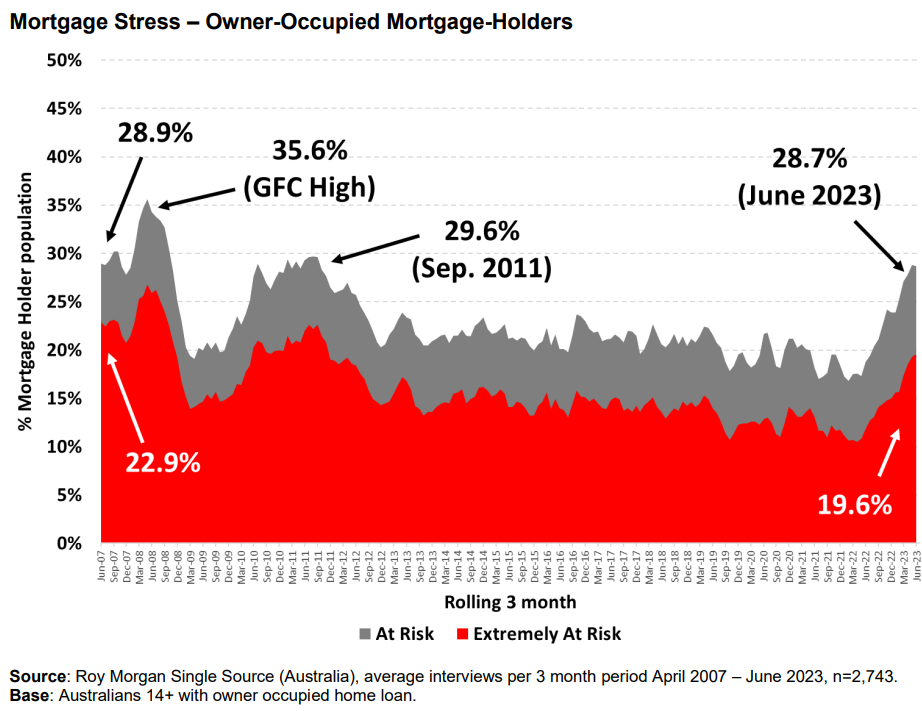
Roy Morgan says that it uses “a conservative model, essentially assuming that all other factors remain constant”.
Thus, if Australia’s unemployment rate rises in line with the RBA’s forecast – i.e. “from its current rate of 3.5% to around 4.5% late next year”, then mortgage stress will be worsen.
To add insult to injury, around 400,000 fixed-rate mortgages are still due to roll over to much higher variable interest rates over the remainder of 2023:
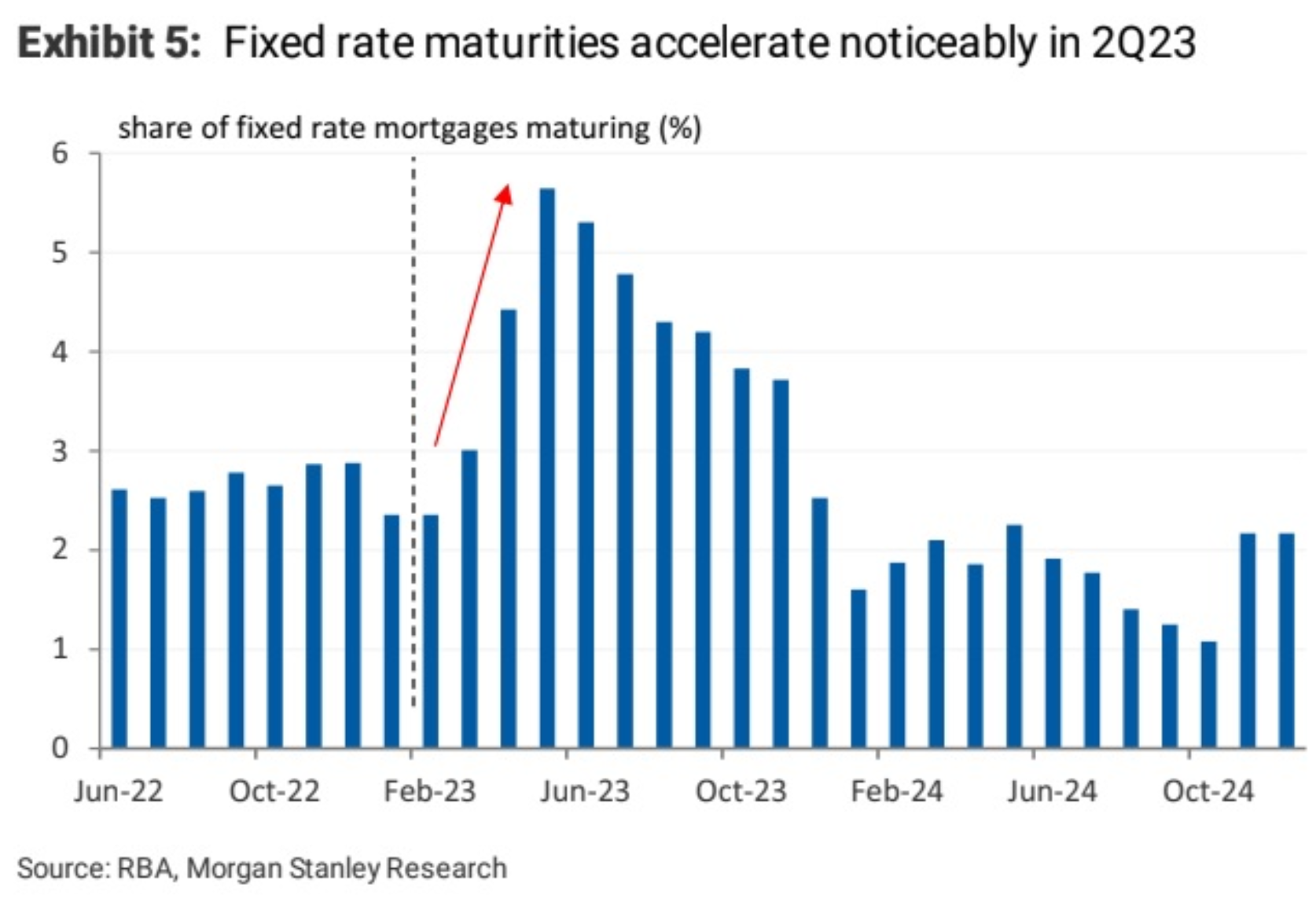
The average monthly repayment on a $750,000 mortgage will rise from $3,180 to $4,830 as a result of this rollover. This implies that a borrower switches from a 2% fixed rate to a 6% variable rate.
This indicates that average mortgage rates in Australia will continue to rise even if the RBA does not raise interest rates further.
The following chart from CBA’s economics team is insightful. Based on RBA projections, average debt payment costs will reach an all-time high share of household income in 2024, as the fixed rate mortgage reset expires:
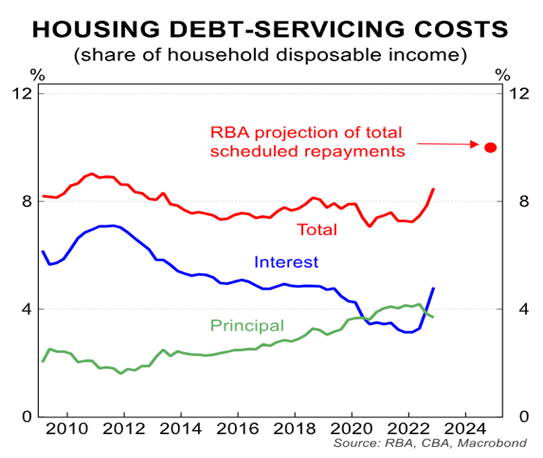
In this light, the RBA is justified in holding interest rates steady.
The fixed rate “mortgage cliff” will result in significant additional monetary tightening, and Australian people with mortgages are facing a record increase in repayments.
