NatWest with a good summary of forex and the Australian dollar.
Support for the long-end of developed market sovereign yield curves is suddenly long gone. Higher long-end rates, relative US growth outperformance, sticky front-end Fed pricing, and August seasonals are all factors supporting the USD. At Jackson Hole, we aren’t expecting a September signal, but broad strokes of an eventual shift from active to passive tightening could be previewed. We discuss our latest views on China growth, policy, and FX below. In short, recent CNH weakness reflects a deepening of existing themes of structural imbalances, lack of carry, and USD resilience. Incremental stimulus eyeing stabilization, not reacceleration at any cost, may be the remit. That’s discouraging for regionally linked FX. We see further downside for AUD and maintain our short AUD against EUR and USD, equal weight.
AUD | Stay Short
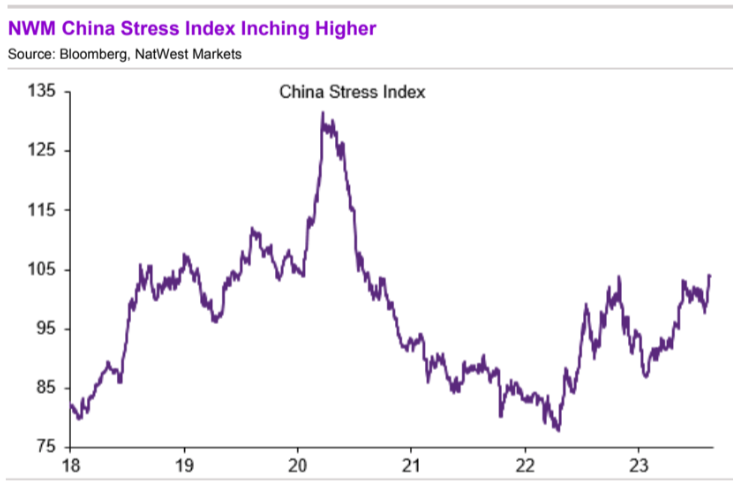
The weakness in the Chinese economic activity has intensified lately, and significant policy response/stimulus from Chinese authorities has been lacking. We think any incremental stimulus may not be enough to arrest the fall in AUD, as highlighted by the muted FX reaction to China’s surprise monetary policy easing, against the backdrop of a slowing global growth. The NWM China Stress Index has started to again inch higher indicatinga further slowing of economic conditions in China.
Looking ahead, outside of China we think the demand for overall construction related activities will likely fade in the coming months with the higher cost of borrowing affecting overall demand. Moreover, there are reports of some global steel producers cutting their steel demand outlook for US and Europe.
In Australia, employment declined by-14.6k for the month of July compared to a gain of 32.6k in the previous month. The unemployment rate increased marginally but we think it’s too early to draw any conclusion about the strength of the labour market based on one month of weak data. On the inflation front, some of the components are still increasing even on a q/q basis. Currently, the policy rate is restrictive but the increase in prices raises the question whether CPI inflation will fall back to target range as per RBA’s current forecast. The overall picture is mixed in Australia, and the RBA has retained optionality for further hikes. Further weakness in data, both locally and in its largest trading partners, complicates a rate hike going forward.
We think the overall weakness in Chinese economy will continue to weigh on AUD for the medium term. To be sure, any major policy response/stimulus from Chinese authorities will be a risk to our bearish view on AUD. Also, there is a risk of the RBA tightening policy rate further, but we think one more rate hike may not be enough to support AUD considering the weakness in China. On balance, we see further downside for AUD for the medium term. We maintain our short AUD, against EUR and USD (equal weight).