I was chatting with a residential builder yesterday and asked why so many houses suddenly use steel framing over lumber.
He answered, “There are no chippies to build framing. They’ve all been vacuumed up by public building projects at twice the wage”.
And so they use steel which is much more expensive than lumber but still cheaper when you include inflated chippy wages.
This is another inflationary impact of mass immigration as state governments try, and fail, to keep pace with Albo’s lunatic population surge.
Advertisement
The direct result is the price of dwelling construction has blown out, and housing affordability has plummeted (made worse still by immigration-crushing wage growth) so the impact again falls upon youth and the most vulnerable via the housing crisis.
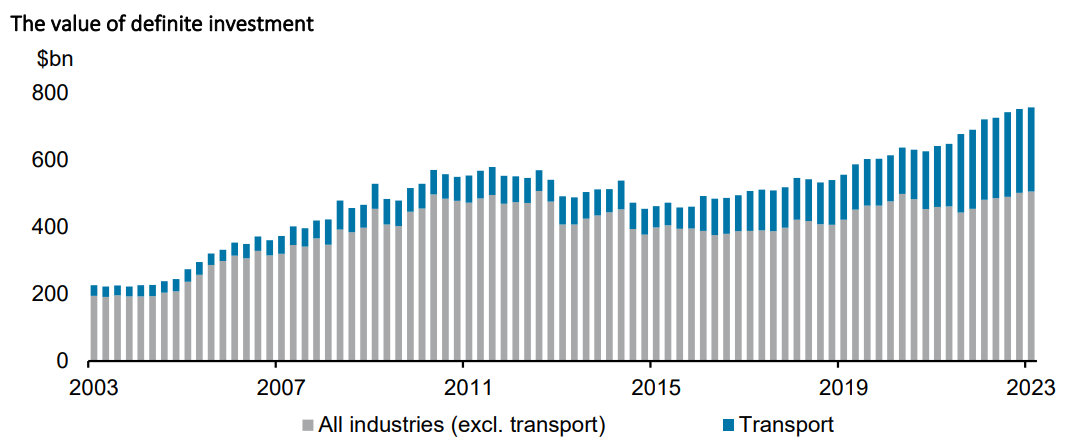
Deloitte’s Investment Monitor today confirms the dynamics at the macro level:
Australia’s infrastructure investment boom has pushed definite project investment (work underway or committed) to its highest level since late 2014. The key driver of this increase has been publicly funded infrastructure investment, with the transport industry accounting for 60% of the increase in definite activity from the trough in late 2020 to mid-2023.
Releasing the latest edition of Deloitte Access Economics’ quarterly Investment Monitor, Deloitte Access Economics partner and report lead author, Stephen Smith, said: “Business investment had a stellar start to 2023.
That’s unusual, because when the economy begins to slow, business investment slows by even more.
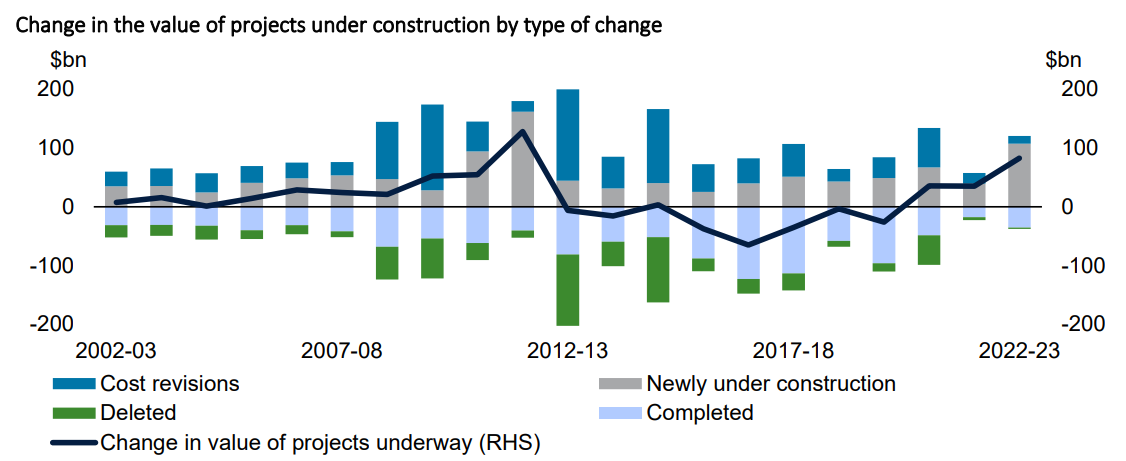
“Capacity constraints in the construction sector have meant that some projects commissioned back when the economy was on more solid footing are only now starting construction or catching up to earlier work schedules. This is contributing to the current strong gains in both engineering and non-residential construction.
Advertisement
Now imagine what happens if and when the AlbogGreens begin constructing public housing. More crowding out and less than otherwise private dwelling investment that is the far larger component.
The fake debate has turned more interesting in fake left media:
The value of tax breaks given to property investors is 78 times the promised minimum spend on social housing under the Albanese government’s flagship fund, new data released by the Greens shows.
Max Chandler-Mather, the Greens’ housing spokesperson, described the magnitude of the tax concessions as “morally reprehensible” as the minor party digs in on opposing the housing Australia future fund (Haff) in its current form.
“These tax breaks are turbocharging the housing crisis,” he said. “[They are] making it easier for an investor to buy their 10th property, driving up property prices and depriving the government of revenue that could be put to work building housing for those who need it.”
But the prime minister, Anthony Albanese, is holding firm on the policy and Labor has accused the Greens of holding up social housing by opposing it.
Advertisement
How it is that the Fake Greens have turned MB against them is a miracle of bad policymaking. We would cheer the scrapping of negative gearing and capital gains concessions louder than anyone.
But, if the Fake Greens keep their mass immigration obsession, cap rents, and scrap NG/ CGC, where do they think the property investment will come from?
There would be none from the private sector, which they expect to build 94% of stock even if they got their beefed up HAFF.
Advertisement
The shortage of stock would hold capital values up as riots erupt at rental open inspections. Tent cities will spread across Sydney and Melbourne.
The Fake Greens and Chandler-Mather in particular, are economic dilettantes aiming to cultivate votes with grandstanding, not solve problems.
David Llewellyn-Smith is Chief Strategist at the MB Fund and MB Super. David is the founding publisher and editor of MacroBusiness and was the founding publisher and global economy editor of The Diplomat, the Asia Pacific's leading geo-politics and economics portal.
He is also a former gold trader and economic commentator at The Sydney Morning Herald, The Age, the ABC and Business Spectator. He is the co-author of The Great Crash of 2008 with Ross Garnaut and was the editor of the second Garnaut Climate Change Review.