Following decades of high immigration, Melbourne’s population has increased by 1.7 million people since the 2001 Census:
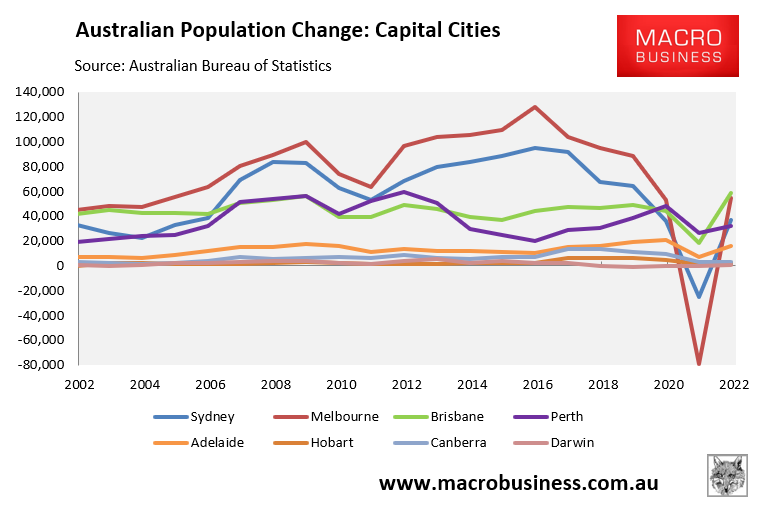
As a result, Melbourne has become a permanent building site in an ongoing effort to keep up with the city’s never-ending population growth.
It never works, however, since traffic congestion, infrastructure bottlenecks, and liveability continue to deteriorate each year.
To make matters worse, the state government has sold off nearly ever public asset in order to fund additional infrastructure investment for the population expansion.
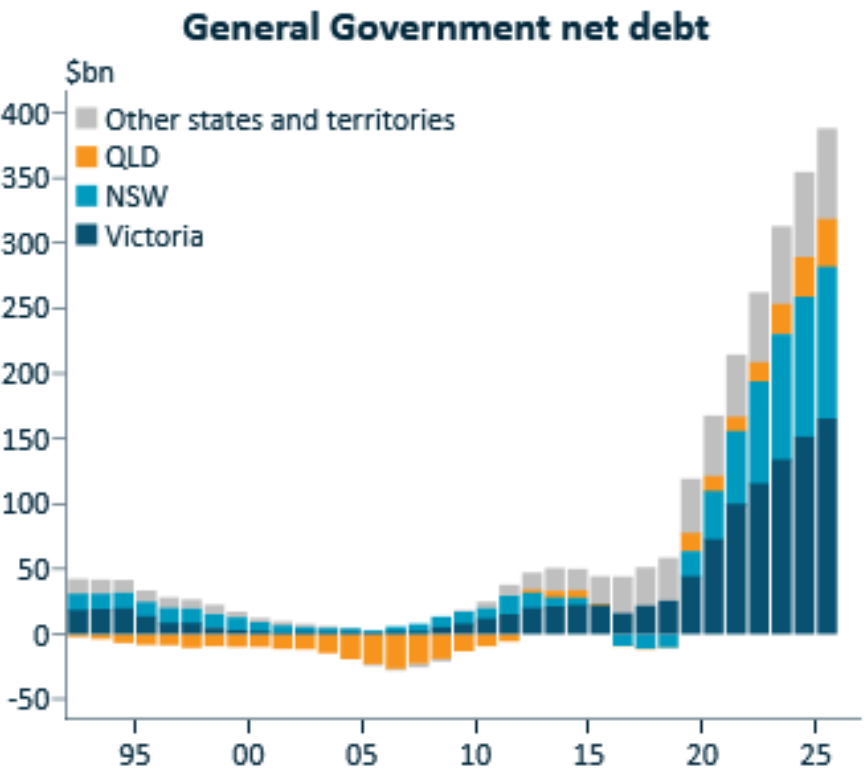
Regardless, Victorians are drowning in state debt and paying ever-increasing taxes and user fees:
The population crush will only worsen given the 2023 Federal Budget forecast that Victoria’s population would grow by a staggering 694,000 residents in just five years:
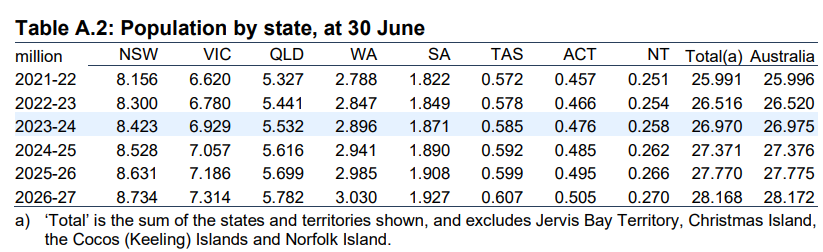
Source: 2023 federal budget
Based on historical population settlement patterns, around 500,000 of this population increase will settle in Melbourne, meaning the city will grow to around 5.5 million residents by 2026-27, up from 3.3 million at the 2001 Census.
The Federal Treasury’s Centre for Population projects that Melbourne’s population will swell to around 6.1 million residents by 2033, with net overseas migrants accounting for nearly three-quarters of these new residents.
With Melbourne’s housing crisis worsening by the day amid the fastest population inflow in history, Victorian Premier Dan Andrews announced a plan to squeeze an extra million dwellings into established suburbs by the middle of the century.
Andrews’ wants to deny local governments of decision-making control over large projects so that high-density developments can be forced into middle-ring suburbs.
The Andrews Government’s housing and planning overhaul, which is set to be revealed next month, is likely to shield developers from legal disputes with councils and resident groups before the Victorian Civil and Administrative Tribunal (VCAT).
The Age recently noted the difficulty in shoe-horning one million homes into established suburbs:
“Considering there are currently about 2.1 million dwellings in Greater Melbourne, hitting the target will require roughly one new dwelling for every two existing homes within the city’s boundaries”.
“Having taken about 188 years to get to our current situation, accommodating 50% more houses within existing boundaries in the next 20 years represents a major policy challenge”.
Architect Michael Smith this week penned an opinion piece in The Age arguing that Dan Andrews’ planning overhaul has put politics over the public good:
“There are two separate objectives to consider: providing affordable housing and allowing existing local residents to protect themselves from excessive impacts”.
“Both objectives provide benefits, but this fundamentally poor policy is telling us that we have to choose a side”.
“We need a careful redesign and rebuild of our planning system, rather than a quick political fix”.
“A a state policy that is limited to playing well politically, rather than what will actually make our built environment work for the greater good and well into the future is something we should all be objecting to”.
Dan Andrews’ faux concern about housing supply and affordability is contradicted by his desire for more immigration (population growth) into Melbourne.
Andrews recently told Italian-language community newspaper Il Globo that he has been lobbying the federal government to increase immigration even more:
“I’ve always been a very strong supporter of more skilled migration”.
“And the new federal government have taken some important steps towards increasing the amount of permanent skilled migration, but I think they might need to do more again”.
“Prime minister Albanese knows this. I’ve spoken to him about it personally and part of it also is clearing the Visa backlog”.
Dan Andrews also appears to have amnesia about the last decade’s high-rise construction boom:
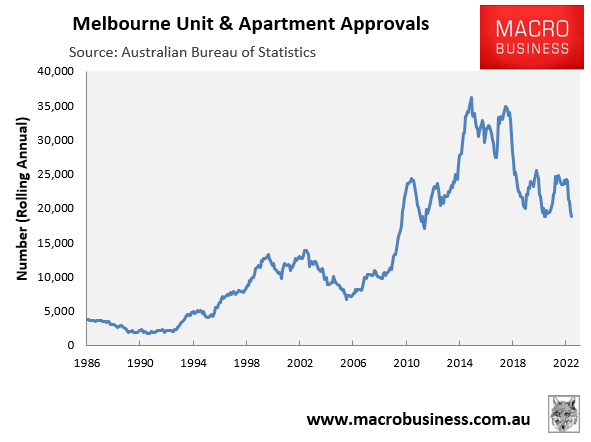
Melbourne was plastered substandard and combustible apartments, which the state is still attempting to repair at great expense.
The Age recently reported on large numbers of apartment developments with balcony defects, which follows other systemic problems.
We all know what will happen if a huge volume of apartments are built quickly to accommodate Melbourne’s record immigration-driven population growth.
Construction quality will deteriorate even further and thousands more shoddy high-rise apartments will be constructed across Melbourne.
Melbourne’s infrastructure will also become increasingly congested, limiting resident access to hospitals, schools, parks, and other public services.
Melburnians will also be forced to waste more time stalled in traffic and on crowded public transport.
The obvious solution to Australia’s (particularly Melbourne’s) growing pains and diminishing liveability is to limit net overseas migration to levels proportionate to our ability to deliver new housing and infrastructure.
Nobody voted for Labor’s record immigration, and the vast majority of Australians are opposed to it.
Stop crush-loading our living standards by flooding our cities with extra people.