
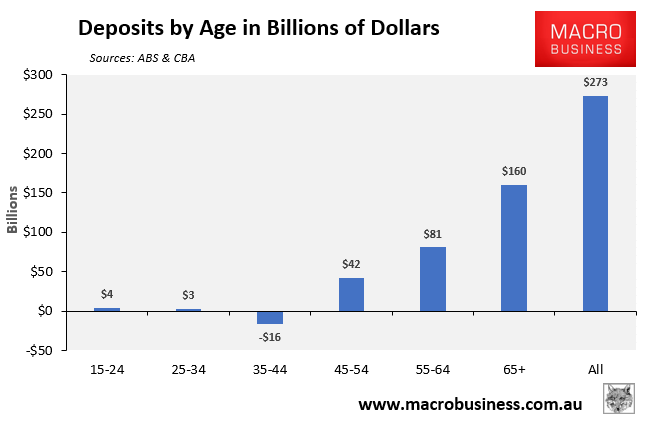
According to Australia’s national accounts, the baby boomer generation amassed a monstrous $160 billion in savings over the pandemic:
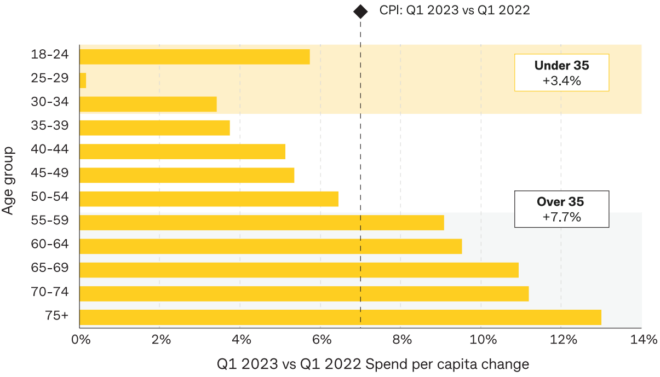
Recent data from CBA economics showed that Australian households aged 55 and over increased their spending by more than the rate of inflation in the year to March, whereas younger cohorts cut their spending in real inflation-adjusted terms:
Source: CBA
Baby boomer households aged 65-plus increased their spending the most, led by spending at cafés and restaurants, which grew by 18% year-on-year.
Unlike younger households paying mortgages and rent, many baby boomers households are benefiting from higher interest rates on savings, while those that own investment properties outright are enjoying record rental returns.
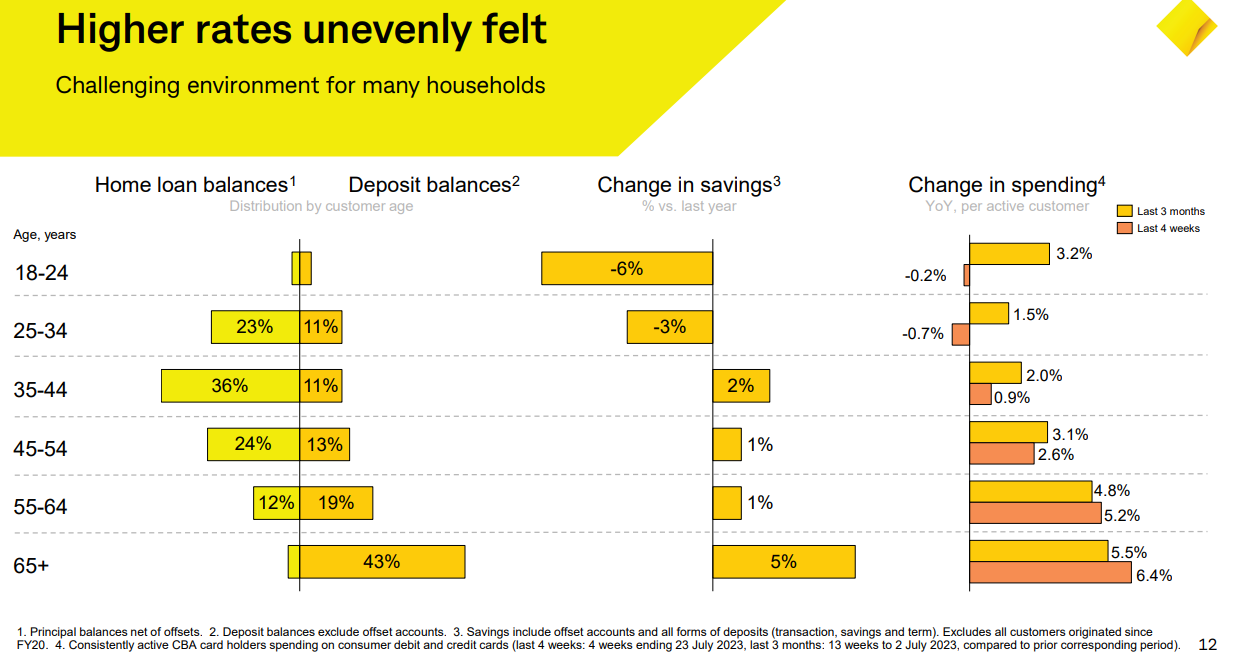
The next chart from CBA’s latest investor pack highlights the extent to which the Reserve Bank of Australia’s (RBA) 4.0% of interest rate hikes have punished younger Australians, while benefiting the baby boomers:
Source: CBA Investor Pack
As shown above, baby boomers aged 65-plus barely carry any mortgage debt, but hold 43% of total CBA savings.
By contrast households aged between 25 and 54 carry the lion’s share of mortgage debt and have little in the way of savings.
Savings levels have also grown most strongly year-on-year for baby boomers aged 65-plus (+5%), whereas savings have shrunk for those households aged 34 and under.
Finally, baby boomers aged 65-plus have increased spending the most over the last four weeks (+6.4%) and the last three months (+5.5%) compared the prior year, followed by households aged 55 to 64.
By contrast, younger households have experienced much smaller increases in their spending, with households aged between 18 and 34 actually cutting their expenditure over the last four weeks compared to the prior year.
The data clearly shows that the RBA’s rate hikes are exacerbating intergenerational inequality. Young people with mortgages are losing, while older people with savings are winning.
The baby boomer generation is also driving Australia’s household consumption, which has forced the RBA to respond with higher interest rates to the detriment of young Australians with mortgages.
The success in fighting inflation is heavily dependent on curbing spending for those households aged over 55, in particular the baby boomers.
