
Last week, CBA senior economist, Belinda Allen, published the below chart showing the annual change in savings and spending across age cohorts:
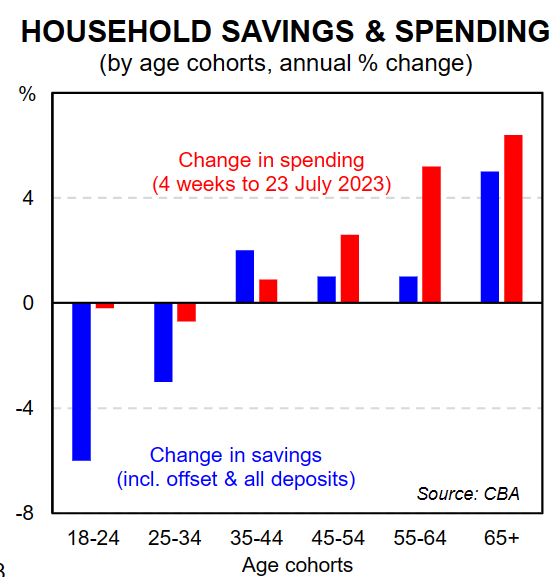
As you can see, younger Australians have experienced heavy falls in their savings, alongside reduced consumption expenditure.
By contrast, older Australians have experienced an increase in both savings and expenditure over the past year. This phenomenon has been most pronounced for those aged 65-plus.
Separate data released as part of CBA’s latest investor pack illustrated how the Reserve Bank of Australia’s (RBA) 4.0% of interest rate hikes has hurt younger Australians, while benefiting older Australians:
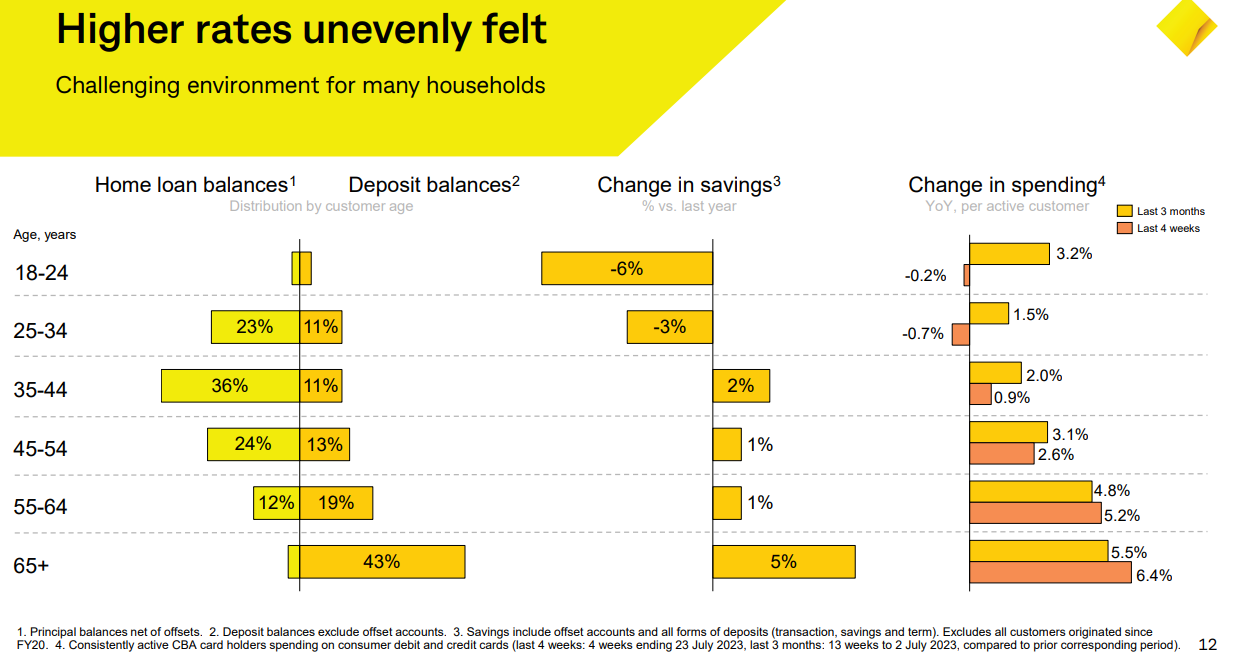
Those aged 65-plus carry little mortgage debt and account for 43% of total CBA savings.
Households aged 25 to 54, on the other hand, carry the lion’s share of mortgage debt and have little in the way of savings.
Savings have also increased the greatest for Australians aged 65-plus (+5%), while savings have decreased for those aged 34 and under.
Finally, households aged 65-plus raised their expenditure the most in the last four weeks (+6.4%) and the last three months (+5.5%) compared to the previous year.
Younger households, on the other hand, have seen significantly smaller gains in spending, with households aged 18 to 34 actually cutting their spending over the last four weeks compared to the previous year.
The data reveals how the RBA’s rate increases are worsening intergenerational equity. Younger households with mortgages are losing, while older folks with savings and wealth are winning.
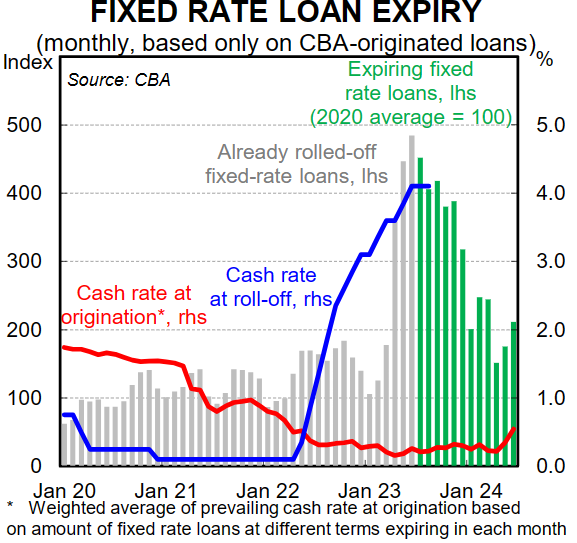
The situation will only get worse as the fixed rate mortgage cliff unravels.
Only two-thirds of the RBA’s current cash rate increase has been felt by borrowers, according to the CBA.
But with a further $52 billion worth of fixed rate loans expiring in the 6 months to December 2023, around 85% of the RBA’s rate hikes will be felt by borrowers by year’s end:
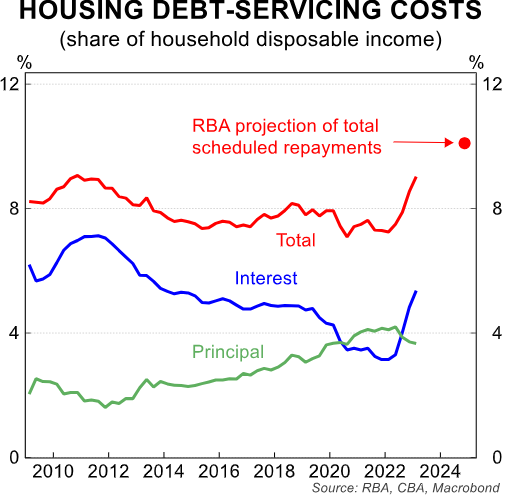
Worse, by mid 2024, Australian households will be paying their highest share of income on mortgage debt repayments in history:
The baby boomer generation has driven the nation’s household consumption, which has arguably forced the RBA to respond with higher interest rates, which has harmed young Australians with mortgages.
The success of controlling inflation hinges, in part, on curbing the spending of households aged over 55, particularly the baby boomers.
