
The federal government’s recently-released housing package – which has an upwardly revised target of building 1.2 million new homes in five years – fails to address one of the key contributors to the nation’s housing crisis, according to The Australian’s economics editor, Judith Sloan.
“Let me be clear, the numbers are not slightly higher – they are massively higher. In the 2022 budget, it was predicted that net overseas migration (long-term arrivals minus long-term departures) would rise by 180,000 in 2022-23. The actual figure is 400,000 – more than double. And instead of net overseas migration in 2023-24 being 213,000, the expectation is that it will be 260,000”, Sloan writes.
The government’s unwillingness to reduce the migrant intake – and temporary migrants in particular – is contributing to the gap between housing supply and demand, according to Sloan:
“With that sort of uncontrolled increase in the population, mainly in Melbourne and Sydney, it is inevitable that the housing situation will remain strained and unable to adjust in a reasonable timeframe”.
“Given the current circumstances, is it any wonder that rents are rising at rates much higher than inflation and the price of dwellings is escalating, notwithstanding the dozen increases in the cash rate feeding into higher mortgage rates?”
“The demand for housing is rising so rapidly that it is inevitable that there wouldn’t be enough homes”.
Sloan argues that it is highly likely that the housing package will fail to meet its targets and that more and more people will be dealing with housing stress.
Therefore, unless the federal government is prepared to reduce the number of migrants entering the country, as well as insist that temporary migrants leave, this will be an ongoing crisis:
“The bottom line is that it’s odds-on that the housing package will fail to meet the targets and more and more people will be dealing with housing stress”.
“Unless the government is prepared to bite the bullet and reduce the number of migrants entering the country, as well as insist that temporary migrants leave, this will be an ongoing crisis”.
Judith Sloan is correct, of course.
Australia’s housing shortage is a direct result of nearly 20 years of excessive immigration, which is projected by the latest Intergenerational Report to continue for at least another 40 years:
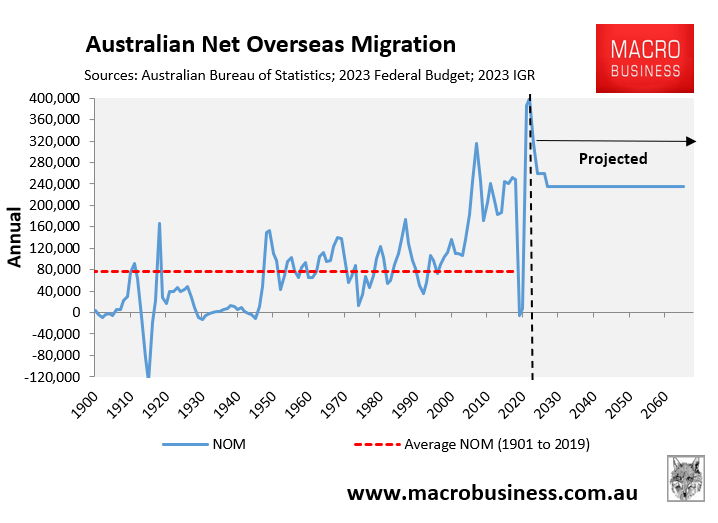
If the Albanese Government genuinely wanted to end the nation’s housing shortage, it would run an immigration program that was substantially lower than the overall expansion in the housing stock, not the other way around.
It is time to stop scapegoating a ‘lack of supply’ and start acknowledging the immigration elephant behind Australia’s housing shortage.
