
The Westpac-Melbourne Institute Leading Index has been released (below), with the 11th consecutive negative print registered. This result indicates that the Australian economy will operate below trend growth over the next six to nine months.
Westpac’s chief economist Bill Evans notes that the bank’s current forecasts “envisage growth of a modest 0.3% over the year to June 2024, including a contraction in consumer spending of 0.2% over the year”.
Given that Australia’s population is officially projected to grow by 1.7% over the same period, this means Australia’s per capita GDP growth will plummet by 1.4% in the year to June 2024.
- Leading Index growth rate lifts from -1.01% in May to -0.51% in June.
- This is the eleventh consecutive negative print for the growth rate.
- US industrial production and dwelling approvals explained most of the improvement.
- Market expectations of a lower RBA cash rate also lifted the Index.
- Deteriorating confidence in the labour market was a drag on the Index.
The six-month annualised growth rate in the Westpac-Melbourne Institute Leading Index, which indicates the likely pace of economic activity relative to trend three to nine months into the future, lifted to -0.51% in June from -1.01% in May.
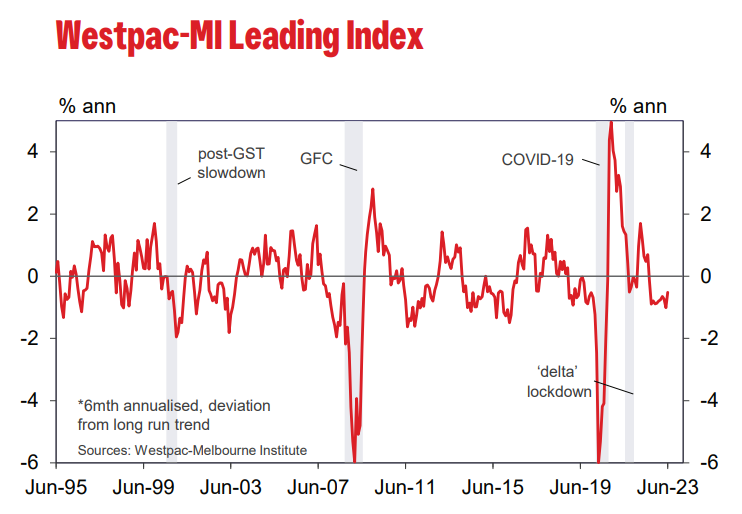
Despite a welcome improvement in the growth rate of the Index in June it remains in negative territory for the eleventh consecutive month.
The components of the Index that contributed most of the modest improvement over the month were: US industrial production; dwelling approvals and the yield curve, the latter reflecting a lift in market expectations that the RBA may be pausing for an extended period.
Negative reads on the Index’s growth rate indicate that the economy will be operating below trend over the six to nine months outlook.
That view is certainly consistent with Westpac’s current forecasts which envisage growth of a modest 0.3% over the year to June 2024, including a contraction in consumer spending of 0.2% over the year.
Such a profile is contingent on the Reserve Bank lifting the cash rate by a further 0.5% to address the inflation risks associated with a very tight labour market and associated concerns around inflationary expectations.
The observations around the improvement in the Index over the month are also pertinent for the modest improvement over the last six months.
The Leading Index growth rate has improved slightly over the first half of 2023, lifting from –0.87% in December to –0.51% currently.
However, the component detail behind the shift is less convincing.
The improvement over the last six months is mostly coming from reduced drags rather than outright positives.
Three components account for most of the shift: the yield spread (adding +0.40ppts to the growth rate overall); US industrial production (+0.26ppts); and dwelling approvals (+0.12ppts).
For the yield spread, the reduced drag reflects a less aggressive pace of monetary tightening and market expectations which are flirting with the prospect that the cash rate has already peaked.
In the case of US industrial production and dwelling approvals, the improvement is coming from a stabilisation after a sustained period of weakness.
The signal would be more promising if the shift looked to be a precursor to significant positive contributions, but this does not look likely at this stage for either monetary policy or real economy drivers.
Over the same six-month period there have also been some significant component deteriorations that have largely offset these improvements, including: the Westpac-Melbourne Institute Unemployment Expectations (–0.27ppts); commodity prices, measured in AUD terms (–0.10ppts) and equity markets (–0.10ppts). Some of these drags look likely to be more enduring.
The Reserve Bank Board next meets on August 1. Contrary to those market expectations Westpac expects that the Board will decide to raise the cash rate by a further 0.25% at the August meeting.
By the August meeting we expect that the Board will be dealing with an inflation read still above 6%; an unemployment rate registering nearly 1ppt below the Board’s current estimate of full employment; and the recent report from the national accounts showing unit labour costs growing at 7.9% over the year.
While the minutes from the June Board meeting highlighted the Board’s concerns around these risks, in part justification for the decision to raise the cash rate, the minutes from the July Board meeting gave considerable attention to the deteriorating growth outlook, giving strong support for the decision to pause.
The data-flow, particularly the June quarter inflation report, will be important inputs into the decision in August.
