
Two pieces of data were released on Tuesday showing how Australian households are cutting back on discretionary spending amid soaring interest rates and squeezed cost of living.
First, CBA’s Household Spending Intentions (HSI) Index fell 1.7% in June, as consumer activity continued to weaken across a range of discretionary categories:
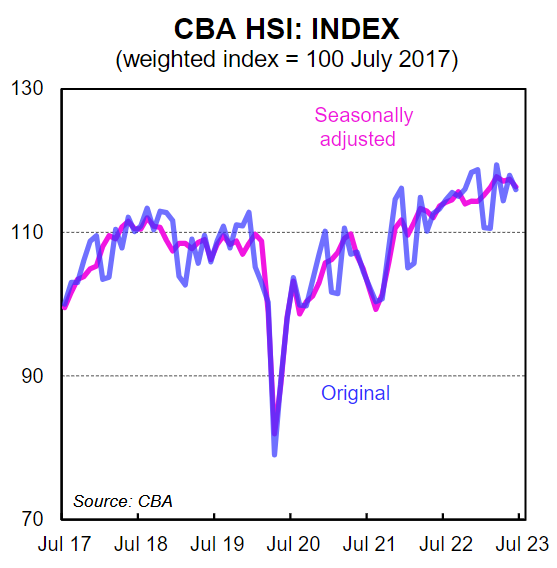
Discretionary spending has weakened further, with entertainment spending down 5.4% in May and 15.4% year on year. Following May’s dip, travel spending declined another 2.5%, with spending on hotels, motels & resorts, trailer parks & campgrounds, and sport & leisure clubs all down.
This was partially offset by increases in spending on travel agencies, airlines, cruise ships, and airports as families travelled abroad during the school holidays.
Although significant population growth supported increasing spending on grocery stores, supermarkets, and bakeries, retail activity remained subdued.
However, discretionary retailing has continued to deteriorate, with lower activity in department shops, apparel, appliances, hardware, florists, and confectionery.
In annual terms the pace of growth in the HSI index moderated further in June, down to 2.4%/yr from 4.7%/yr in May and the peak of 15.2%/yr in August 2022.
With inflation running at 5.6%/yr in May, this would imply a decline in the HSI index in real terms, and even further when adjusted for population growth.
Commonwealth Bank of Australia Chief Economist, Stephen Halmarick, said the tightening of financial conditions in Australia, especially for households with a mortgage or paying rent, continues to constrain discretionary spending.
“Although the RBA held interest rates steady in early July, monetary policy in Australia is highly restrictive and this is expected to see ongoing softness in household spending in the months ahead. We are forecasting a final rate hike from the RBA in August, taking the cash rate to 4.35 per cent. Given the lags involved with monetary policy, financial conditions are expected to continue to tighten for many Australian households well into 2024″, Halmarick said.
Second, the Australian Bureau of Statistics has released its monthly household spending indicator, which shows that discretionary spending was 0.6% lower compared to May last year, versus a 6.9% rise in non-discretionary spending:
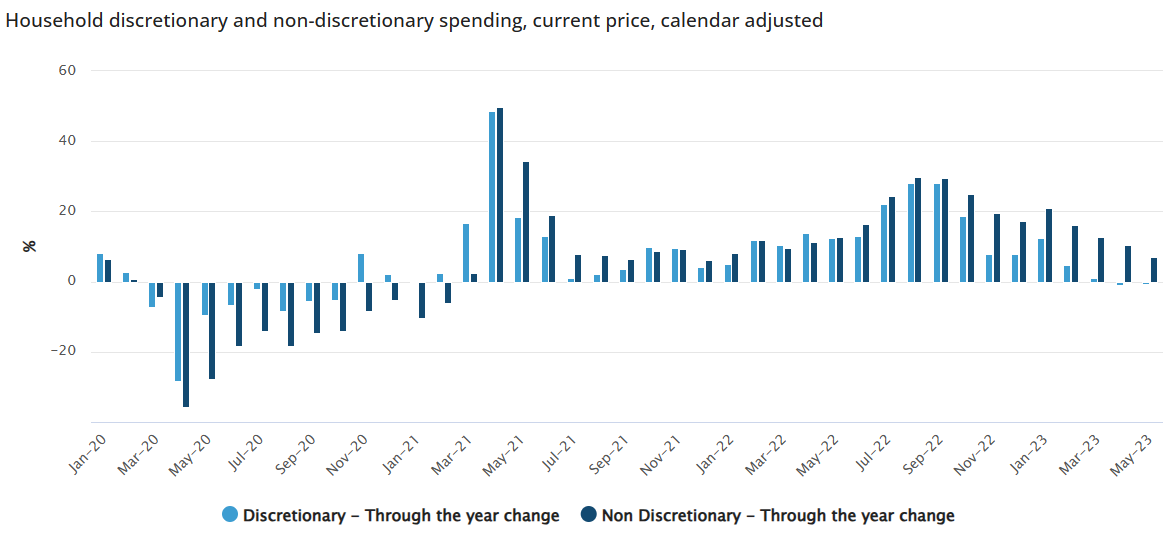
“Driving the fall in discretionary spending over the year was 4.8% less spending on Furnishings and household equipment, and 3.4% less on Clothing and footwear”, noted ABS head of business indicators, Robert Ewing.
“While overall household spending rose 3.3% in May compared to the same time last year, it was the lowest growth rate since July 2021. This comes as households respond to cost-of-living pressures”.
Given inflation was running at 5.6% in May, alongside circa 2% population growth, real per capita household spending is falling fast.
Real household spending will likely fall further as hundreds of thousands of cheap fixed rate mortgages expire over the remainder of the year, sapping household income and cutting discretionary spending.
