
Below is the CBA economics team’s assessment of Wednesday’s CPI result, which means next week’s interest rate decision from the RBA is ‘line ball’:
Key Points:
- The headline CPI rose by a lower than expected 0.8%/qtr in Q2 23 and the annual rate dipped to 6.0%, from 7.0% in Q1 23.
- The RBA’s preferred measure of underlying inflation, the trimmed mean, increased by 0.9/qtr and the annual rate moved down to 5.9% (from 6.6% in Q1 23).
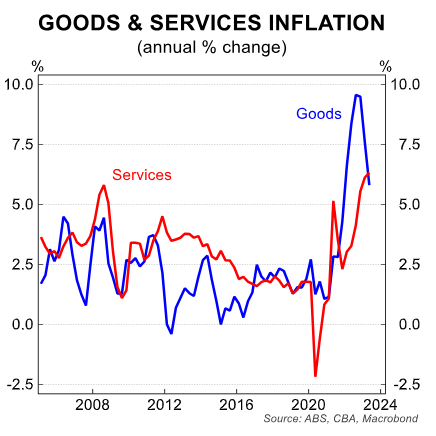
- Services inflation stepped up again, the highest annual rate since 2001,while goods inflation continued to track lower.
- Inflation in Q2 23 tracked lower than the RBA’s forecasts from May; at the same time the labour market is resilient.
- The slightly softer than expected Q2 23 CPI print suggests the RBA’s August Board meeting will be line ball call again.
- At this stage we continue to expect the RBA to lift the cash rate one final time in August but we will publish our full preview after the retail trade print on Friday.
Headline Q2 23 CPI and trimmed mean CPI shift lower, but services inflation is high:
The Q2 23 CPI confirms that the inflation pulse in the Australian economy continues to track lower.
Inflation remains high, but is heading in the right direction as goods inflation continues to retreat, partially offset by strong services inflation.
The headline CPI rose by 0.8%/qtr and the annual rate stepped down to 6.0%/yr (from 7.0%/yr).
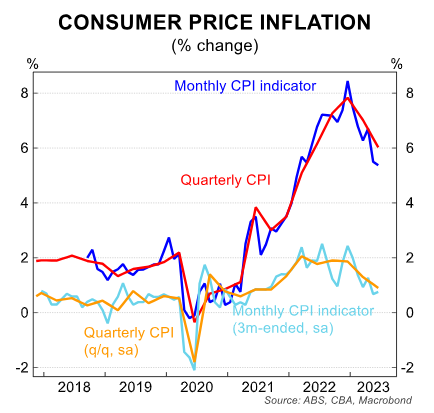
The market median forecast was 1.0%/qtr and 6.2%/yr (CBA below consensus at 0.9% and 6.1%/yr).
This was the lowest quarterly headline inflation since the September quarter 2021. For context, headline CPI rose by 1.4%/qtr in the March quarter 2023 and 1.9%/qtr in the December quarter 2022.
Base effects from here, with the 1.8%/qtr September quarter 2022 outcome to drop out next quarter, will continue to lower the annual rate of inflation. We expect inflation to reach just below 4%/yr by year end.
The trimmed mean, the RBA’s preferred measure of underlying inflation, rose by 0.9%/qtr and 5.9%/yr, compared to consensus expectation of 1.1%/qtr and 6.0%/yr.
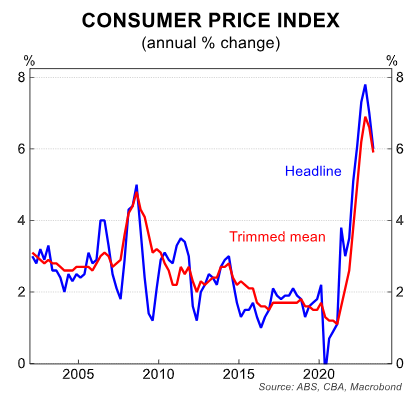
Once again, CBA was below the consensus at 1.0%/qtr and in line with the trimmed mean outcome at 5.9%/yr.
Like the headline rate, trimmed mean inflation is also dropping, down from 1.3%/tr in the March quarter and a peak of 1.9%/qtr in September quarter 2022.
The RBA’s rapid 400bp of hikes since May 2022 are working to slow the pace of aggregate demand in the economy.
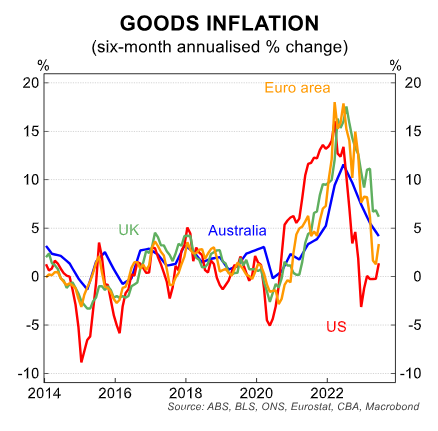
The normalisation of supply chains and freight costs back to pre-pandemic levels are playing a major role in bringing goods inflation down. Goods inflation in other advanced economies is also retreating at a similar pace.
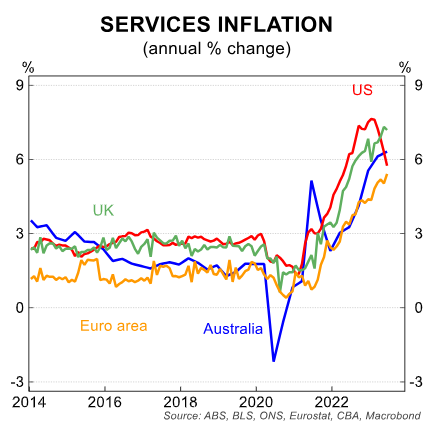
Australia is currently experiencing goods disinflation but high and rising services inflation. This trend has also been playing out offshore.
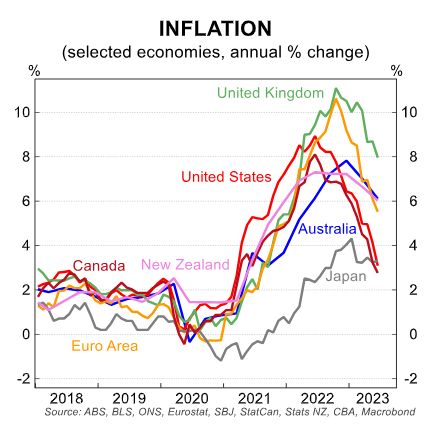
Goods disinflation has been the dominant driver of falling headline inflation in many countries.
The lesson from overseas so far is that services inflation is proving ‘sticky’.
A key uncertainty for Australia for is how sticky services inflation will be.
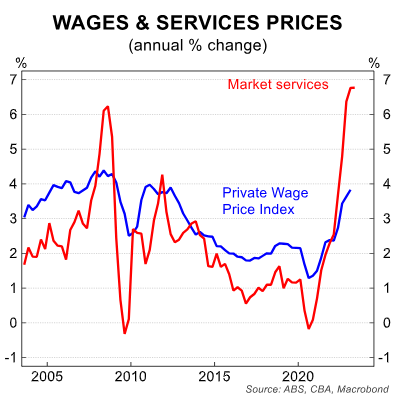
Wages growth (a key driver of services inflation) is lower in Australia than many peer economies. This could mean services inflation will come down more quickly in Australia.
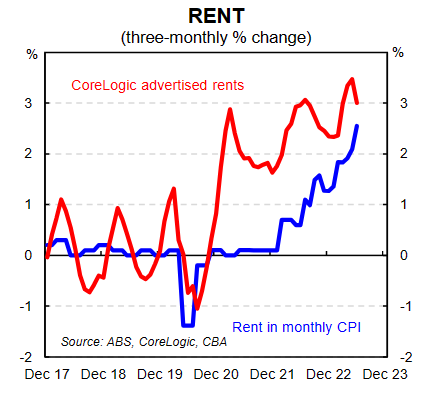
However, key services categories such as rents (driven by supply shortages and strong demand) and insurance are rising strongly, which may keep services inflation higher for longer.
Monetary policy is restrictive. We expect the impact of rate hikes on aggregate demand to continue from here and slow the inflation pulse in the Australian economy.
A resilient labour market and uncertainty around the feedback to wages growth are also front of mind for the RBA.
Highlights
Goods disinflation continued in the June quarter while the annual rate of services inflation accelerated. The annual rate of goods inflation slowed to 5.8%/yrin Q2 23, down from 7.6%/yrin the March quarter.
Automotive fuel prices fell over the past year, helping lower the rate of goods inflation. Prices continued to rise for food, furniture, some household appliances and clothing, but at a slower pace than past quarters.
Working the other way was services inflation. It rose to 6.3%/yr in the June quarter, up from 6.1%/yr in the March quarter and just 5.5%/yr in Q4 22.
We continue to think the RBA is focussing on the composition of inflation and not just the overall number.
Services inflation, particularly market services inflation, has been correlated with labour cost growth. Offshore services inflation has remained sticky despite central banks lifting rates higher than here in Australia, though we note real wages outcomes elsewhere have been stronger.
In Australia services inflation is being supported by rents, restaurant meals, child care, international travel & accommodation and insurance.
Our card spending data continues to show resilient spending on eating & drinking out and some other recreation items.
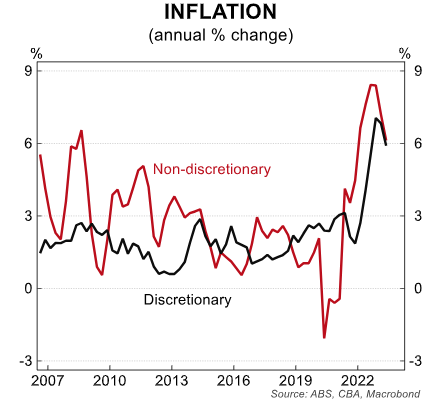
Discretionary inflationary rose by 0.8%/qtr and 5.9%/yr. Non-discretionary inflation also rose by 0.8%/qtr, and sits at 6.1%/yr.
The tradables versus non tradables split was interesting. Tradables inflation rose by 1.1%/qtr, driven by strength in overseas travel and accommodation, furniture and household textiles.
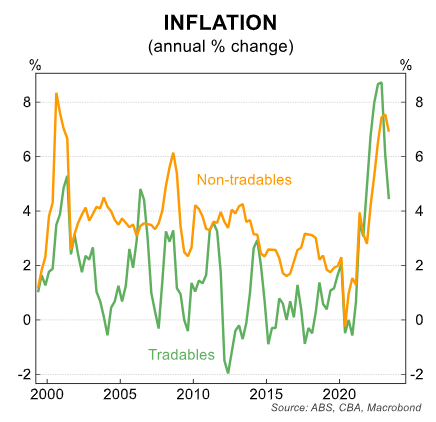
In contrast to the March quarter, non tradables was softer than tradables, at 0.8%/qtr, because domestic travel & accommodation prices fell sharply.
Rents was the largest contributor to non-tradeable inflation. Over the past year tradables inflation is running at 4.4% compared to non tradables at 6.9%.
Implications for monetary policy
The CPI today has set up the RBA August Board meeting decision to once again be a finely balanced.
A slightly softer June quarter inflation, but still resilient labour market, high services inflation, a recovering housing market and concerns around productivity growth will all feature in the policy deliberation.
The RBA retained a hiking bias after its on hold decision in July. At the time,the RBA noted they wanted to see the flow of data between now and August.
Governor Lowe also highlighted they will have access to refreshed staff forecasts at the August meeting.
The challenge for the RBA, as we noted above, is a mixed set of data.
The labour market report for June was strong. Employment growth is running above expectations and the unemployment rate was only 3.5% in May and June. Together with the higher than expected Fair Work Commission decision on minimum and award wages, the RBA will re-assess the ongoing risks to the outlook for wages growth based on the still low unemployment rate as well as any formal and informal indexation of wages to inflation.
On the other side though is the softer June quarter CPI print. We did note in our CPI preview that such an outcome would not necessarily preclude the RBA from delivering another 25bp rate hike in August.
A material undershoot would have ruled out a hike. Today’s data is not a material undershoot. The Q2 23 inflation figures, and June’s labour market data, will be viewed in the context of how it influences the RBA’s inflation and labour market forecasts as well as the perceived risks around those point forecasts.
The lower-than-expected June quarter inflation figures raises the possibility that the RBA could downgrade their inflation forecasts, or characterise those risks as skewed to the downside.
Given the uncertainty around the path of services and consumer durables inflation the path of least regret, we expect, is for the RBA is to deliver one final rate hike in August, taking the cash rate to 4.35%.
We will publish our full preview for the August Board meeting on Friday after the retail trade print.
