
Roy Morgan reports that mortgage stress has hit its highest level since May 2008, with 28.8% of mortgage holders considered ‘At Risk’ after the RBA raised interest rates by 3.75%:
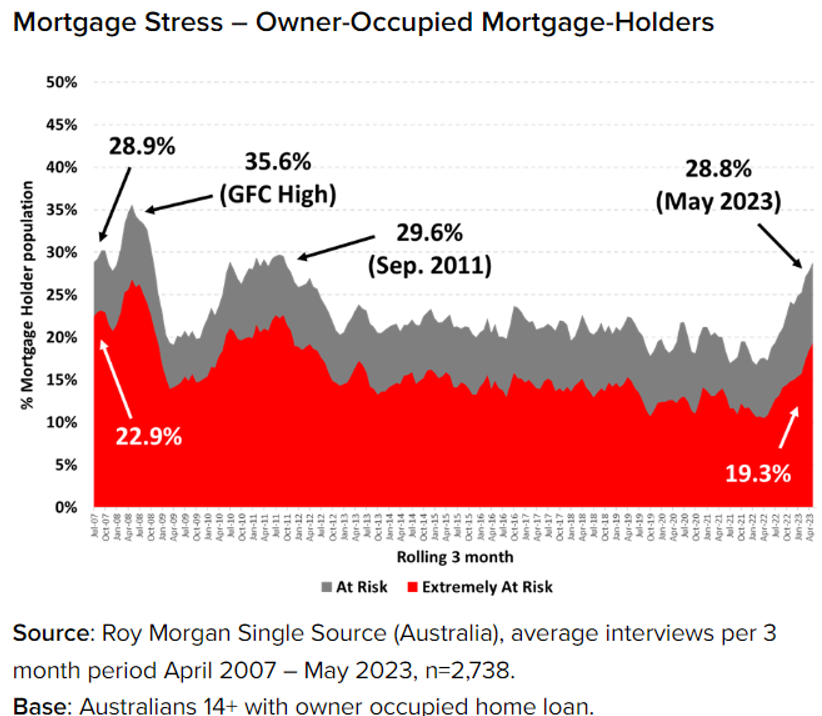
A borrower is considered “At Risk” by Roy Morgan if their mortgage payments exceed a predetermined amount (between 25% and 45%, depending on income and consumption).
The data for May 2023 include 11 RBA interest rate rises that raised the official cash rate from 0.1% in May 2022 to 3.85% in May of this year.
The RBA then raised the official cash rate by 0.25% in June, which is not reflected above.
Nonetheless, Roy Morgan expects that 29.0% of mortgage holders will be stressed if the RBA hikes interest rates one more time (to 4.35%).
And if the RBA raises rates twice more (to 4.60%), then 29.9% of mortgage holders will be stressed.
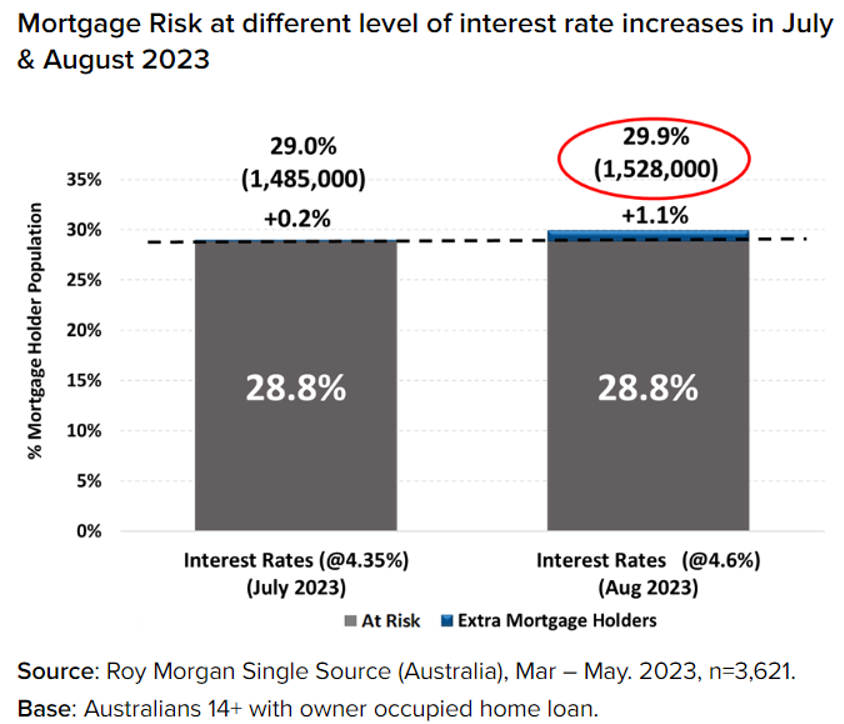
Roy Morgan employs “a conservative model, essentially assuming that all other factors remain constant”.
As a result, if unemployment rises significantly, mortgage stress will be more than predicted above.
I’ll add that up to 500,000 fixed-rate mortgages are still set to expire over the second half of this year.
Mortgage rates for these borrowers will rise from about 2% to 7% (higher if the RBA hikes further) as these fixed rate mortgages expire:
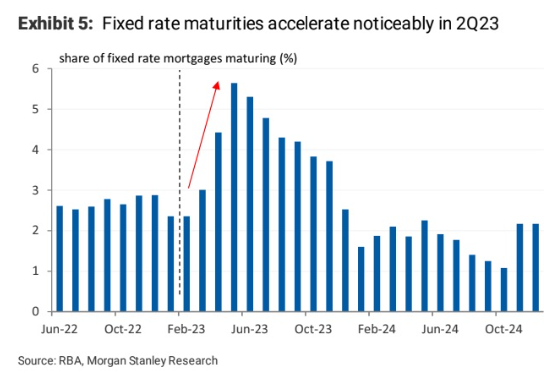
Therefore, even if the RBA maintains current interest rate settings, Australian homeowners would suffer more financial pain as a result of this fixed-rate “mortgage cliff”.
The chart below, from the CBA shows the consequences of this fixed-rate “mortgage cliff”:
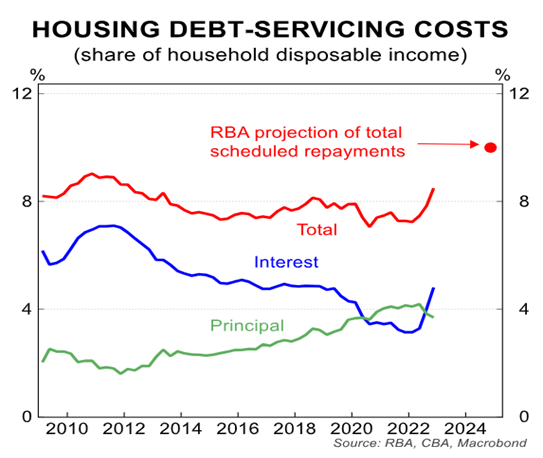
As you can see, following the completion of the fixed rate mortgage reset, planned mortgage repayments will hit a record percentage of household income.
Mortgage rates have already risen well above the APRA-mandated 3% mortgage serviceability buffer created at the time these fixed-rate mortgages were originated.
Accordingly, many borrowers run the risk of defaulting when their fixed-rate mortgage terms expire.
Indeed, according to S&P Global Ratings data published last month, mortgage arrears in Australia hit a two-year high in the March quarter.
Specifically, 30-day prime mortgage arrears increased to 0.95% of borrowers in the March quarter, up from 0.76% at the end of 2022, which followed a historic low of just 0.68% in the September quarter.
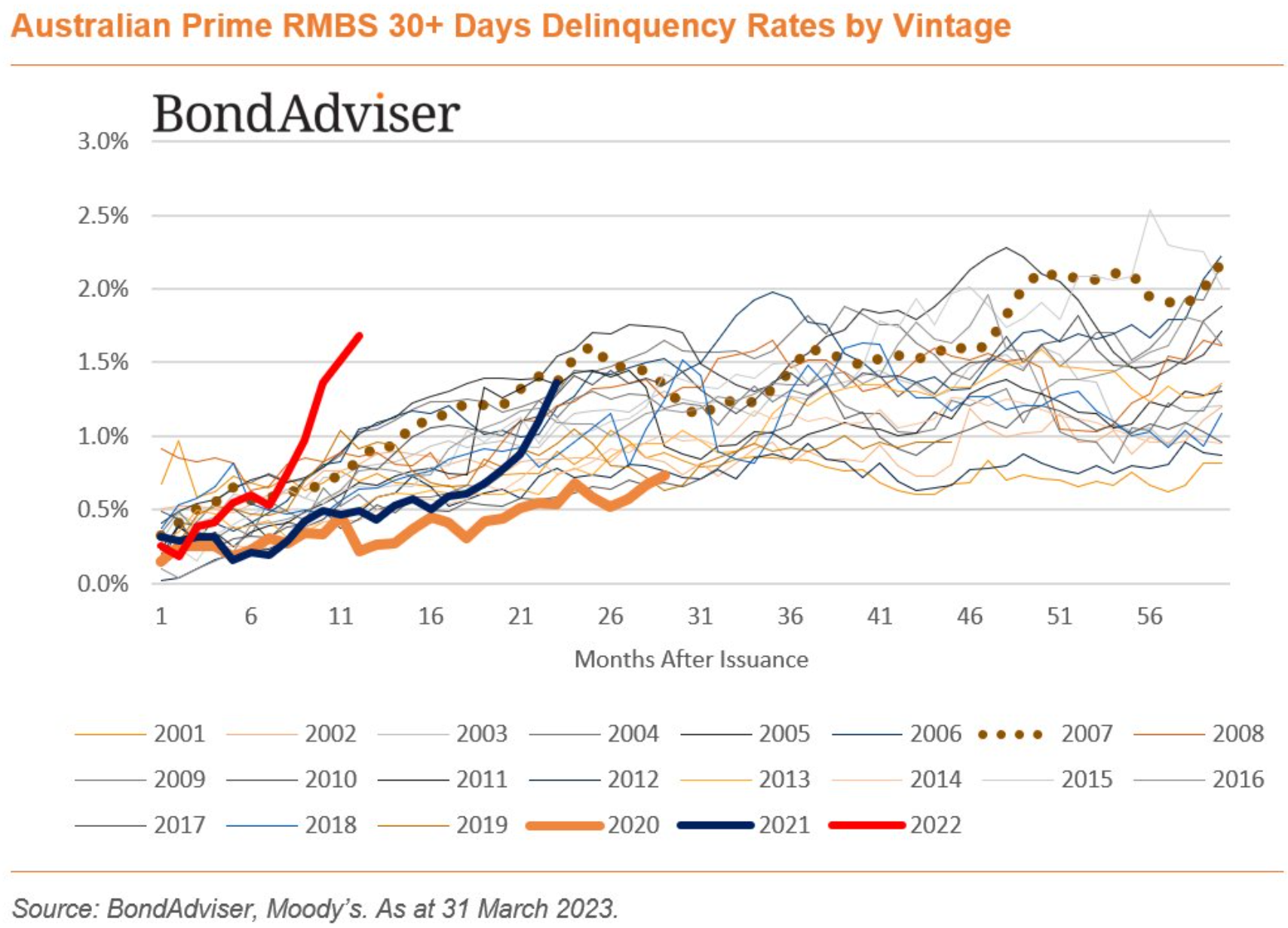
Moody’s similarly reported that 30-plus day arrears on 2022 vintage prime residential mortgage-backed securities (RMBS) had rocketed (red line below), with 2021 vintage mortgages also rising sharply (blue line below):
The team at Coolabah Capital shows similar trends.
Mortgage arrears hit a record high in 2012, and the threat of further cash rate increases, the fixed rate mortgage reset, and rising unemployment may cause arrears to challenge this level once more.
