
Last Monday, the Australian Bureau of Statistics (ABS) released housing finance data for May, which revealed that the annual value of mortgage refinances hit a record high $230 billion, roughly double its pre-pandemic level:
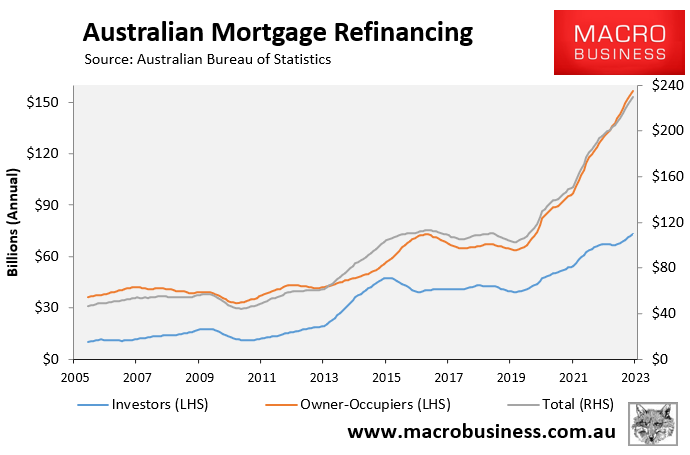
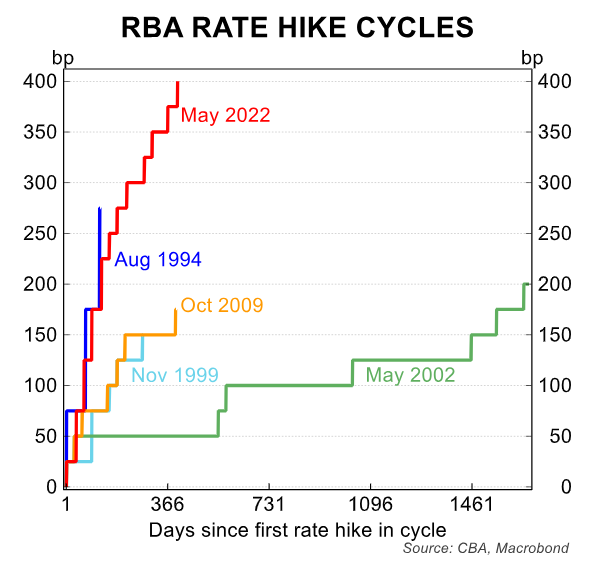
The surge in mortgage refinances is being driven by the sharp rise in mortgage rates in response to the Reserve Bank of Australia’s (RBA) aggressive monetary tightening:
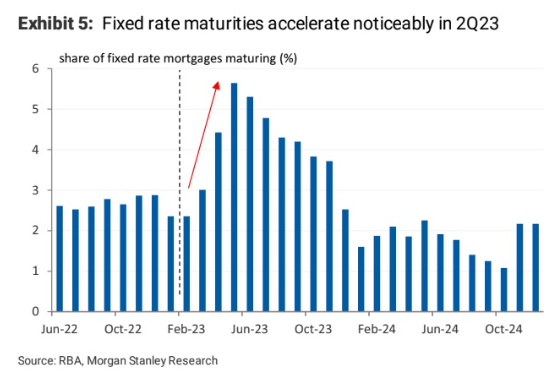
It is also being driven by the large volumes of mortgages converting from cheap pandemic fixed rates of around 2% to variable rates approaching 7%:
The financial pressure from rising mortgage repayments has driven borrowers to search for a better deal.
The number of mortgage refinances would be even higher except that lenders until now had to assess mortgage serviceability using the Australian Prudential Regulatory Authority’s (APRA) 3% buffer, which was increased from 2.5% in late 2021.
According to APRA, this serviceability buffer is “designed to reinforce the stability of the financial system… ensuring the financial system remains safe, and that banks are lending to borrowers who can afford the level of debt they are taking on – both today and into the future”.
Many of the above fixed-rate borrowers were assessed at mortgage rates ranging from 4.5% to 5% (i.e. 2% fixed rate plus a 2.5% or 3% buffer).
Therefore, if they wish to refinance under APRA’s 3% buffer, many would be assessed at mortgage rates of close to 10% (i.e., up to 7% variable rate plus a 3% buffer).
Many borrowers will be unable to meet these serviceability requirements, making them ‘mortgage prisoners’ paying uncompetitive rates to their existing lender.
A few weeks back, CBA chose to override APRA’s 3% buffer for mortgage refinances, instead permitting only a 1% buffer provided a range of criteria are met (see here for details).
Westpac followed suit shortly afterwards, effectively emulating the CBA.
NAB on Thursday become the next major bank to ease its mortgage serviceability requirements, advising its bankers and brokers that its criteria for assessing people are seeking to refinance a home loan will be relaxed from 21 July.
NAB says it will make exceptions for borrowers who are regarded as a good credit risk but may not meet stress-testing standards such as serviceability buffers.
This will be determined on a case-by-case basis, while borrowers will still require a good repayment history.
Relaxing the 3% mortgage serviceability buffer for refinances is sensible for the following reasons:
- These people are already ‘in the market’ and were assessed for serviceability when they took out their loans.
- Trapping them with their current lenders at uncompetitive interest rates may be detrimental to financial stability because it may result in a flood of forced sales.
- Creating ‘mortgage prisoners’ reduces competition since lenders have little incentive to give a better rate if they know their borrower will be unable to leave.
- It is inequitable to force recent first-time buyers out of their homes for the sake of meeting an arbitrary buffer.
In short, maintaining the 3% mortgage serviceability buffer on refinances is illogical, unfair, and potentially harmful to financial stability and competition.
If you are looking to save thousands of dollars in mortgage repayments, try the MB Compare n Save mortgage comparison tool. It takes less than a minute. And if you choose to refinance, Compare n Save will handle the process.
