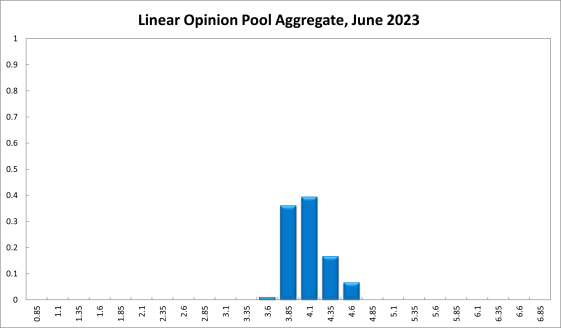
For the current (June) round, the Shadow Board believes that, on balance, the overnight rate should rise again: it is attaching a 36% probability that pausing the tightening cycle is the appropriate policy and a 63% probability that another rate rise, above the current level of 3.85%, is the appropriate policy stance, with a mode recommendation of a 25 bps increase to 4.10%. The probability attached to a required rate reduction is negligible (only one percent).
The probabilities at longer horizons have shifted slightly: 6 months out, the confidence that the cash rate should remain at the current setting of 3.85% equals 21%; the probability attached to the appropriateness of an interest rate decrease equals 15%, while the probability attached to a required increase equals 64%. The mode recommendation at this horizon is, as for the current recommendation, 4.10%, 25 bps above the current level.
One year out, the Shadow Board members’ confidence that the appropriate cash rate is at the current level of 3.85% equals 17%. The confidence in a required cash rate decrease, to below 3.85% equals 45%, and its confidence in a required cash rate increase, to above 3.85%, is 38%. Three years out, the Shadow Board attaches a 10% probability that the overnight rate should equal 3.85%, a 71% probability that a lower overnight rate is optimal and a 19% probability that a rate higher than 3.85% is optimal.
However, the Shadow RBA’s founder and generalised monetary legend, Warwick McKibbin, say stop:
“There’s a deflationary shock coming from the supply side [as] supply has gone back to where it was. The central banks [are] still looking backwards and saying we need to raise interest rates.”
The central bank might yet need to lift rates again but only if a nascent increase in wages developed into a bigger wave, but there were reasons not to exaggerate the concerns.
“Wages are a small part of the Australian economy,” McKibbin said. As a proportion of gross output in Australia, the share was just 18% once you exclude the input from overseas’ workers
“We’re going to get some surge in wages” after the Fair Work Commission’s 5.75% verdict for low-paid workers and other decisions, he said. “We’re probably not going to be cutting rates anytime soon but we certainly may not need to go as high as we were going to.”
I agree. Wage growth is falling away anyway.
Advertisement
But the problem for the RBA is not wages, it is Alboflation in rents and utilities. The central bank is forced to “make room” for Albo’s lunatic mass immigration and energy policy failure.
Tarric Brooker made a good fist of these two on the weekend:
During a recent Senate Estimates hearing, RBA Governor Philip Lowe shared the RBA’s estimate that the CPI rental component would rise by around 10% and that “Rent growth is going to stay high for quite a long time,”.
Amidst reports that the Australian Energy Regulator and Victorian Essential Services Commission has confirmed that electricity prices will rise by between 20% and 25% from July 1st, its clear that there are inflationary pressures that are very much baked into the CPI.
To explore this in a bit more detail, I put together three scenarios to measure the impact of household energy and rental price inflation on the broader CPI. To put these numbers into a bit of perspective, these CPI components make up 8.95% of the overall CPI basked. In each of the scenarios household energy costs rise by 25%, with the variable being the level of rental price inflation.
Household Energy And Rental Price Inflation – Total Contribution To CPI
As you can see even in the more optimistic scenario almost 70% of the RBA’s 2% inflation target floor is consumed by these items that make up less than 9% of the overall CPI basket.
In order to put these numbers into a broader historical context, the chart below is of inflation since 2012, but with the rental and household energy CPI components replaced with those of the three scenarios. Even during what was historically periods of lower than target inflation, the CPI remains well above the 2% RBA target floor and frequently spent time above the top end of the RBA’s 3% inflation target.
This illustrates how challenging it is likely to be to get inflation back under control on a relatively short timeline. Its worth noting that even during the global financial crisis it was 21 months after the collapse of Lehman Brothers before the RBA’s preferred inflation
The good news is that I do not expect 25% energy inflation to persist unless there is another external shock. The 50% price rise to date covers Albo’s new gas deal. So, next year, it should only be rent inflation to worry about. Though power subsidies will push the timing around.
Advertisement
I expect the RBA to pause this meeting and reckon it’s odds-on that it is done as extant tightening lands on households and the terms of trade deteriorate amid a global recession.
David Llewellyn-Smith is Chief Strategist at the MB Fund and MB Super. David is the founding publisher and editor of MacroBusiness and was the founding publisher and global economy editor of The Diplomat, the Asia Pacific's leading geo-politics and economics portal.
He is also a former gold trader and economic commentator at The Sydney Morning Herald, The Age, the ABC and Business Spectator. He is the co-author of The Great Crash of 2008 with Ross Garnaut and was the editor of the second Garnaut Climate Change Review.