
New Australian Securities and Investments Commission (ASIC) data shows that in the year to June 2023, the number of corporate insolvencies surged by 62%, headed by the construction industry.
7943 Australian businesses went into administration, liquidation, or receivership in the 2022-23 financial year:
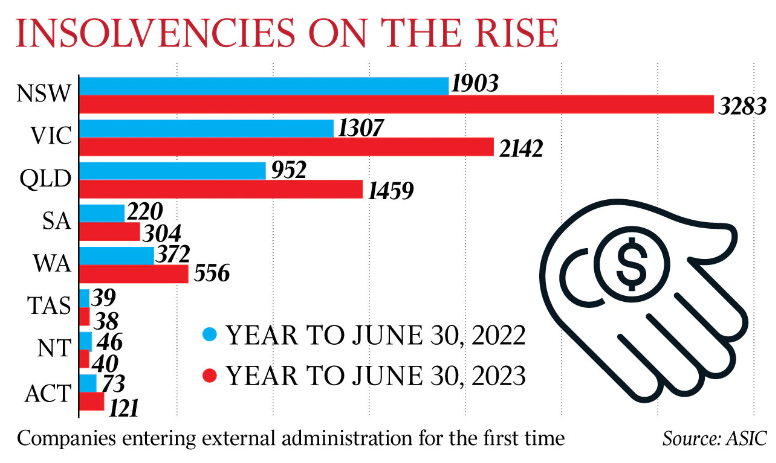
This was an increase from 4912 in 2021-22 and the highest number of business failures since 2018-19.
In the construction sector alone, insolvencies hit 2211 in 2022-23, a 72% increase over the previous year.
New South Wales had the most building failures with 981, followed by Victoria with 619.
“It’s never been this bad”, said Builders Collective of Australia president Phil Dwyer, who believes builders are facing their biggest crisis in his 40 years of experience.
“Even when we go back to the ‘60s, ‘70s ‘80s and so on, when we used to have a recession every six or seven years, we never saw this sort of fallout from the industry”.
“These fixed price contracts and numerous issues we can relate to Covid, the escalation of costs, supply chain problems and the increase in timber and steel have had a dramatic effect”.
“We’re seeing an increase in the cost of building by about 30% and none of these contracts can withstand that sort of increase”.
Dwyer also sees further storm clouds ahead for home builders as the former Morrison Government’s HomeBuilder stimulus continues to fade.
“The industry is slowing down – there’s no doubt about that”, Dwyer said.
“We had a stimulus package that everyone jumped on at 100 mile an hour, took on far too much work, and that’s what’s biting us now, and going to bite us in the next six or nine months”.
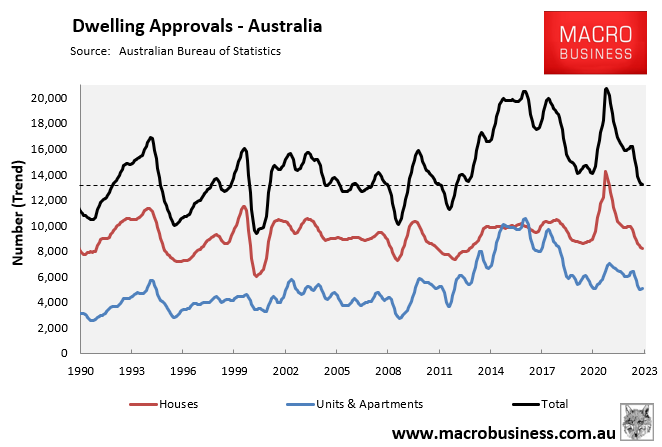
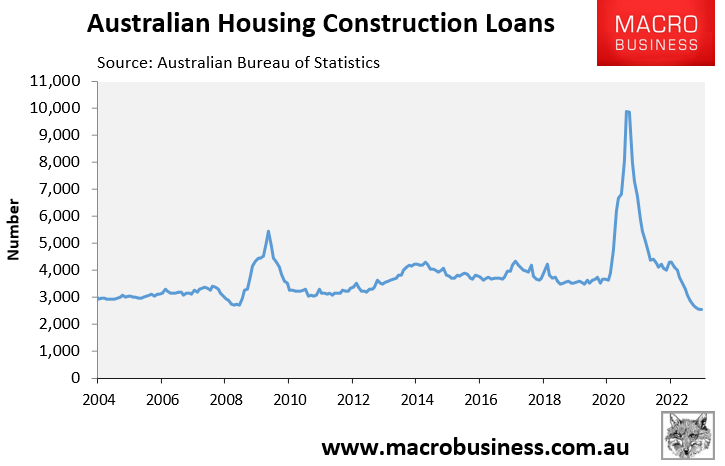
Dwyer is not wrong. The main leading indicators for housing construction are each showing weakness.
Specifically, the number of homes approved for construction has fallen to an 11-year low:
The number of finance approvals for the construction of new dwellings has fallen to a record low:
Finally, the new number of new home sales fell by one-third over the 2022-23 financial year, according to the Housing Industry Association (HIA):
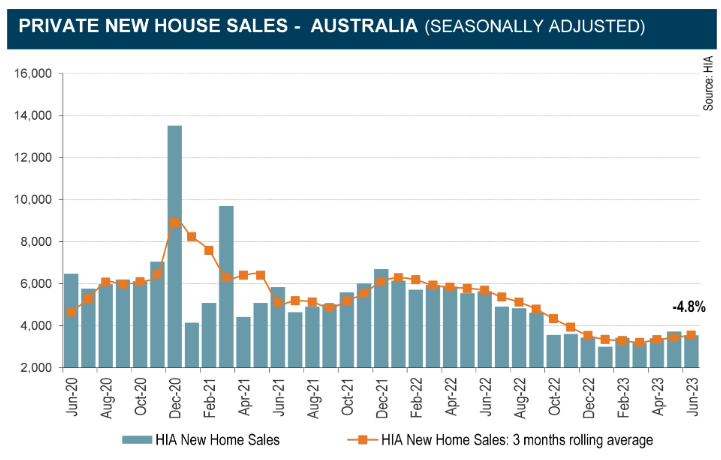
“This will result in the least number of new homes commencing construction for more than a decade in 2024”, warned HIA Chief Economist Tim Reardon last week.
“A significant number of existing projects are also being cancelled, as buyers find themselves unable to obtain finance after interest rates and construction costs continued upwards since they signed the contract”.
“This lack of new work entering the pipeline will result in fewer projects being commenced, and the volume of work under construction shrinking rapidly from late this year”, Reardon added.
The Australian Treasury recently forecast that Australia’s housing downturn would run until 2025, with investment in new homes expected to fall by 5% over the two financial years to 2024-25.
Oxford Economics Australia is even more bearish, predicting that dwelling construction output would contract by 21% over the three years to 2024-25.
The above construction prognosis is a disaster for renters, given it is occurring at the same time as Australia’s population is growing at a record rate via the Albanese Government’s record immigration program:
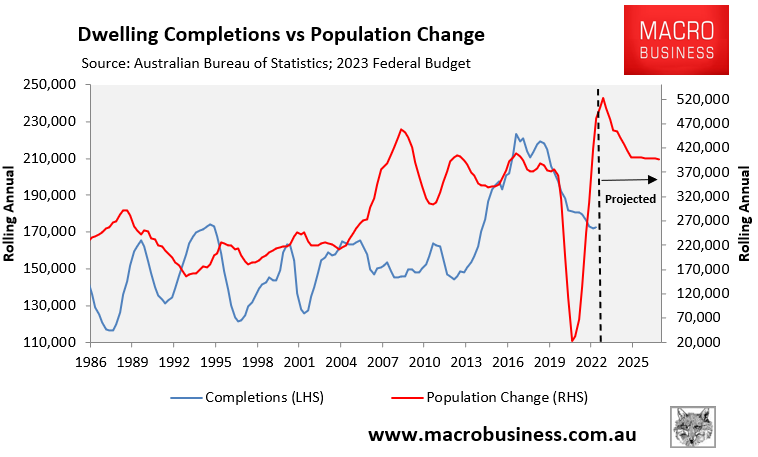
Australia needs to supply an extra 329 homes per day (net of demolitions) to house the federal budget’s projected 1.5 million net overseas migrant arrivals over the five years to 2026-27.
Meeting such a supply target was an impossible task under ideal housing conditions, let alone the dire conditions facing builders currently.
Australia’s housing shortages will, therefore, continue to worsen under the Albanese Government’s reckless extreme immigration program.
In turn, rental costs will continue to rise at an alarming rate and many thousands of Australians will be forced into group housing and/or homelessness.
The only workable solution to the housing crisis afflicting Australia is to reduce net overseas migration to a level that allows the nation to catch up on accumulated housing and infrastructure deficits.
The historical level of roughly 100,000 net overseas migration per year would be a sensible target.
