
Via the ANZ.
The series formerly known as ANZ Australian Job Ads has been updated and renamed ANZ-Indeed Australian Job Ads. Indeed is a leading website for job advertisement listings, and its data have been incorporated in the ANZ-Indeed Australian Job Ads series from 2018 onwards. The series has also been converted to an index (2019 average = 100) and the data going back to 1975 will be published at https://media.anz.com/. Please see page 4 for recent changes. ANZ-Indeed Australian Job Ads declined by 2.4% m/m in March. In trend terms, the decline over the past six months has accelerated, reaching -1.6% m/m in March. But the Job Ads index is still 53.4% higher than pre-pandemic, signalling excess labour demand persists.
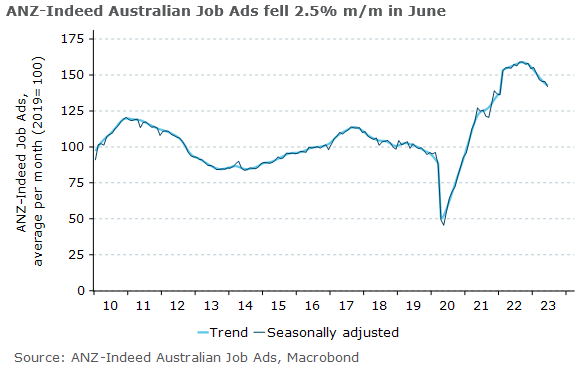
ANZ Senior Economist, Catherine Birch: ANZ-Indeed Australian Job Ads has fallen 7.2% from its September 2022 peak but is still more than 50% above its prepandemic level, indicating the volume of unfilled labour demand remains significant. This is consistent with NAB and ACCI data showing the share of firms reporting labour as a major constraint is still at or close to record highs. And ABS data show the ratio of job vacancies to unemployed was still 0.86 in February, almost triple the pre-pandemic level of 0.3. As such, we expect the labour market will remain very tight through 2023, with unemployment staying below 4%.
The full text of this article is available to MacroBusiness subscribers
