
RBA Governor Phil Lowe told the Senate Estimates Committee in May that he wants to see Australians band together to tackle the rental shortage.
“We need more people on average to live in each dwelling”, he said.
“As rents go up, people decide not to move out of home, or you don’t have that home office, you get a flatmate”.
“Higher prices, they do lead people to economise on housing, don’t they?”
“Kids don’t move out of home because the rent is too expensive, or you decide to get a flatmate or a housemate because that’s the price mechanism at work”.
Phil Lowe appears to have gotten his wish, with Australians moving into group housing at a record pace.
Flatmates.com.au, the nation’s largest share house website, saw a 70% year-on-year increase in sign-ups in May, shattering the record for the most new members with 70,000.
“There has been a significant increase in demand for share accommodation across Australia over the past six months”, said Flatmates.com.au community manager Claudia Conley.
“Traffic started to increase in October last year and has not died down, even after our usual ‘peak season’ ended in February”.
The latest rental market data from PropTrack and SQM Research shows that rental vacancy rates are finally easing.
SQM research recorded a 0.1% increase in the nation’s rental vacancy rate in June, driven by rising vacancies in Sydney and Melbourne:
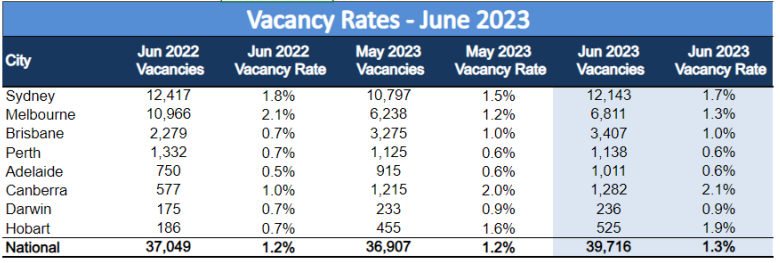
Growth in capital city asking rents also eased to 0.6%, with the 12-month rise standing at 19.4%.
Commenting on the results, SQM Research managing director Louis Christopher said “there is now more evidence that we are past the worst of our national rental crisis with an easing in vacancy rates recorded for our largest capital cities and a material slowdown on market rent increases”.
“Now, at 1.3%, the rental crisis is not yet over and given our ongoing strong population growth rates it is very unlikely we will get to an oversupply of rental properties anytime soon”.
“However, just an easing in the crisis can at least translate to a steadying of market rents after what has been an extended period of very rapid market rent growth”.
PropTrack likewise reported a slight easing in the vacancy rate in June, up 0.02 percentage points over the month and by 0.14% over the quarter to 1.45%:
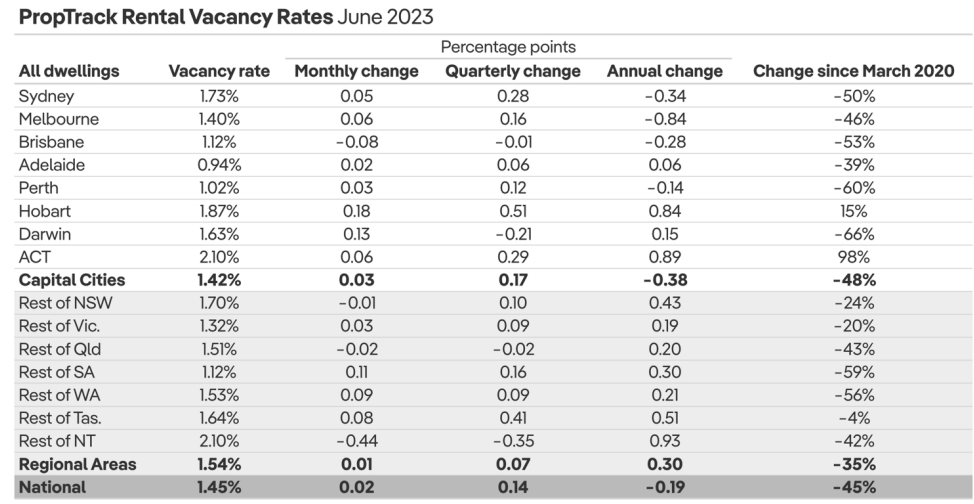
“The rental market eased further in June, providing some much-needed relief for renters”, PropTrack notes.
“Capital cities are seeing more promising rental market conditions, with vacancy rates up 0.17 ppt over the past three months. This is the most significant easing in rental market conditions since early in the pandemic in November 2020″.
“Slowing rental demand has resulted in more rental properties being available for lease. But despite the improvements, rental vacancy rates remain low – around half the levels seen before the pandemic – and demand is easing, but still strong”.
“It remains difficult to find a rental across the country and we expect rents to continue to grow quickly, placing additional financial pressure on renters”, PropTrack warns.
Any rental reprieve will be only temporary. Over the five years to 2026-27, Australia’s population is officially projected to rise by 2.18 million people, which is equivalent to adding five Canberra’s or one Perth.
Worse, this population surge will come at a time when actual housing construction levels are falling due to widespread builder insolvency and rising financing (interest rate) costs.
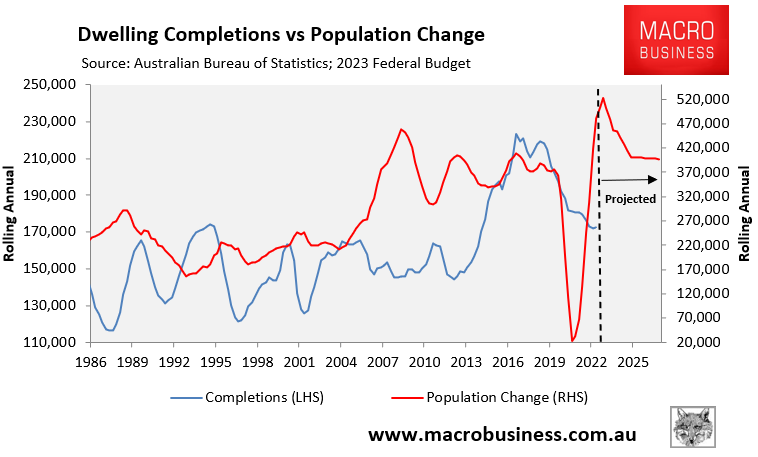
Treasury Secretary Steven Kennedy recently stated at a Senate Estimates hearing that the construction downturn will last until 2025, with new housing investment expected to fall by 2.5% this year, 3.5% in 2023-24, and 1.5% in 2024-25.
Oxford Economics Australia also predicted that total building work will reduce by 21% over the next three years, through the financial year 2025.
Growing Australia’s population by 400,000 to 500,000 people per year while building fewer homes means the country’s housing shortage will worsen, resulting in higher rents and increased homelessness.
