
According to CBA analysis, a little more than 60% of the Reserve Bank of Australia’s (RBA) interest rate increases have been felt by households so far.
Appearing Thursday’s parliamentary committee, CBA chief executive Matt Comyn said he expected Australian households to feel increasing financial pain over the next six months.
This is because the full impact of the RBA’s interest rate hikes have yet to be fully transmitted through the economy, and energy costs and rents will rise further this year, adding to household expenses.
“You’ll continue to see more pressure on households over the course of … the next six months, even if there isn’t further increases in the cash rate, just simply as more customers are coming off fixed rates, rents are continuing to increase, energy prices will continue to go up”, Comyn said.
Australians aged 30 to 34 are facing the greatest financial pain, whereas older households aged between 60 and 74 will feel the least strain.
“We see renters under more pressure, actually, than those with a mortgage, and of course those that own their own home outright the least”, Comyn said.
Recent young first home buyers are also struggling, according to CBA:
“Among younger people who bought their first home during the pandemic, the majority have now reduced their spending, and a third have reduced it by more than 30% year-on-year”, Comyn said.
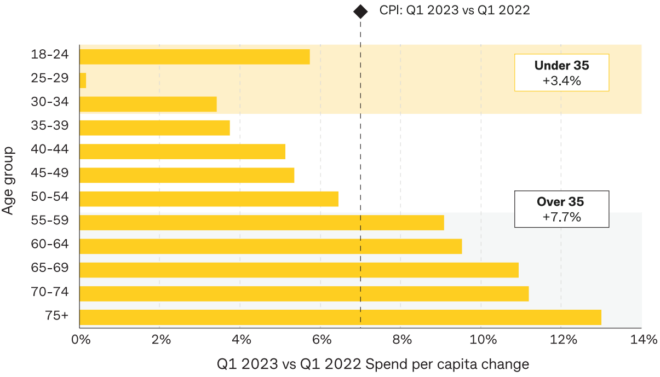
Recent CBA analysis of seven million customers’ purchasing habits showed that spending per capita for all age groups under the age of 55 fell relative to the rate of inflation in the year to March 2023:
Source: CBA
Australians aged under 35 increased their spending by only 3.4% in the year to March 2023, which was less than half the rate of inflation (7.0%).
Therefore, the average younger Australian is purchasing less goods and services in real terms.
The age group under most financial pressure was 25 to 29-year-olds, whose spending remained flat in value terms over the previous year despite a 7.0% rise in prices.
In contrast, spending among Australians aged over 55 increased at a faster rate than inflation in the year to March, with CBA customers over the age of 75 increasing their spending by 13%.
CBA’s data also revealed that the lift in spending at cafés and restaurants reported by the Australian Bureau of Statistics had been driven by older Australians, who spent 18% more on dining out than the previous year, compared to a 7.1% increase among under-35s.
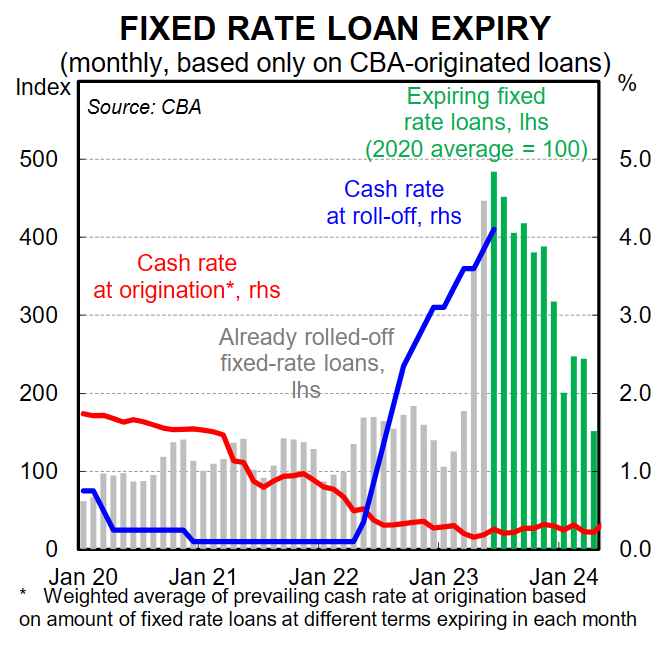
The next chart from CBA shows that a huge volume of fixed rate mortgages will expire over the remainder of this year, which will see these borrowers reset from mortgage rates of around 2% to variable rates approaching 7%:
Source: CBA
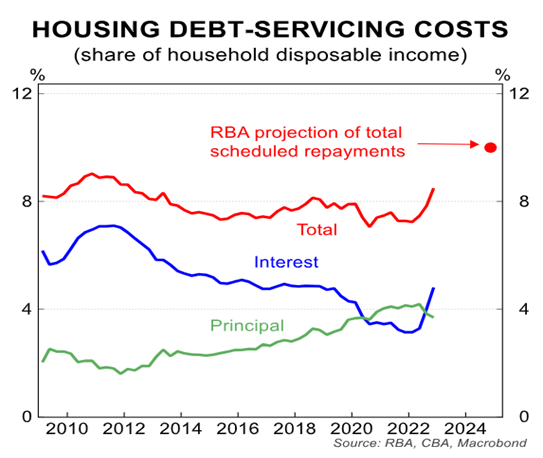
In turn, household debt servicing costs will continue to rise even if the RBA holds the cash rate at its current level of 4.10%:
Source: CBA
Add the circa 25% increase in energy costs that came into effect along the east coast from 1 July, alongside the ongoing strong rise in rents, and you have the ingredients for rising financial pain among the two thirds of households with a mortgage or renting.
