
The Australian Financial Review’s quarterly survey of economists shows that several respondents do not expect mortgage holders to feel the full impact of official interest rate rises until late 2023 and early 2024.
Commonwealth Bank chief economist Stephen Halmarick predicted that the final three months of 2023 and the first quarter of 2024 would be the most impacted by the fastest monetary tightening in a generation.
“There is a large volume of fixed rate mortgages expiring in the second half of 2023 and there is a similar three-month lag between when a fixed rate mortgage expires and the new variable rate mortgage interest rate is paid”, Mr Halmarick said.
Similar sentiments were expressed by KPMG chief economist Brendan Rynne.
“A greater proportion of households who have been relatively shielded from cash rate increases to date will have rolled off their fixed rate contracts by the end of the first quarter of 2024″.
“The September quarter is when this starts to gather pace, but it peaks during the first half of 2024”, he said.
MLC Asset Management senior economist Bob Cunneen agrees, predicting that households will suffer from the “the crushing impact of high interest rates and surging rents and electricity prices”.
Barrenjoey economist Jo Masters said that households were being squeezed hard, but the pain was uneven.
“Highly leveraged households are being confronted by high interest costs, while those with no debt and high savings – typically older Australians – are benefiting from higher interest income and rental income”, she said.
Finally, Judo Bank economic adviser Warren Hogan warned that rising unemployment would pressure the household sector, and could lead to “precautionary saving”.
“The extent of the job losses will determine how much of a fright the broader household sector gets”, Hogan said.
“If people are worried enough by the extent of the slowdown in economic activity and the loss of jobs that comes with it, then we should expect to see a risk in precautionary saving”.
Even if the RBA pauses rates from here, average mortgage rates and debt repayments will continue to rise owing to the fixed rate mortgage reset:
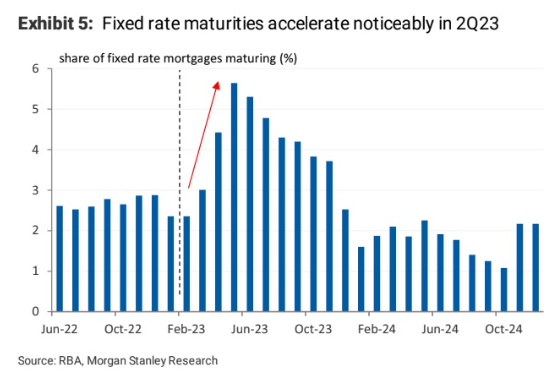
There are still around 500,000 fixed rate mortgages due to expire in the second half of 2023, most of which will reset from rates of around 2% to variable rates approaching 7%.
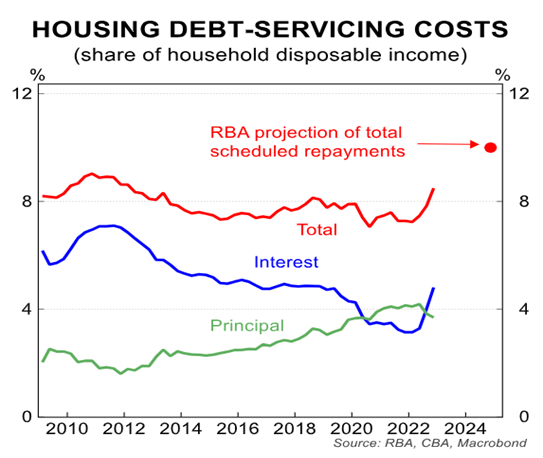
For this reason alone, RBA modelling predicted that scheduled mortgage repayments would hit record high levels in 2024:
For these reasons alone, the RBA would be wise to keep rates on hold.
Significant monetary tightening is already ‘built in’ and the economy is already weakening.
Further RBA rate hikes risks an economic hard landing.
