
Last week, Australia’s mainstream media pumped dozens of articles blaming Australia’s housing crisis on a lack of supply and NIMBYism, to the delight of the property development industry.
The common inference is that Australia has become worse at building homes, and if we simply increased supply, then Australia’s chronic housing shortage would be fixed.
This argument ignores the fact that Australia has one of the highest rate of home construction in the developed world:
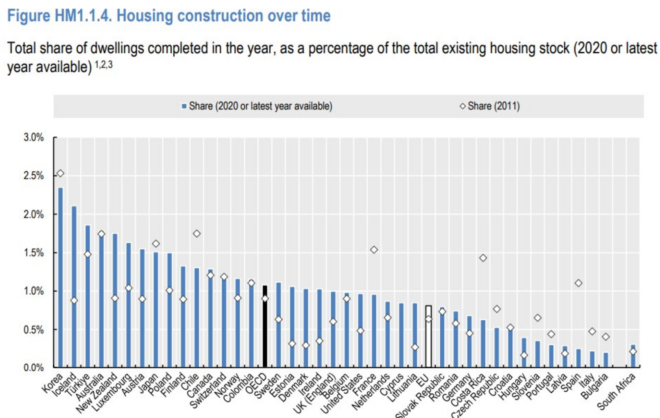
Source: OECD Affordable Housing Database
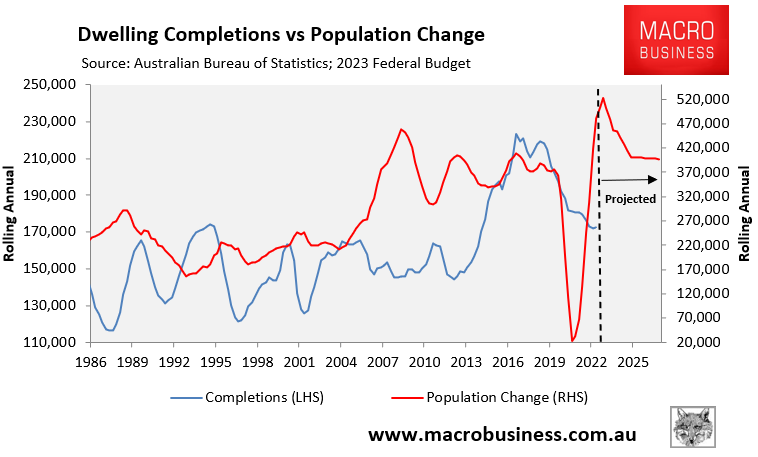
Australia also ramped-up housing construction to record levels last decade, only to be completely swamped by the massive surge in net overseas migration from 2005, which is projected to surge higher over the next five years:
A similar situation is playing out in Canada, where an obscene one million net overseas migrants landed last year.
Like Australia, the solution put forward has been to increase supply, rather than taming demand by moderating immigration to sensible and sustainable levels.
A recent study from BMO explained how the supply-side solution is unrealistic and will fail to solve Canada’s housing shortage:
“The knee-jerk response by seemingly one and all to Canada’s affordability constraints is “more supply”. There is no debate that increased supply needs to play an important part in improving affordability”.
“But there are at least three reasons why we simply cannot rely on supply alone to do the job”.
“First, and most obviously, housing supply can only respond gradually, and is essentially fixed in the short run, whereas demand can change in a moment”.
“Second, even over a more extended period of time, there are clearly limits to how quickly supply can respond, given Canada’s existing skilled trade workforce, availability of serviced land, and materials”.
“Third, and perhaps more subtly, any success in improving affordability (i.e., lower prices) will sow the seeds for less building in the future”.
“There are some who look at starts relative to population levels, and suggest that they are inadequate. But a more appropriate metric is the growth in the adult population (which is a flow, as are starts)”.
“Based on that comparison, the level of new building in the past decade is far from unusually low—on the contrary—at least up until the most recent sprint in population (Chart 5)”:
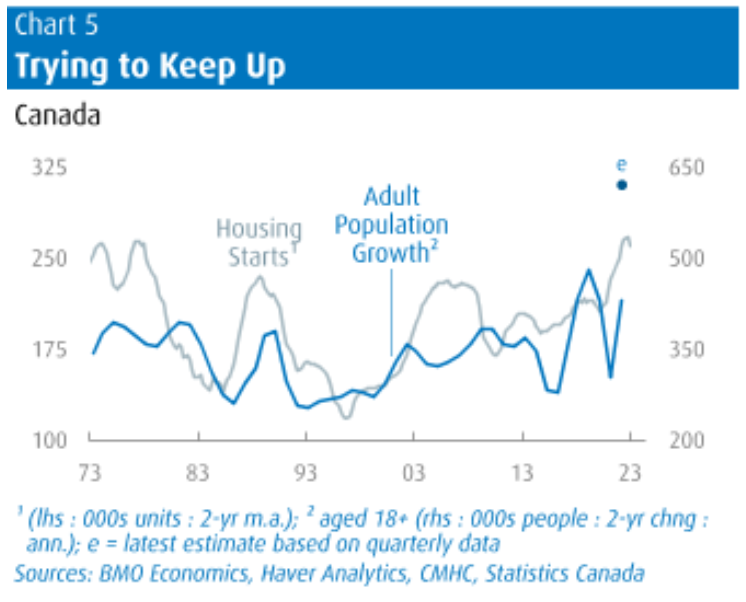
Population Flows: A Demand Juggernaut
“Canada’s strong population growth is no doubt a steady source of support for home price appreciation”.
“Evidence from 18 large advanced economies since the start of the century shows that real home prices are closely correlated with population growth over time (Chart 6)”.
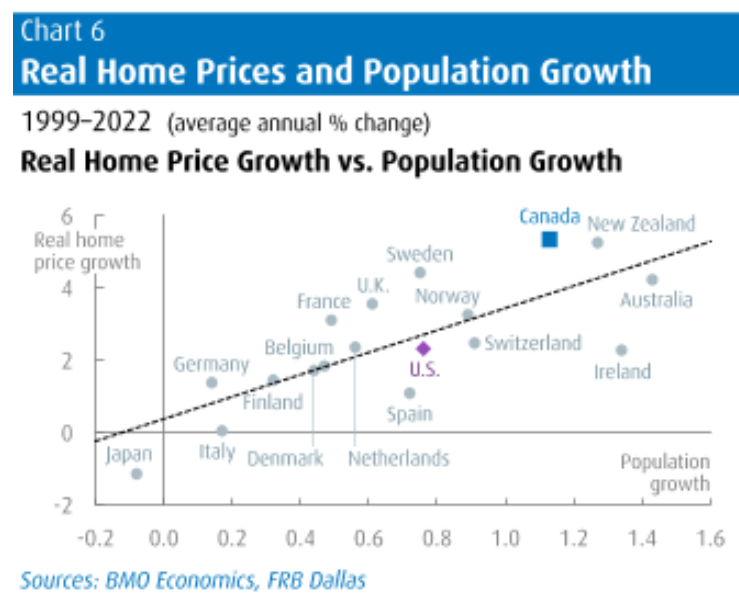
“For example, New Zealand, Australia, and Canada have seen both the fastest growing populations (aside from Ireland) over that period, and the fastest rise in real home prices, while Japan and Italy have been at the other end of the spectrum on both counts”.
“Regression analysis suggests that every 1% rise in population will be associated over time with real home price growth of just over 3% per year”.
“In recent years, Canada’s population has been growing at an average annual pace of 1.5% per year (and a whopping 2.7% in 2022 alone), which is consistent over time with 5% annual home price gains on top of inflation”.
“Canada’s home price inflation has been much stronger than in most other major economies over a long period of time (Chart 7)”.
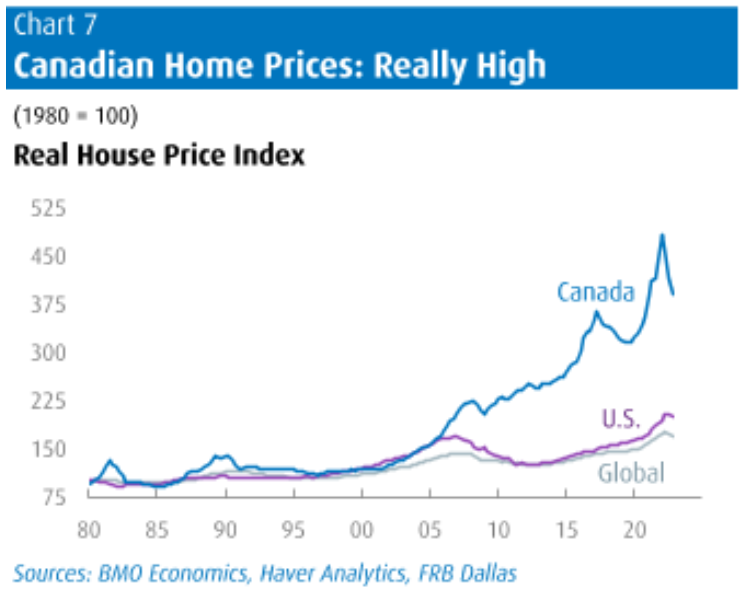
“The divergence with the U.S. market over the past 15 years is quite stark and cannot be explained away by the small differences in interest rate policies or economic growth”.
“Canada’s 2.7% population growth in 2022 was the strongest since at least the 1970s, with more than 1 million people added to the country (Chart 8)”.
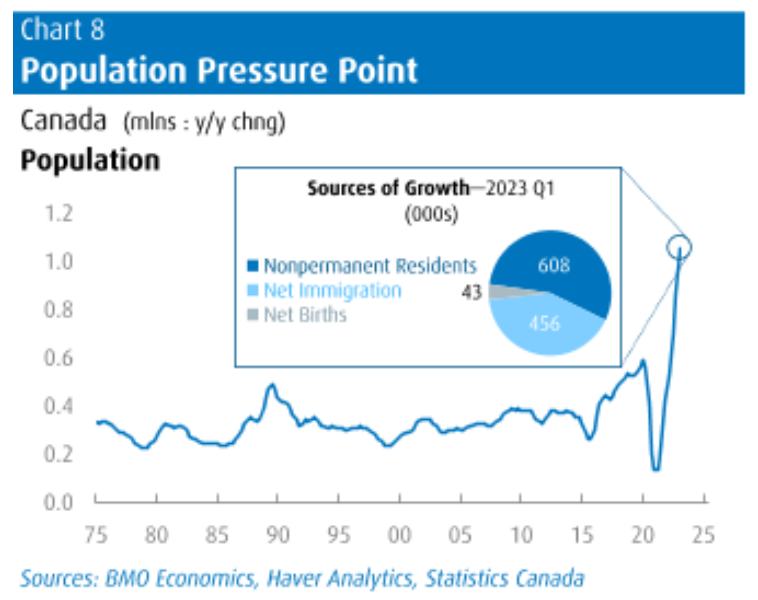
“So, with the construction industry already building at full speed to satisfy domestic demand, we clearly don’t have the infrastructure or ability to meet the additional demand created by historic immigration levels”.
“The result is not only still-high resale prices, but surging rents across many markets, including smaller cities with universities”.
“Canada’s affordability crisis may be an unintended consequence of record international inflows layering on top of peak domestic demographic demand, both of which are combining to pressure a construction industry already near full capacity”.
“The infrastructure in place and the industry’s ability to build clearly can’t support unchecked levels of demand, so the affordability conundrum continues”…
BMO’s analysis applies equally to Australia, which is projected to receive a record 1.5 million net overseas migrants in the five years to 2026-27 – more than an Adelaide’s worth of people.
In turn, Australia’s population is projected to grow by a record 2.18 million people over the same five year period, which is the equivalent to adding five Canberra’s or one Perth to Australia’s current population.
It’s time to stop scapegoating a ‘lack of supply’ and acknowledge that Australia’s housing problem is really an excessive immigration problem.
