
Stubborn housing market increases pressure on RBA
Auction results over the King’s Birthday long weekend suggested the Reserve Bank’s latest interest rate hikes might finally be dampening home buyer demand.
CoreLogic’s recorded its worst final auction results for six weeks in the week ended 11 June, with the combined capital city clearance rate falling to 68.2%.
This weekend’s auction clearance rate rebounded, however, despite the number of homes taken to auction almost doubling to 1951 – the most in 11 weeks, according to CoreLogic:
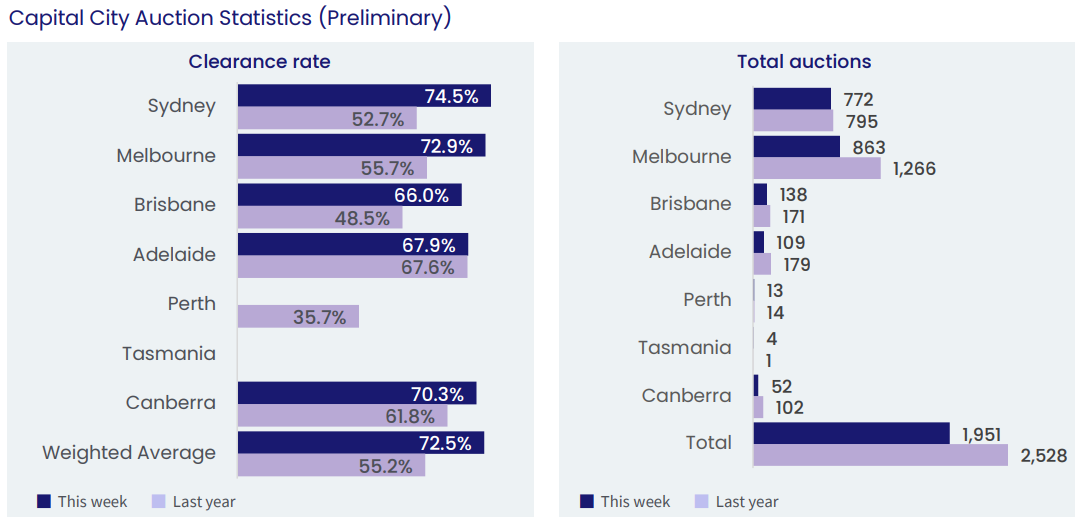
The national preliminary auction clearance rate rose by 0.1% to 72.5%, with both Sydney (74.5%) and Melbourne (72.9%) recording solid results.
However, Melbourne’s preliminary clearance rate was the lowest in eight weeks, whereas Sydney’s was the lowest in seven weeks.
Ray White, the nation’s largest real estate brokerage, recorded a 50% increase in the average number of bidders at its auctions, up to four and a half from three, and a higher 72% clearance rate across 347 auctions.
“Looking ahead we anticipate more stock reaching the market”, Ray White NSW chief auctioneer Alex Pattaro said to The AFR.
“The buyer pool is very strong and deep. It is the strongest it has been in over 12 months, which should encourage sellers to come to the market”.
“Competition remained fierce across a number of auctions”, Ray White Victoria chief auctioneer Jeremy Tyrell also said.
Selling agent James Bennett of Belle Property Lane Cove likewise said that “with the lack of stock we are still seeing great buyer activity at our open homes. Buyers are still bidding well under auction conditions”.
The stubbornly strong auction market is also being reflected in dwelling prices, with CoreLogic’s daily dwelling values index continuing to rise in the face of higher mortgage rates.
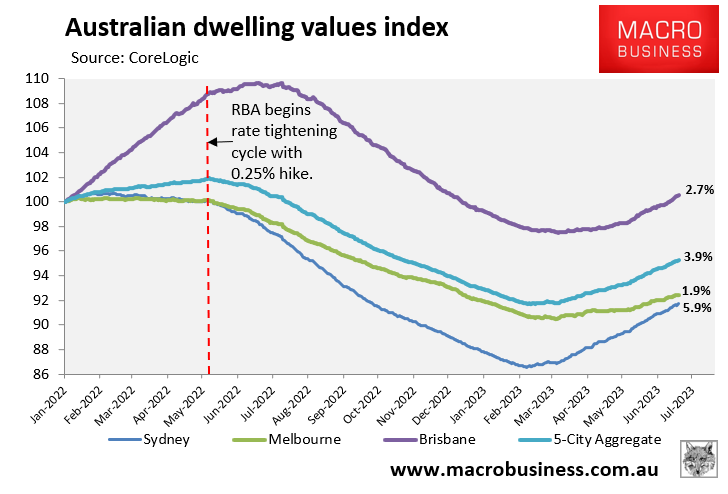
As shown above, dwelling values across the five major capital city markets have risen 3.9% since their trough on 7 February, led by a 5.9% rise across Sydney.
One of the primary causes of the rising house prices despite higher interest rates is record immigration-driven population growth.
This extraordinary population increase has resulted in a severe shortage of properties to rent and buy, driving up rents and instilling a sense of FOMO (Fear of Missing Out) in the market.
Rent is also the single largest component to the consumer price index.
As a result, rising rents are directly contributing to Australia’s inflation problem.
Rising property values are also generally associated by higher consumer spending, which could keep inflation higher for longer.
Despite the economy experiencing a per capita recession, there is the clear risk that the RBA will lift rates higher to counterbalance the inflationary pressures produced by the Albanese Government’s record immigration.
