
By Gareth Aird, head of Australian economics at CBA:
Key Points:
- We expect the RBA to leave the cash rate on hold at 3.85% at the June Board meeting. But we consider the meeting now ‘live’.
- We ascribe a 70% chance to no change and a 30% probability to a 25bp rate increase to 4.10% (we consider the risk of any other move immaterial).
- The economic data released since the May Board meeting does not support another rate hike in June.
- Indeed key economic data that the RBA forecast has come in softer than their most recent updated forecasts.
- The 2023 Fair Work Commission decision to increase both the minimum and award wages by 5.75% is broadly in line with what we think the RBA had pencilled in to their wages growth forecasts.
- We believe the domestic economy is now showing sufficient signs of slowing and we expect the RBA Board will judge that leaving the cash rate on hold is the appropriate policy move in June.
- The Board can resume increasing the cash rate in July or August following a pause in June if the economic data makes the case (note that our base case is for 3.85% to be the peak in the cash rate, but the near term risk sits with another hike).
- RBA Governor will deliver a speech on Wednesday 7 at the Morgan Stanley Australia Summit, Sydney (9.20am AEST).
- The ABS will publish the Q1 23 national accounts also on Wednesday 7 at 11.30am.
Overview
This week is another big one for Australian financial market participants.
The RBA Board meet on Tuesday 6 June. And Governor Philip Lowe will deliver a speech on Wednesday 7 June at the Morgan Stanley Australia Summit, Sydney (9.20am).
The key domestic economic events for markets for the week ahead don’t stop there. The official statistician will publish the all-important Q1 23 national accounts on Wednesday 7 June (11.30am). The data is relevant for the outlook for monetary policy.
The national accounts contain information on real economic activity (i.e. production), income, savings, inflation, productivity and unit labour costs.
All of this information will feed into RBA Board deliberations over the period ahead given the nexus between economic output, unit labour costs, productivity and inflation.
But the RBA Board will not have the Q1 23 national accounts on hand when they meet on Tuesday.
Rather they will discuss the economic data that has been published over the last month. And they will consider how the 2023 Annual Wage Review, which was handed down by the Fair Work Commission (FWC) today, fits into their outlook for wages growth and the labour market.
The June Board meeting is now ‘live’
Last week we published a note on the RBA’s June Board meeting. In the note we stated that at this juncture we did not consider the June Board meeting ‘live’.
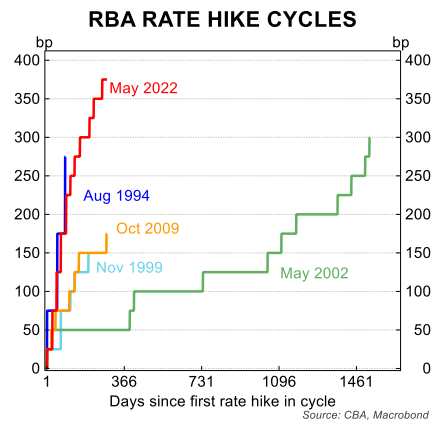
But we added the caveat that, “the April monthly CPI indicator, due for release on 31 May, would need to print much higher than expectations for us to characterise the June Board meeting as ‘live’”.
In addition when we went to press last week it was not announced that the FWC would hand down their decision before the June Board meeting (recall the 2022 Annual Wage Review was handed down in mid-June 2022).
The April monthly CPI indicator printed stronger than anticipated. The annual rate of inflation stepped up 6.3% to 6.8%.
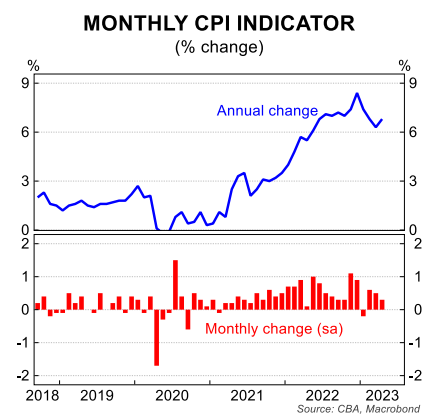
The optics of the annual rate of inflation increasing at a time when the RBA Board want inflation to drop do not look good. But the increase in the annual rate masked a softening trend in the data.
On that score, it paid to look at the monthly change in the seasonally adjusted inflation data rather than the annual rate.
The monthly seasonally adjusted change in April was 0.3%. The monthly seasonally adjusted change over the last 6 months from November 2022 was 1.1%, 0.9%, -0.17%, 0.6%, 0.5% and 0.3% (latest in April).
As the below chart shows, the monthly seasonally adjusted change is slowing (disinflationary). It is simply that the annual rate has been impacted by base effects. The final prices gauge in the April NAB business survey supports this view.
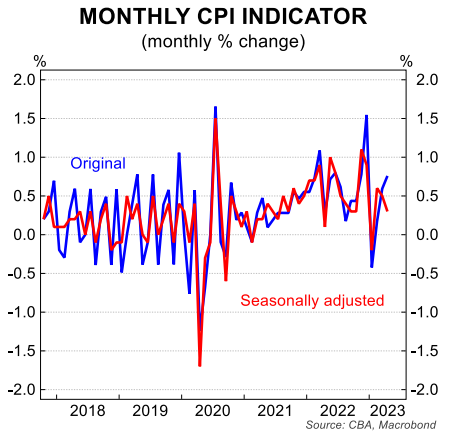
The bottom line is that inflation continues to decelerate. But the annual rate in April simply masked the trend.
The upside surprise on the monthly print saw markets price in a slightly higher chance that the RBA increases the cash rate in June. And we are mindful that the RBA Board may place some weight on the change in the annual rate due to its influence on inflation psychology and inflation expectations.
But overall we thought the data was encouraging rather than cause for concern.
Fair Work Commission decision
On Friday, the FWC handed down the 2023 Annual Wage Review. The FWC decided that award rates of pay will be increased by 5.75%, effective from 1 July 2023. The national minimum wage has also been increased by 5.75%.
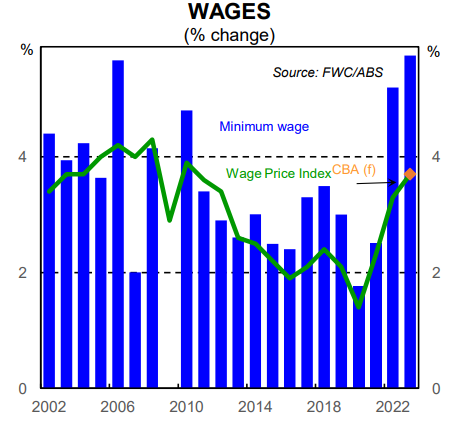
According to the FWC, ~0.7% of Australian employees are paid the National Minimum Wage. And ~20.5% of Australian employees are paid in accordance with minimum wage rates in modern awards.
But the total wages cost of the modern award-reliant workforce constitutes only ~11% of the national ‘wage bill’.
It is also worth keeping in mind that pre-tax wages increases result in a post-tax pay rise being less than the wage increase for most workers due to the marginal tax system.
The FWC stated that, “as the total wages of modern award-reliant workers constitute a limited proportion of the national wage bill, we are confident that the increase we have determined will make only a modest contribution to total wages growth in 2023-24 and will consequently not cause or contribute to any wage-price spiral”.
We agree with this assessment.
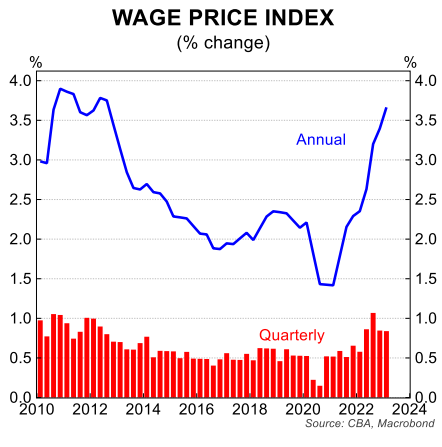
On our calculations the decision by the FWC today will add 0.2ppts to the wage price index (WPI) in 2023/24 compared to 2022/23. We believe the 2023 Annual Wage Review outcome is therefore in line with the RBA’s most recent wages forecasts.
What about the other economic data?
Other data since the May RBA Board meeting has largely been weaker than anticipated.
As covered last week, the Q1 23 Wage Price index was a downside miss on the RBA’s implied profile. And the unemployment rate increased from 3.5% in March to 3.7% in April.
Other key data to print over the past week was mixed.
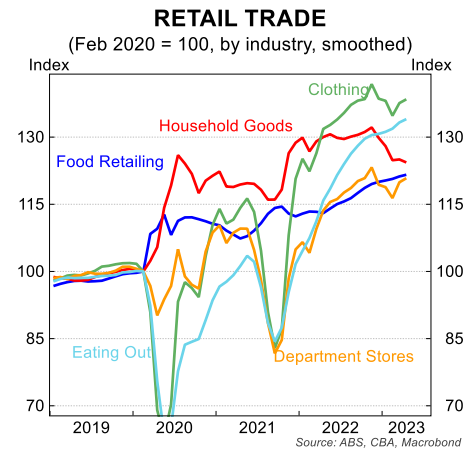
April retail sales were flat compared to expectations of a 0.3% increase. A flat nominal outcome indicates the volume of retail trade continues to contract.
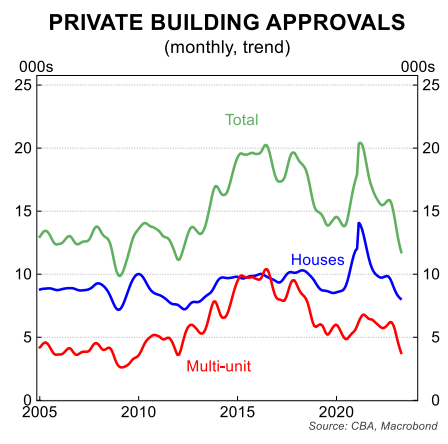
And building approvals in April collapsed. The level of building approvals in April fell to the lowest level since April 2012.
Working the other way was a decent capex survey. Investment intentions were firmer than we anticipated.
But not all strong data is bad data just because the objective is to drop inflation. Indeed firmer capex plans should be welcomed.
Business investment lifts capital deepening (where the capital per worker is increasing in the economy). This improves productivity (output per hour worked).
There has been a lot of focus lately on weak productivity in the economy. So firming capex intentions are good. The RBA wants to see productivity rise. And higher investment is an ingredient required to lift productivity.
In the long run business investment is disinflationary as the productive side of the economy is expanding. It also makes sense to have a decent investment outlook given annual population growth is 2%.
Finally home prices rose solidly in May. Stronger than anticipated population growth has caused vacancy rates to drop and rents to surge around the country.
This dynamic lies at the heart of the turning point in Australian property prices.
Despite the lift in prices, new supply to the market remains low. We believe lower turnover will largely offset any positive wealth effect from the recent lift in home prices.
So we don’t think the RBA would look to raise the cash rate further simply because home prices have lifted.
Indeed the RBA have specifically said they do not target home prices.
It is also worth noting that the lift in home prices is not due to an increase in the demand for credit.
New lending for homes, excluding refinancing, fell by 2.9% in April compared to the consensus forecast for a lift of 2.0% (CBA the only house forecasting a contraction in lending over April – we were looking for -1.0%).
Current forward guidance from the RBA May Board Minutes is that, “members also agreed that further increases in interest rates may still be required, but that this would depend on how the economy and inflation evolve”.
As we noted at the time, our take on this forward guidance is that the Board is willing to raise the cash rate again in this cycle. But another rate increase would require the economic data, particularly around inflation, GDP, the unemployment rate and wages/unit labour costs, to come in stronger than the RBA’s updated forecasts.
Put another way, we do not think the RBA will lift the cash rate again if the economic data prints in line or weaker than their forecasts from the May Statement on Monetary Policy (SMP).
Since the May Board meeting the main economic data that will feed into policy deliberations at the June Board meeting has come in slightly weaker than the RBA’s latest forecasts.
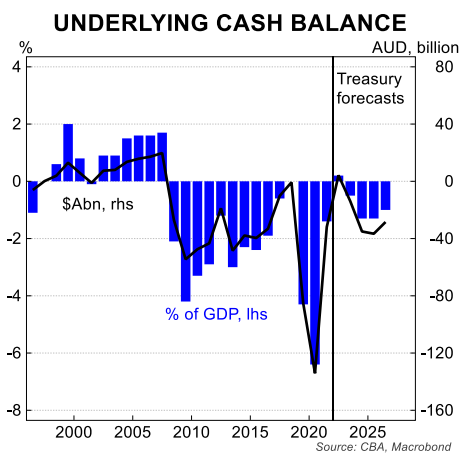
The 2023 May Commonwealth Budget has also been handed down since the May Board meeting. The RBA Governor agreed with our assessment that it does not add to inflationary pressures in the economy.
Overall we expect the RBA to leave the cash rate on hold at the June Board meeting. But we expect the RBA to retain their forward guidance that, “further increases in interest rates may still be required, but that this would depend on how the economy and inflation evolve”.
