
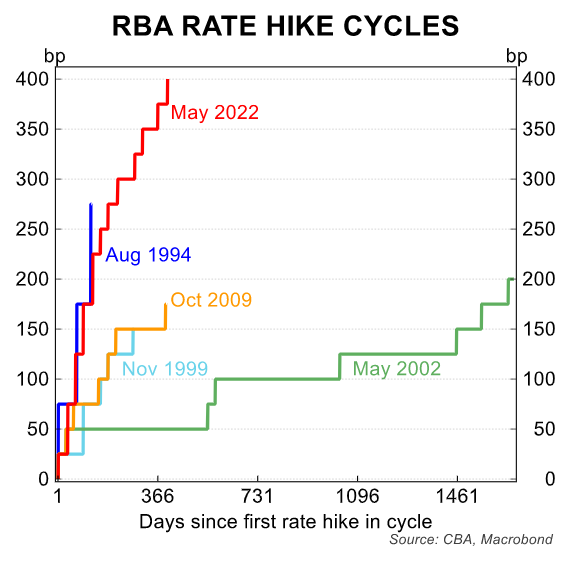
The Reserve Bank of Australia (RBA) this week increased the official cash rate (OCR) by 25 basis points to 4.10%, making it feel like Groundhog Day for Australian mortgage holders.
In turn, the OCR rose to its highest level since April 2012, representing the nation’s sharpest hike in history:
In his statement accompanying the announcement, Lowe warned that recent data suggested “that the upside risks to the inflation outlook have increased and the Board has responded to this”.
In particular, “while goods inflation is slowing, services price inflation is still very high and is proving to be very persistent overseas”.
Lowe also said that “some further tightening of monetary policy may be required” if inflation doesn’t come down in a timely manner.
A blowtorch to mortgage holders:
Once the rate hike is fully passed on by lenders, Australian variable mortgage holders will pay around 50% more in monthly repayments than they did in April 2022, just before the RBA’s first hike.
There are also around 500,000 fixed-rate mortgages that will expire over the rest this year who will reset from ultra-low rates of around 2% to rates of around 6%:
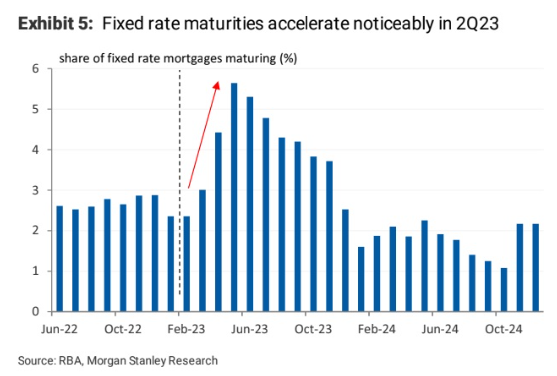
As a result, even if the RBA does not raise interest rates further, average mortgage rates will continue to rise across Australia.
Betashares chief economist David Bassanese told The Australian in April that the fixed rate mortgage reset “will result in de facto policy tightening (at least on the mortgage sector) equivalent to around one third of the policy tightening already seen over the past year”.
That means at least 1% worth of rate increases will be passed on to mortgage holders once these fixed-rate mortgages expire.
The following CBA chart illustrates the impact of the fixed rate reset:
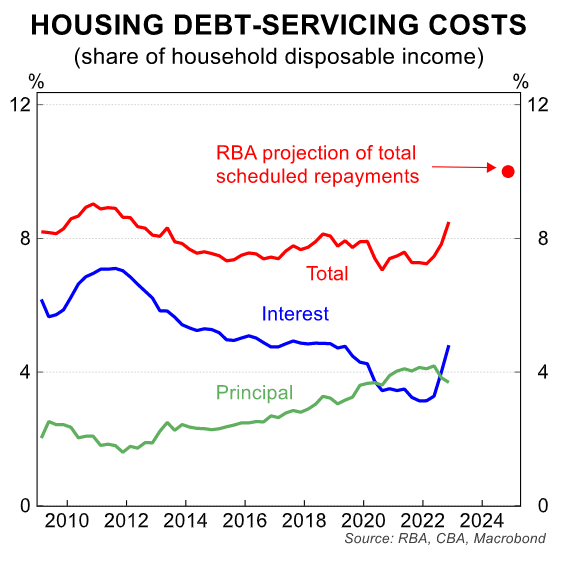
It shows that scheduled mortgage repayments will reach an all-time high proportion of household income by 2024.
Thus, Australian mortgage holders will be required to devote a record portion of their incomes to loan repayments.
How much worse can things get?
Forget the uproar over the Fair Work Commission’s decision to grant a 5.75% salary increase to 20% of the workforce, which amounts to a wage decrease in real terms.
The RBA’s primary inflationary risks come from two factors that are largely beyond its control: rents and energy.
Residential rentals are the single largest component of the Consumer Price Index (CPI), accounting for around 6% of the CPI basket.
Phil Lowe cautioned during last week’s Senate Estimates hearing that residential rental growth is expected to reach a three-decade high, fuelling inflation.
According to Lowe, the rental metric included in the CPI is now increasing by roughly 6%:
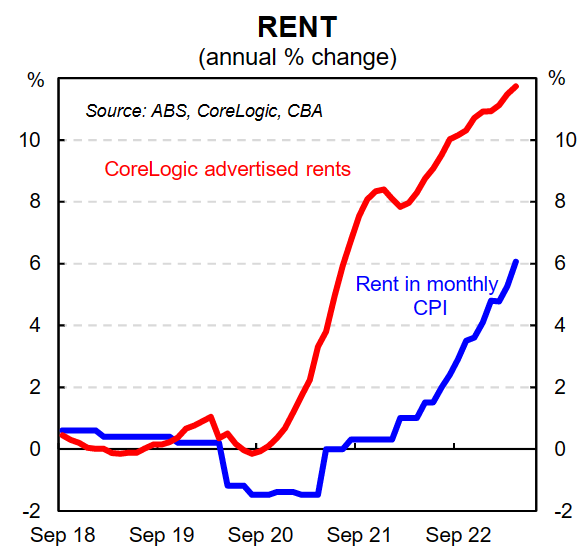
However, he noted that rents are accelerating swiftly because of record low vacancy rates and will reach 10%, the highest rate since June 1989.
Lowe also predicted that rent inflation will remain high for a long time because Australia’s population is rapidly rising and rental demand is considerably outstriping supply.
At the same time, the RBA’s aggressive interest rate increases have contributed to the collapse in new housing development, which will exacerbate rental shortages amid record immigration-fuelled population growth:
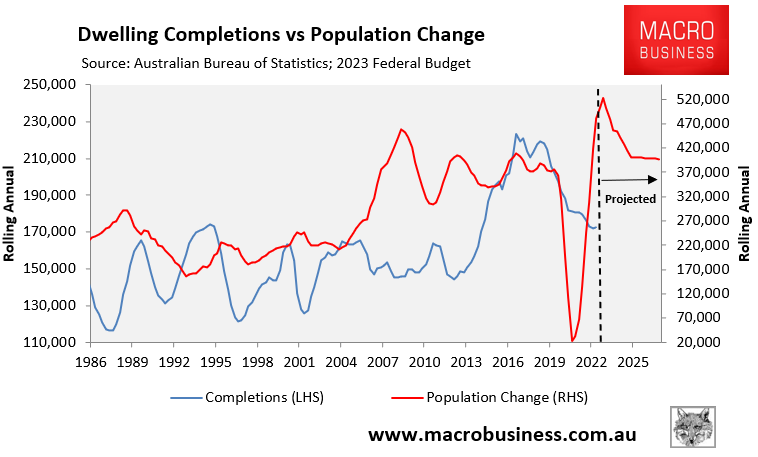
Therefore, residential rents will continue to soar, putting upward pressure on the CPI and forcing the RBA to keep rates higher for longer.
The other significant source of inflationary pressure is rising energy prices, which are fuelling inflation throughout the economy.
Despite the fact that Australia is the world’s largest LNG exporter – “the Saudi Arabia of gas” – east coast consumers are currently paying the highest gas prices in the world due to our government’s refusal to adopt a domestic gas reservation program.
Gas is the primary price driver for electricity, and on July 1, electricity prices down the east coast will jump by at least 25%, following a roughly identical increase last year.
Over a year, this energy inflation will directly add 1.8% to Australia’s CPI.
However, because energy costs affect everything else, the inflationary consequences will be far worse because the costs will be passed on to consumers.
Energy costs could, therefore, raise the CPI by as much as 3.5%.
The RBA attacks Albo’s mismanaged immigration:
During last week’s Senate Estimates hearing, Phil Lowe cautioned that the supply-side of the economy – business investment, infrastructure, housing, and energy – was failing to keep up with the record number of migrants landing in Australia.
The May federal budget projected that an unprecedented 1.5 million net overseas migrants will land in Australia during the five years to 2026-27, with 400,000 arriving this financial year and 315,000 arriving the next.
Lowe told the Senate Estimates Committee that “the amount of capital that on average we have to work with is one of the drivers of productivity growth”.
“We do need to increase the capital stock in line with the number of people in the country and that requires high levels of investment. And if we don’t do that, then we’re going to struggle”, Lowe explained.
“If we’re going to have 2% more people in the country [this year], we need 2% more capital, and that requires investment by business and investment by government”.
“Solving the housing problem, I think that’s the single biggest thing we could do. And then we’ve got to build the transportation infrastructure to support that”.
“Are there 2% more houses? No”, Lowe cautioned.
The above statement was a disguised jab at the federal government, which has decided to force-feed Australia with record immigration with no plan in place to accommodate the additional people.
As a result, capital per worker is shrinking and rents are rising, undermining productivity growth and fuelling inflation.
In turn, the RBA has been forced to raise interest rates, which is punishing one-third of Australians with mortgages without addressing the fundamental problems.
Ultimately, the answers to Australia’s inflation problems are with the federal government: restrict immigration and fix the east coast energy market.
Rather than beating around the bush with wishy washy statements, the RBA should call out the federal government directly and demand it do its job to lower inflation.
