
Goldman’s Andrew Boak is starting to look like a winner in this tightening cycle. He’s been too hawkish for a few cycles but has nailed this one.
He now sees MOAR rate hikes:
Bottom line: In a speech following yesterday’s RBA Board meeting, Governor Lowe highlighted a range of upside risks to the RBA’s inflation outlook, including April’s CPI data, recent wage outcomes, rebounding house prices and offshore data.
In the Q&A Governor Lowe noted the Board couldn’t be “idle” in the face of these risks and that their patience “has a limit.”
Governor Lowe also pushed back on concerns around the impact of higher rates on borrowers, noting that mortgage arrears remained low and that households could pull back on consumption to continue to service their debts.
While acknowledging the impact of rates was uneven across the community, he highlighted that “unevenness is not a reason to avoid using the tool that we have.”
Overall, we viewed the speech as signaling a hawkish shift in the RBA’s reaction function, which to date has been somewhat more dovish than global peers.
Combined with today’s National Accounts data showing a surprise acceleration in unit labour costs (+7.9%yoy), we now expect the RBA to hike +25bp in July/August/September (prev. +25bp July) to a terminal rate of 4.85% (prev. 4.35%).
We view the risks as skewed to a more elongated tightening cycle, for example a slower pace of hiking through 2H2023, with additional uncertainty stemming from upcoming institutional changes to the RBA.
The productivity focus is a furphy. The last four years is actually better than the previous four:
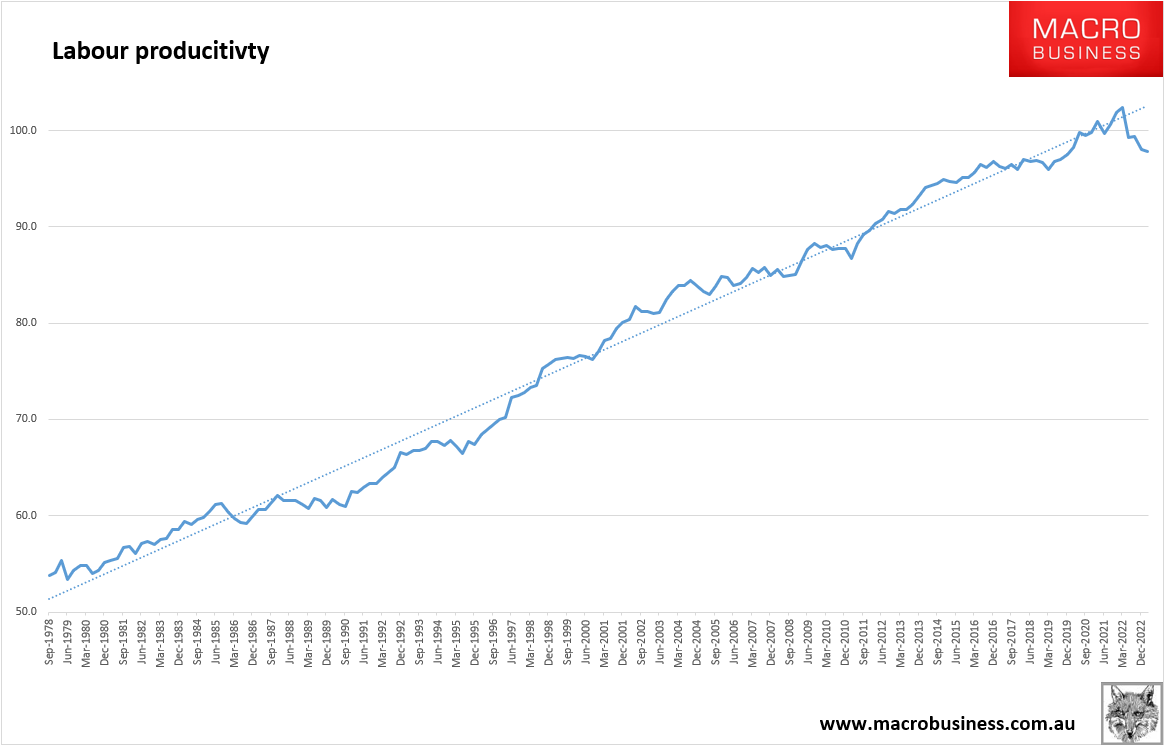
We managed 1.3% productivity growth through 2015-19. Then we did 1.8% over the next four years.
Any idiot can see that the COVID stimulus played a role in boosting then busting the performance. Labour Productivity is just GDP divided by hours worked.
What do you think is going to happen when you give everybody free money to spend? GDP up a lot! Then remove it. GDP down a lot!
Is there a productivity issue? Sure there is. But it’s not limited to, nor mostly, labour. It is capital productivity that is terrible over the long run:
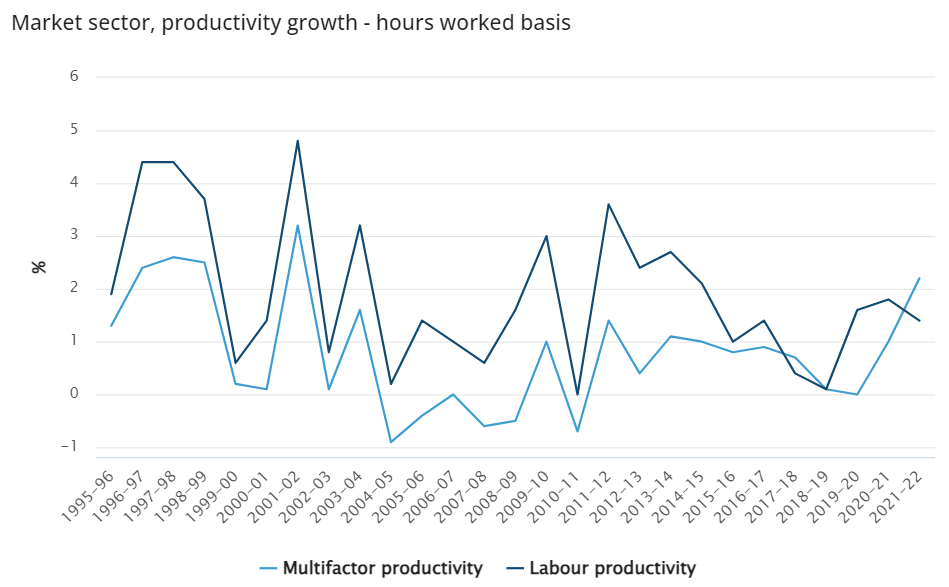
Of course it is when capital shallowing is the defining long-term trend in an economy.
Ever since we embarked on the great quantitative peopling experiment post-2003, competition has failed, foreign corporations have stolen our commodity endowment, we flooded the joint with dis-automating foreign slaves, crush loaded and degraded all public infrastructure, and did little else but build houses that produce nothing.
MFP includes capital and other inputs like land prices to give us a much truer guide to productivity performance but that appears too hard a notion for the RBA to get its head around. Just blame those lazy workers. Never mind the RBA’s 400 lazy economists!
Yet, real unit labour costs are down 6% since 2019. They are growing much less than broader inflation and the permanent mass immigration supply shock guarantees it will remain that way while destructively inflating every other input into MFP.
The problem for the RBA is the same as it ever was. It is the same as it is for the Fed. Without a real MFP productivity agenda to grow incomes, the only way to grow is to blow bubbles.
After 25 years of it, the moment the central banks take their foot off the brake, the bubbles resurface and inflation comes with them.
In the US it is tech stocks. In Australia it is houses.
Expect hikes to resume in both countries until both bubbles pop again enough to deflate inflation.
