
JPM with a wrap on why.
June’s pronounced MTD dollar weakness belies global cyclical developments that are murky rather than corrosive for the greenback. After a promising 2% rally in May, the trade-weighted dollar has given back more than half its gains MTD, most acutely in the latter half of this week following a hawkish ECB meeting that now sees us expecting two more rate hikes to take the terminal rate to 4%. If this dollar weakness is about an abruptly sunnier turn in the global growth outlook, it is not obvious in our usual suite of cyclical indicators (EASI) has continued to surprise to the downside and global growth forecasts have stabilized at best for now but still at risk of further downgrades given continued soft trends in European (PMI, Sentix confidence, retail sales) and especially Chinese dataflow (exports, TSF, FAI, new home sales and starts); the latter brought about another round of growth forecast downgrades that is not yet captured in Figure 2.
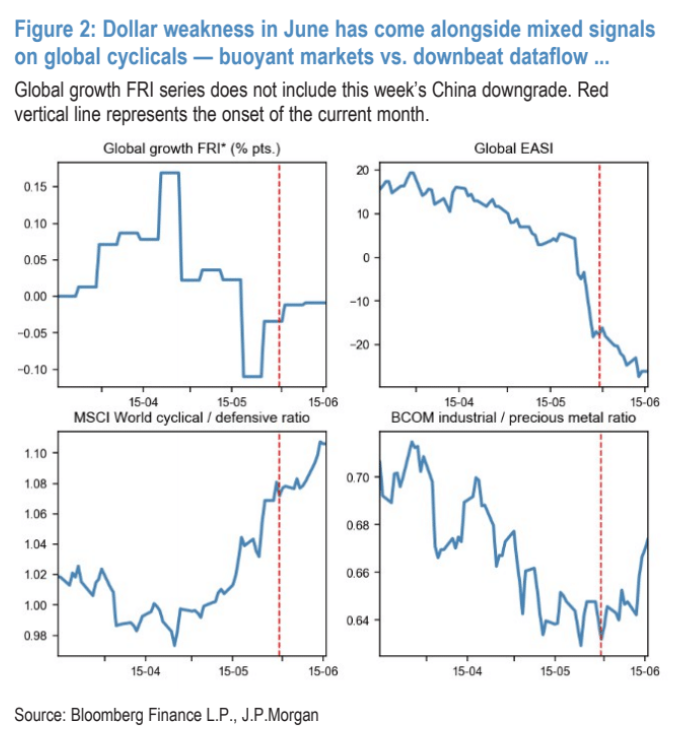
On a relative basis too, US activity data surprises on the month have continued to outpace those in the rest-of-the-world (RoW) amid a mixed slate of economic releases (strong payrolls, weaker ISM services, uptick in jobless claims), while the flatlining of rate and equity momentum differentials after central banks that are at or near the end of their year-long tightening cycles, coupled with receding US recession anxiety and more recent enthusiasm around Chinese stimulus. Some aspects of this story have a modicum of truth to them. For instance, data-based US recession odds have indeed cooled a little from last month’s highs (though still uncomfortably high ~65%), and JPM Economics has been flagging the increasing possibility that such models may be overstating the risks of an imminent recession. There is also likely to be some Chinese policy easing in the works judging from press reports around the issue, and more importantly, the first concrete action in the form of this week’s PBoC policy rate cut. Yet, there remain obstacles to giving this positive outlook a clean bill of health:
The full text of this article is available to MacroBusiness subscribers
