
By Gareth Aird, head of Australian economics at CBA:
Key Points:
- We have updated our RBA call in light of the 25bp rate hike at the June Board meeting, RBA Governor Lowe’s speech today and the Q1 23 national accounts.
- We now expect one further 25bp increase in the cash rate for a peak of 4.35% and see it most likely at the August Board meeting. The risk is a 25bp rate hike earlier in July. And there is also a risk of 25bp rate rises in both July and August, which would take the cash rate to 4.6%.
- We have pushed out the timing of the start of rate cuts from Q4 23 to Q1 24 – we expect 125bp of easing in 2024 (50bp of rate cuts in Q1 24 and further 25bp rate cuts in each of Q2 24, Q3 24 and Q4 24, which would take the cash rate to 3.10% at end 2024).
- The Australian economy contracted on a per capita basis in Q1 23 and we expect a per capita recession to be confirmed in the Q2 23 national accounts. A recession now looks a distinct possibility in H2 23 and we put the chance at 50%.
- Our economic forecasts will be downgraded as a result of our change in RBA call and the 25bp rate hike delivered in June – we will publish updated economic forecasts on Friday.
Are we still walking the narrow path?
The RBA Board increased the cash rate by 25bp to 4.10%, in a move we did not anticipate. We correctly called the 25bp rate rise in May, which was not picked by most forecasters or priced by the market.
But we expected 3.85% to be the peak in the cash rate (though we noted the near term risk sat with another rate increase). Recall we forecast 3.85% to be the peak in the cash rate in February.
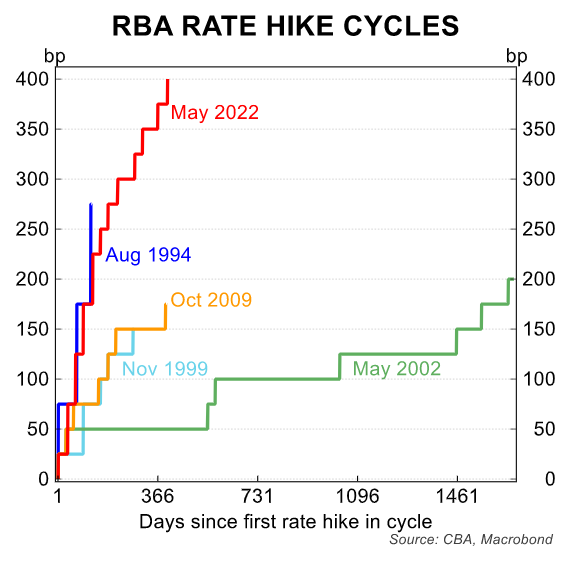
The RBA’s tightening cycle has been incredibly aggressive:
The annual rate of inflation is currently much higher than is desired. But we thought following May’s 25bp rate increase the RBA Board would let the ‘long and variable’ lags of monetary work their way through the system with the objective of “keeping the economy on an even keel”.
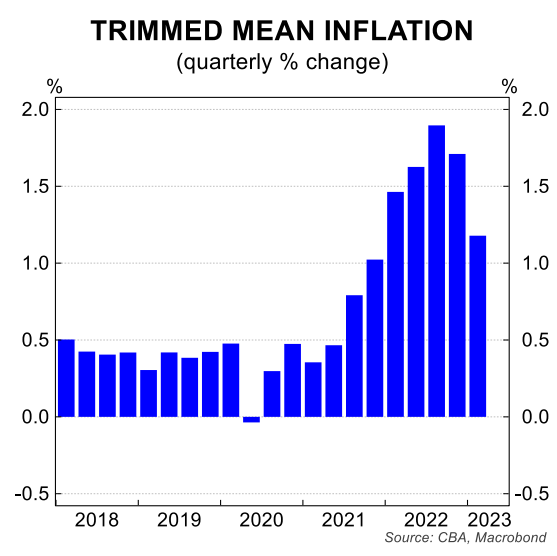
The RBA Board retains that objective. And the Governor’s title of his speech today was “A Narrow Path”. But the idea of remaining on a narrow path and keeping the economy on an even keel becomes harder with each rate increase.
The term ‘narrow path’ coupled with the line “keeping the economy on an even keel” was first used by the RBA in July 2022.
The cash rate had just been increased by 50bp to 1.35%. Today the cash rate is 4.1%. So a further 275bp of tightening has been delivered in 10 months since the idea of navigating a narrow path and remaining on an even keel was first floated.
The title of the Governor’s speech today could have been more aptly named “A Narrower Path”. And if the RBA tightens policy too much further we are simply on “A Path”.
Here we note the national accounts were cause for concern today in terms of what they tell us about the outlook for economic activity and the labour market.
Australia IS different, but there are some similarities
Monetary policy works through essentially four channels: (i) savings and investment; (ii) asset prices and wealth; (iii) the exchange rate; and (iv) cash flow.
In Australia’s case the cash flow channel on the household sector is more powerful than most other jurisdictions because of the structure of our mortgage market.
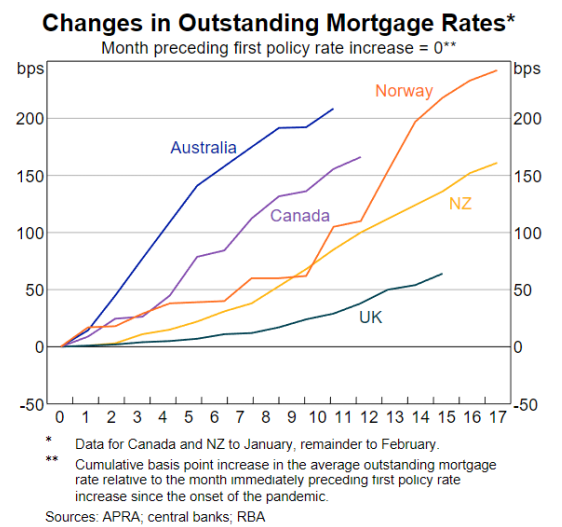
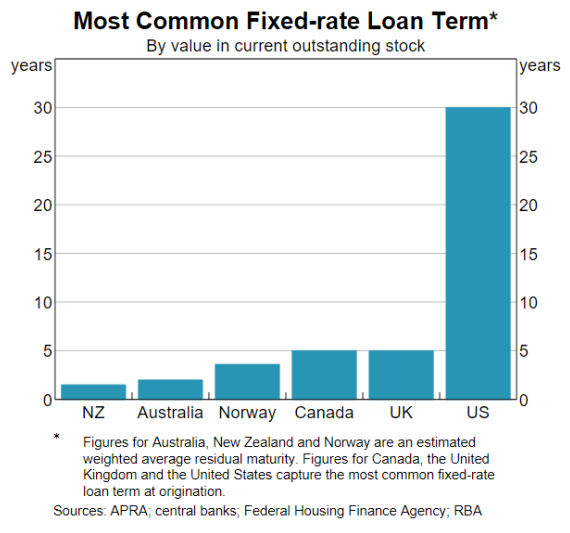
We are predominantly a floating rate mortgage market. And although more home borrowers fixed their mortgages than usual during the pandemic, the average maturity of fixed rate loans in Australia is shorter than most other countries.
Mortgage repayments will rise to a record high as a share of household income as the big number of ultra-low fixed rate loans continue to roll-off over the year.
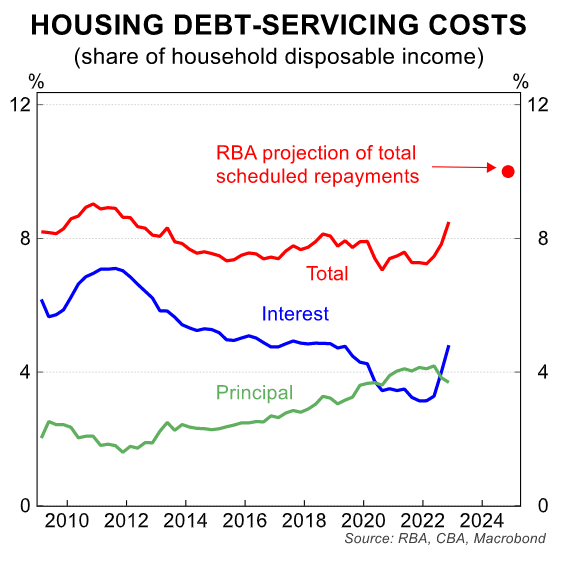
Only around half of the RBA’s already delivered rate hikes have hit home borrower cash flow. So there is a lot of tightening still to come in the pipeline regardless of how much higher the RBA takes the cash rate.
Governor Lowe reminded us today that the starting place for Australia is better than most other countries. We agree.
Wages growth in Australia hasn’t picked up to the same rate as it has in some other countries, particularly in North America and some European countries. And the RBA Board is prepared to have a slightly slower return of inflation to target than some other central banks.
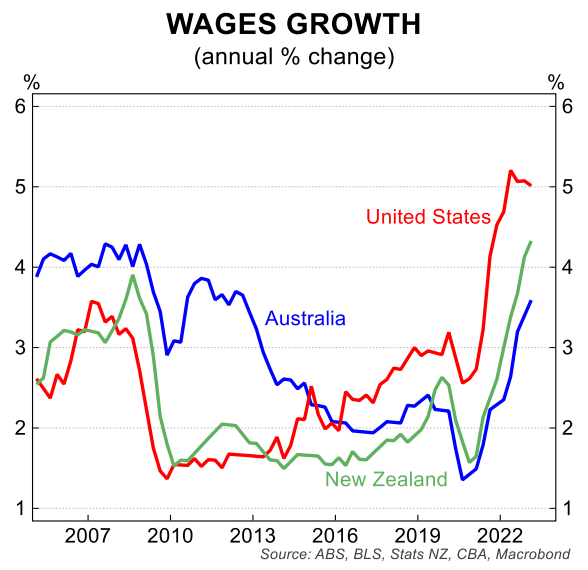
The Governor could have also stated that the RBA’s inflation target of 2-3% is higher than most other major central banks which have an inflation target of 2%.
That makes the job of returning inflation to target a little easier.
The combination of these factors explain why the RBA Board have not increased the cash rate to a level as high as many other central banks.
However the RBA Board are increasingly concerned that services price inflation is proving persistent here as it is overseas. Further persistence in services inflation would become an unwanted part of the Australian economic story.
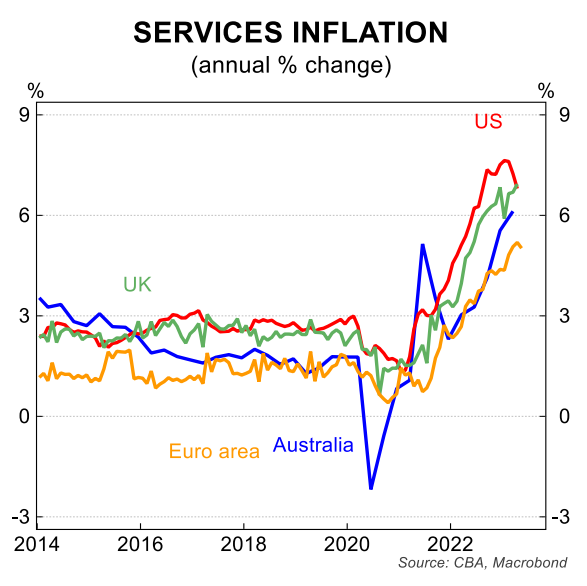
We are not as concerned about services inflation remaining persistent because we expect demand to slow more significantly than the RBA.
Margins are likely to become compressed for a period even if wages growth remains a little elevated if demand slows enough. That is what we anticipate will happen.
Australia does have high inflation. And services inflation has recently accelerated.
Indeed the decision by the Fair Work Commission (FWC), delivered last Friday, to increase the award rates of pay by 5.75%, effective from 1 July 2023, is an upside risk to the outlook for services inflation.
The Governor today in the Q&A session following his speech explicitly stated that the FWC decision was higher than the RBA had expected. That 2023 award wage outcome fed into the Board’s decision to hike the cash rate by 25bp in June.
What is the RBA most worried about?
The RBA Board’s current concerns were most neatly summarised by the Governor in his speech today with this statement: “recent information has suggested greater upside risks to the Bank’s inflation outlook”.
“Services price inflation is proving persistent here and overseas, and the recent data on inflation, wages and housing prices were higher than had been factored into the forecasts”.
So the offshore experience is playing into the Board’s thinking on the outlook for Australian services inflation.
The FWC decision came in stronger than expected (note that the recent wages data, in the form of the Q1 23 wage price index printed slightly below their expectations). And the recent lift in home price might generate a wealth effect that means higher household consumption than otherwise.
The recent lift in home prices is a real conundrum for the RBA and for many Australians more generally. Population growth has massively exceeded expectations.
The Commonwealth Government had forecast population growth to be 1.4% in 2022/23 in the October 2022 Budget. But in the May 2023 Budget this forecast was upgraded to 2.0% this fiscal year and 1.7% in 2023/24.
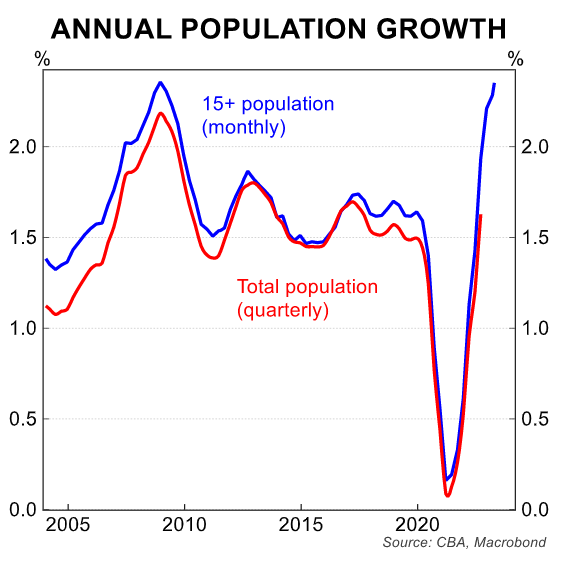
Net overseas migration is forecast to be 400k in 2022/23 and 315k in 2023/24.
Such outcomes would be much bigger than the pre-pandemic average of ~250k per year.
The surge in net overseas migration has occurred at a time when building approvals have collapsed.
For context, building approvals in April 2023 hit their lowest level since April 2012. The upshot is that rental inflation is rising quickly.
The massive imbalance between underlying demand for housing and supply has seen home prices lift despite the RBA’s recent rate increases.
It is possible that a further rate hike does not pull home prices down given the huge mismatch in supply and underlying demand.
The Q1 23 national accounts were a concern
Real GDP rose by just 0.2%/qtr in Q1 23 and annual growth slowed to 2.3% (from 2.6% in Q4 22).
GDP per capita fell by 0.3% in Q1 23 following a gain of just 0.1% in Q4 22.
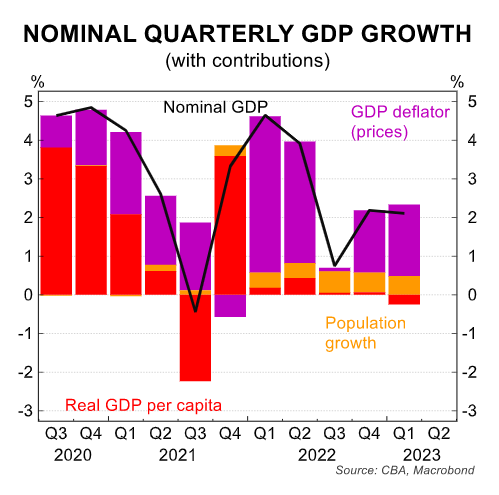
It will almost certainly be confirmed that Australia is in a ‘per capita recession’ when the Q2 23 national accounts are published in early September.
The household sector is feeling the impact of rate increases and negative real wages growth.
Household spending rose by just 0.2%/qtr in the March quarter, the weakest quarterly result since the fall recorded during the COVID-19 Delta variant lockdowns in Q3 21.
Growth in essential spending increased over the quarter (1.1%), while discretionary spending fell by 1.0%. It is no wonder consumer sentiment is sitting in the doldrums.
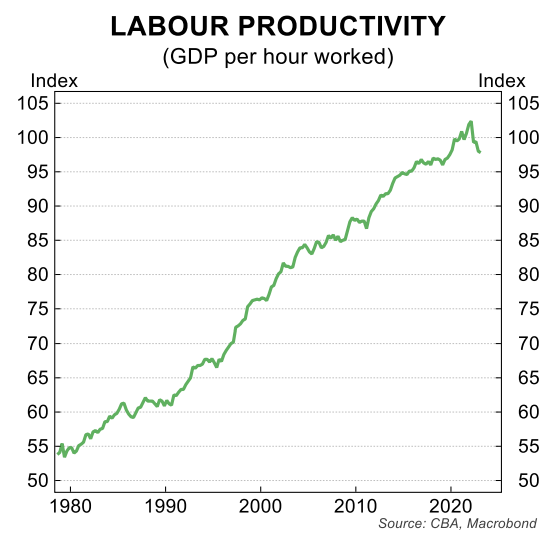
Labour productivity slipped again over the quarter (-0.2%) and is down by a massive 4.5% over the year. This is the worst result on record (the ABS data on GDP per hour worked dates back to 1978).
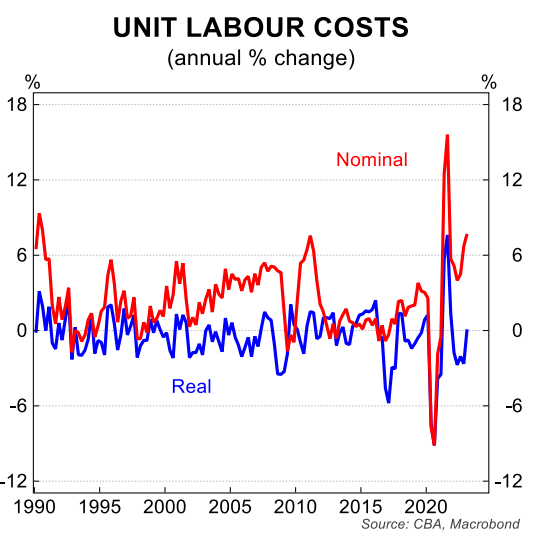
Unit labour costs rose by 2.0%/qtr to sit 7.9% higher over the year – not too dissimilar to the annual rate of CPI at 7.0% over the same period.
Unit labour costs have simply risen too quickly and that is causing the RBA concern.
Our updated RBA call
We now expect one further 25bp increase in the cash rate for a peak of 4.35%.
We consider the hike is most likely at the August Board meeting (the risk is a 25bp rate hike in July).
There is also a risk of 25bp rate rises in both July and August, which would take the cash rate to 4.6%.
We have pushed out the timing of the start of rate cuts from Q4 23 to Q1 24 – we expect 125bp of easing in 2024 (50bp of rate cuts in Q1 24 and 25bp of easing in each of Q2 24, Q3 24 and Q4 24, which would take the cash rate to 3.10% at end 2024).
We believe policy easing will be required of this magnitude over 2024 to avoid the unemployment rate lifting back to 5.0% – around the level it sat pre-pandemic, which is above most estimates of the NAIRU (non-acceleration inflation rate of unemployment).
It is possible that the RBA leaves policy on hold for an extended period in 2024 if inflation proves hard to return to target and unit labour costs don’t decelerate enough.
If such an outcome transpires we believe the Australian economy will not have a soft landing.
Our economic forecasts will be downgraded as a result of our change in RBA call and the 25bp rate hike delivered in June.
We will publish updated economic forecasts on Friday.
