
The Council of Financial Regulators on Wednesday confirmed that it would not lower the Australian Prudential Regulatory Authority’s (APRA) 3% mortgage serviceability buffer.
According to APRA, the 3% mortgage buffer is “designed to reinforce the stability of the financial system… ensuring the financial system remains safe, and that banks are lending to borrowers who can afford the level of debt they are taking on – both today and into the future”.
The buffer was increased from 2.5% to 3.0% in late 2021 when Australian mortgage rates were at record lows and house prices were rising at an unprecedented rate.
Since then, we have seen the Reserve Bank of Australia (RBA) hike the official cash rate by 4.0%, which has flowed onto mortgage rates.
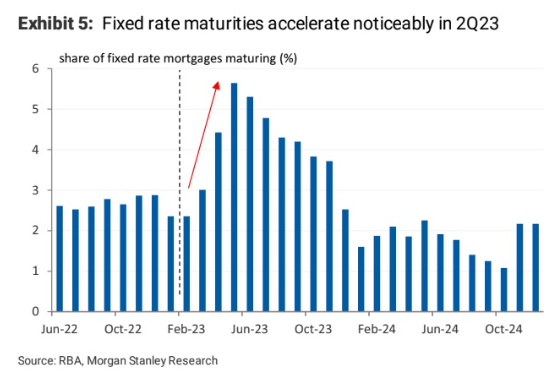
Australia is also experiencing record numbers of borrowers resetting from ultra cheap fixed mortgage rates of around 2% to variable rates approaching 7%.
The RBA estimated that 880,000 fixed rate mortgages would expire this calendar year, with the bulk of those occurring in the second half:
First home buyers will be most seriously impacted, given more than half chose fixed rates mortgages over the pandemic (versus 40% across the overall market):
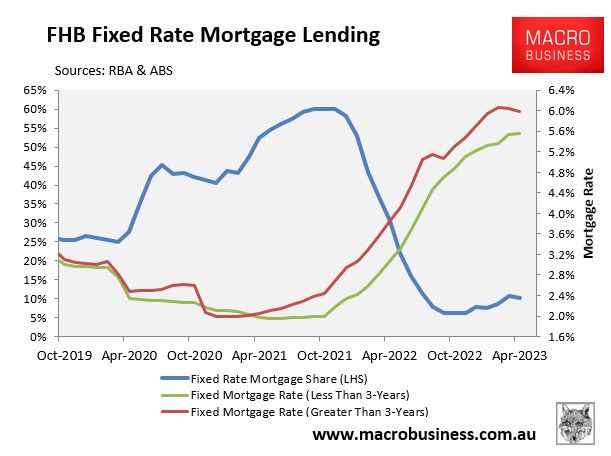
When these fixed rate borrowers took out their loans, they were assessed at mortgage rates of around 4.5% to 5% (i.e. 2% fixed rate plus a 2.5% or 3% buffer).
Now if they seek to refinance, they will be assessed at mortgage rates approaching 10% (i.e. up to 7% variable rate plus a 3% buffer).
Most borrowers cannot meet these new serviceability buffers.
As a result, they have/will become “mortgage prisoners” that are trapped with their current lenders, unable to refinance, and paying uncompetitive rates.
In the below interview with Sky News’ Ross Greenwood, I explain why APRA’s 3% mortgage buffers should be removed for mortgage refinancings.
My reasoning is as follows:
- These people are already ‘in the market’ and were assessed for serviceability when they took their loans out.
- Trapping them with their existing lenders on uncompetitive rates is bad for financial stability, since it will drive more forced sales.
- Creating ‘mortgage prisoners’ is also bad for competition, since lenders will have no incentive to offer a better rate when they know their borrower cannot leave.
- It is inequitable to force first home buyers out of their homes to wear the interest rate adjustment.
In short, maintaining the 3% mortgage serviceability buffer on refinancings is illogical, unfair, bad for financial stability and bad for competition.
