
According to Westpac’s excellent Red Book, the rebound in house prices is not at all popular.
― While the near term outlook for consumer spending remains weak, one expected headwind – negative wealth effects stemming from house price declines – now looks set to be much milder.
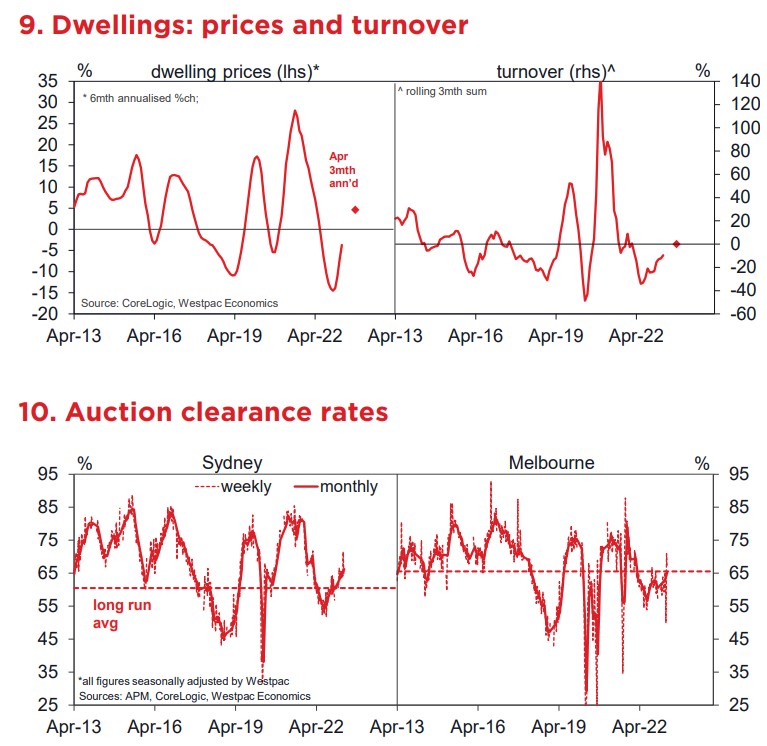
― Recent indicators are showing convincing signs of stabilisation in Australia’s housing markets. Indeed, the material correction seen now looks to be largely over. Westpac expects prices to remain broadly flat this year, with a sustained, broad-based recovery gaining traction in 2024.
― Three factors look to be driving the shift: 1) a resurgence in net migration inflows; 2) the sharp rise in construction costs; and 3) low levels of ‘on market’ supply.
― Notably, the stabilisation has come despite further official rate rises in February and March, and continued hawkish expectations for mortgage rates amongst consumers.
Housing recoveries typically only emerge once the RBA is actively cutting rates or is very clearly poised to do so. Price gains also tend to follow a sustained lift in turnover, not vice-versa.
― The positives in play – migration, construction costs and limited supply – tend to be marginal and gradual drivers of price gains.
With interest rate negatives still in the mix, this suggests the market is stabilising rather than setting up for sustained gains near term.
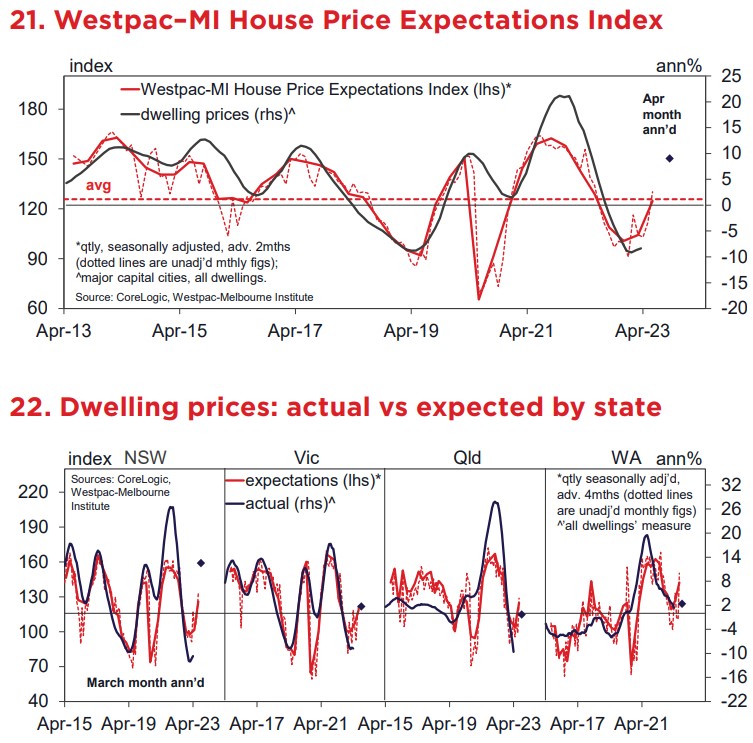
― Consumer house price expectations have shown a decisive lift. The Westpac Melbourne Institute House Price Expectations Index has surged 24.8% over the 3mths to Apr. At 130.3, it is now above the long run avg read of 125.8 for the first time since Apr last year.
― As noted, the shift coincides with a clear stabilisation in housing markets that includes modest price gains in the last few months. A slight majority (50.5%) of consumers now expect prices to continue rising over the next 12mths.
Nearly 21% expect prices to hold flat while 20% expect prices to decline and 9% responded ‘don’t know’. Just 2% expect a fall of 10% of more while 10% expect double-digit price gains.
― The shift in sentiment is broadly in line with gains over the last four months, which have been running at an annualised pace of about 1%. However, its still well below levels consistent with the 6% annual pace seen over the last three months and the 10% annualised pace of gains in March and April.
― The state breakdown is also broadly consistent with the varied price performance in recent months.
― The biggest lift in expectations has been in NSW. Sydney prices having shown the strongest gains in 2023. Other states have lifted more towards levels consistent with a stabilisation in prices. WA a notable exception, expectations in the west coming from a firmer starting point.
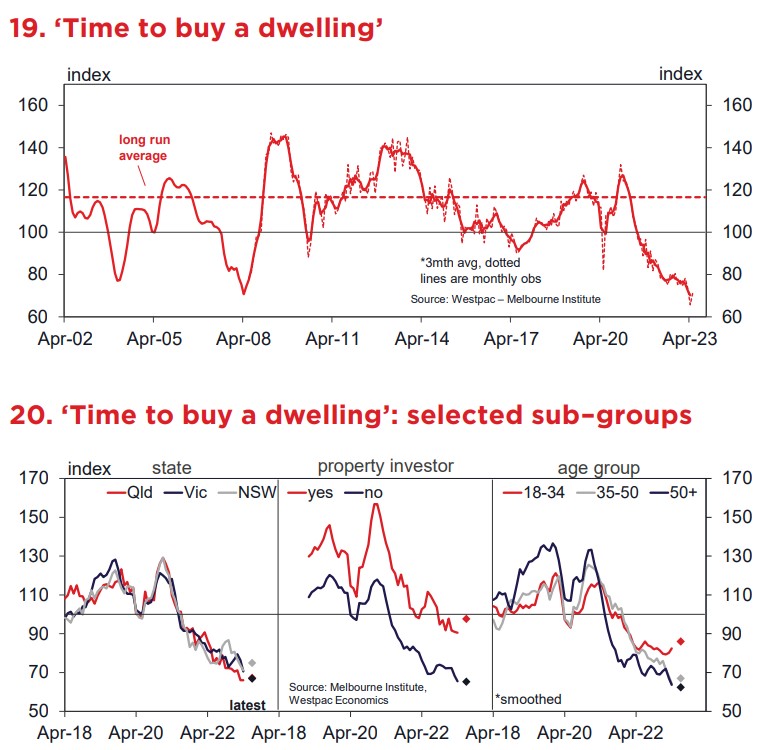
― Consumer house purchase attitudes remain extremely weak. The ‘time to buy a dwelling’ index fell 9.1% over the 3mths to Apr, more than unwinding the ‘dead cat bounce’ through the turn of the year and hitting an all-time low of 65.7 in Mar.
― The combination of interest rate and dwelling prices rises – both current and expected – is clearly weighing heavily on buyer sentiment. That in turn suggests we should be cautious about housing market prospects.
― While the evidence of stabilisation is convincing, some of the pre-conditions for a sustained rise – namely improving buyer sentiment and a prospective lift in turnover – still look to be a long way off .
― That said, we have had housing upturns in the past that have proceeded with relatively weak buyer sentiment and low volumes. The most recent example is in 2015 when strong investor-led gains in Sydney and Melbourne were the main driving force (a development that led to macro-prudential tightening measures from APRA and the RBA).
― This suggests investor activity will be a key area to keep an eye on in 2023. Notably, the sub-group detail shows buyer sentiment is much firmer amongst consumers that already own an investment property. Whether this is a precursor to a lift in investor activity remains to be seen.
Albo’s maniac immigration program in action:
- huge dwelling shortage;
- skyrocketing rents absorbing more of the interest rate price adjustment than capital values;
- investor-led boom incoming, but
- it will need to be very big to restart construction.
Like force-fed battery geese, Australians have every reason to hate this developing boom.
