
Maybe it is the interest rate reset but according to the Westpac credit card tracker, consumption has suddenly dropped like a stone.
The Westpac Card Tracker Index continues to point to a significant weakening in consumer demand.
The Index declined 7.9pts over the two weeks to May 6, unwinding a brief holiday-related bounce in the third week of April.
Looking through recent Easter and ANZAC Day related volatility, the Index is basically unchanged since the start of April, holding in the 133-136 range.
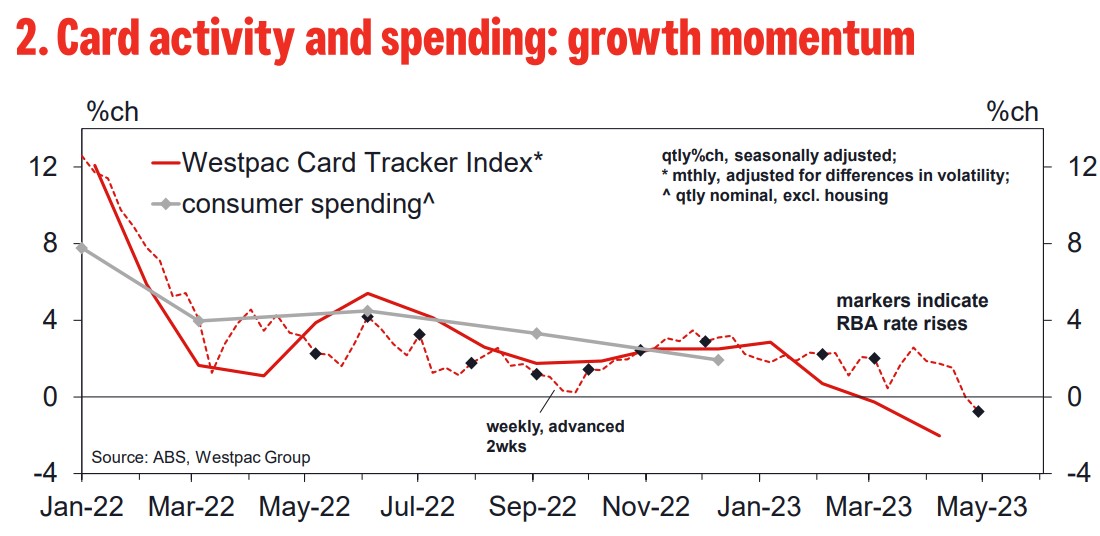
The flat monthly result has taken quarterly growth momentum further into negative territory, the 3mth change dropping to –0.9% in April, the weakest read since the ‘delta’ lock-down in 2021.
Note that this measure is adjusted to remove regular monthly seasonal variations. It is also based on the dollar value of card activity so includes the effect of rising prices.
With the CPI rising 1.4%qtr rise in the March quarter, the tracker results imply activity is seeing an even sharper contraction in real, inflation-adjusted terms.
The weakening signal comes as a variety of other measures are also starting to show a material slowdown in spending.
Official ABS figures show retail sales volumes contracted 0.6% in the March quarter, a second successive decline, with official card-based measures of household spending and tax-based measures of turnover also pointing to weakness in nominal spending, albeit to varying degrees in Q1 and with differences in timing.
How this shows through in the official spending figures for the March quarter will be revealed when the Q1 national accounts estimates are released on June 7.
Risks appear firmly to the downside.
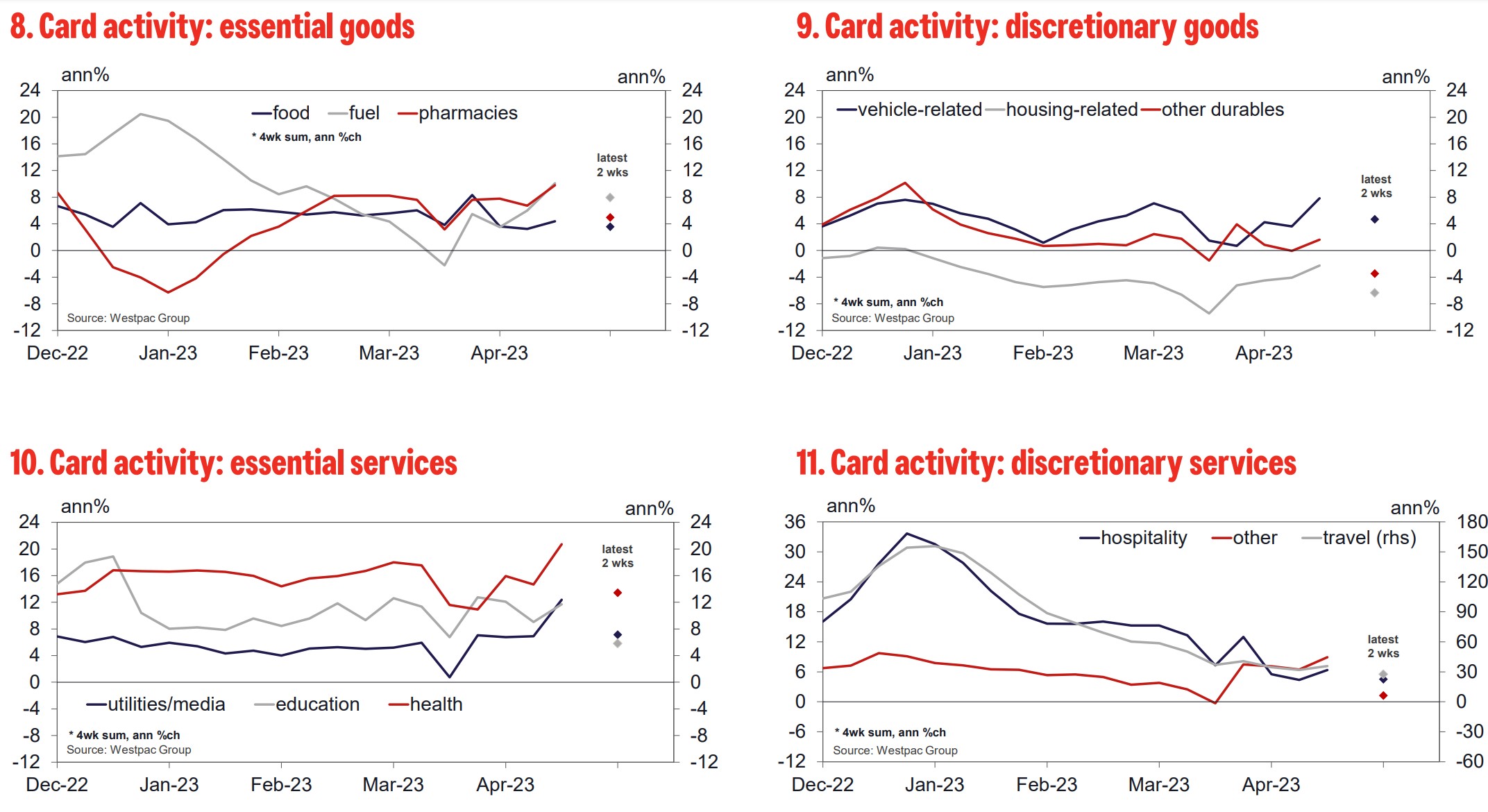
The more granular detail shows stalling across all major segments of retail and outright weakness in non-retail activity.
Discretionary goods activity is particularly weak, particularly for housing-related and other durables.
Growth is notably weaker in NSW and Vic.
Staples holding up better as discretionary spending hits the wall. Classic recessionary pattern.
