
Australia’s house price recovery continued in April, with CoreLogic’s dwelling values index rising 0.5% month on month to be up 1.0% over the quarter.
Sydney, the market that led the slump, is now leading the rebound, with dwelling values up 3.0% since January.
The surprise comeback in property values has been mirrored by an increase in clearance rates from their December lows in the auction market:
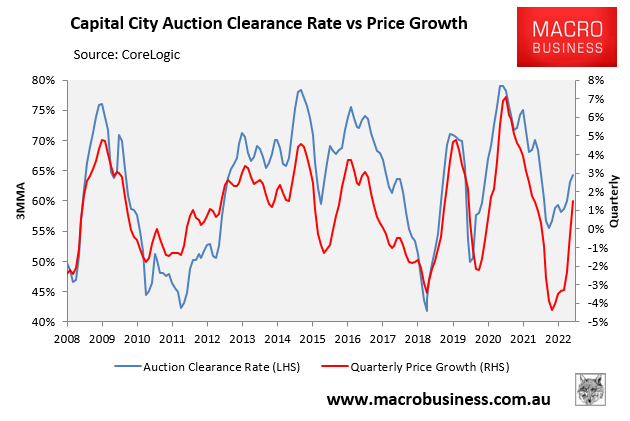
Most analysts were taken aback by the housing rebound, which occurred despite a 0.25% increase in official interest rates in early February and another 0.255 increase in early March.
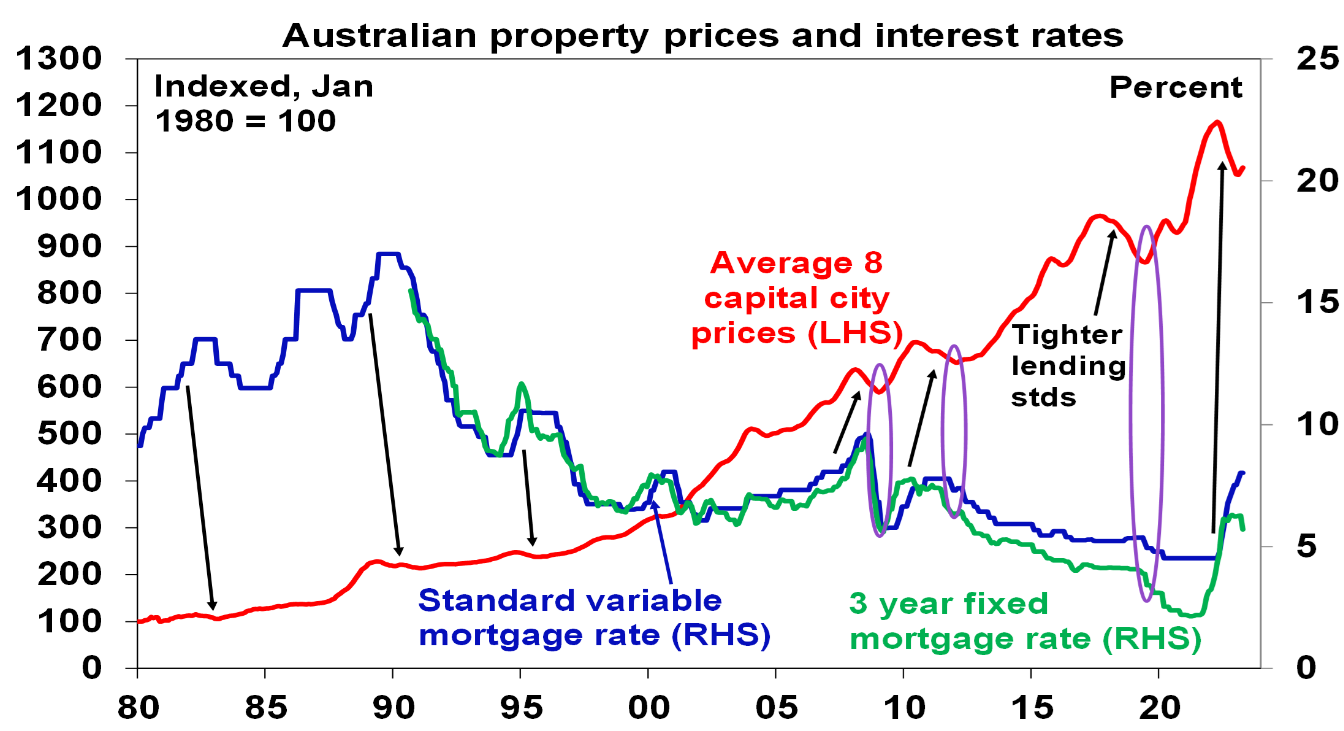
The Reserve Bank of Australia’s (RBA) eleven interest rate increases have nearly doubled mortgage costs and restricted borrowing capacity by approximately 30%.
This is the steepest decline in borrowing capacity on record, and it would generally be accompanied by a significant drop in property values.
In prior cycles, property values did not recover until the RBA began to lower interest rates, as illustrated by the next graphic from AMP Capital’s Chief Economist Shane Oliver (see purple ovals).
A severe lack of available listings, increasing rents, and record immigration are currently outweighing the RBA’s aggressive rate hikes, propelling the surprise price recovery.
At the same time, rents in the combined capital cities are rising by double digit rates amid historically low vacancy rates.
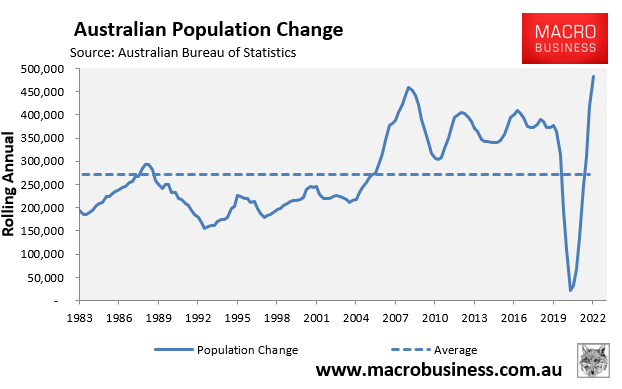
Given that net overseas migration (NOM) is also at an all-time high, the market is projected to tighten even more.
Australia’s population increased by 482,000 in 2022, owing to record NOM:
The Australian Treasury now expects NOM to reach 400,000 this fiscal year and 315,000 in 2023-24.
That is significantly higher than the 235,000 annual NOM forecast in the federal budget released in September.
In short, the aforementioned causes have produced a sense of ‘fear of missing out’ (FOMO) as Australians desperately strive to exit the dysfunctional rental market.
This is driving the house price rebound.
Will the RBA ruin the party?
On Tuesday afternoon, the RBA surprised most analysts and financial market participants by raising the official cash rate (OCR) by 0.25% to 3.85%.
In his statement accompanying the decision, Governor Phil Lowe noted that “inflation in Australia has passed its peak, but at 7% is still too high and it will be some time yet before it is back in the target range”.
“Given the importance of returning inflation to target within a reasonable timeframe, the Board judged that a further increase in interest rates was warranted today”.
Lowe is particularly worried about ‘sticky’ services inflation, noting it “is still very high and broadly based and the experience overseas points to upside risks”.
Lowe also warned that “some further tightening of monetary policy may be required to ensure that inflation returns to target in a reasonable timeframe, but that will depend upon how the economy and inflation evolve”.
Before ending his statement with “the Board remains resolute in its determination to return inflation to target and will do what is necessary to achieve that”.
Although the nascent housing recovery was not specifically cited as a reason for the rate hike, it could have played a minor role, given that rising home prices are typically accompanied by an increase in consumer confidence, which supports consumption and potentially keeps inflation higher for longer.
The forecast for house prices remains positive:
Despite the surprise rate hike by the RBA, the outlook for Australian home prices remains positive.
Even if the RBA hikes again, interest rates are likely to be near their top.
Record immigration will drive up demand for housing, both for purchase and for rent.
This unprecedented population surge has arrived at a time when Australia’s housing construction industry is on the verge of collapse due to widespread company failures and soaring material and financing (interest rate) costs.
As a result, Australia’s housing problem will deteriorate in the near future as record immigration-driven demand collides with diminishing home supply.
The extent of Australia’s housing supply problem is clearly represented in the following chart from AMP Capital’s Chief Economist Shane Oliver, which depicts the country’s acute housing shortage:
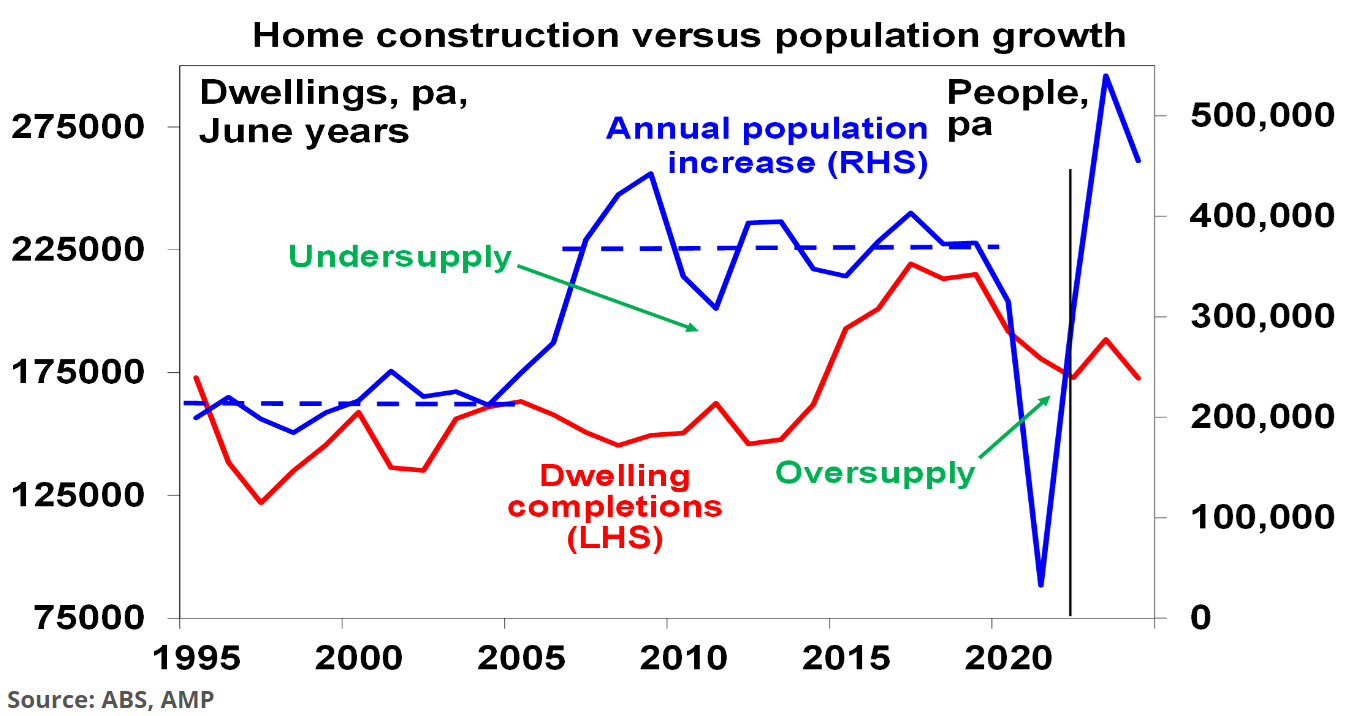
This shortage will cause the rental market to tighten even further, pushing more people to buy.
Finally, foreign buyer demand, led by China, will continue to rise, providing additional support to home prices.
When the RBA eventually cuts rates, housing prices will launch:
The significant bounce in immigration, auction clearances, and prices suggests that home demand remains strong.
The only thing holding down prices is a sharp decline in borrowing capacity as a result of the RBA’s 3.75% of interest rate hikes.
Borrowing capacity and mortgage demand will increase once the RBA begins cutting the OCR, most likely at the end of the year.
The Australian Prudential Regulatory Authority (APRA) may also follow suit by cutting its mortgage serviceability buffer from 3%, expanding borrowing capacity and demand even further.
The bottom line is that the majority of the elements are in place for the next house price boom.
All that is required is for the RBA and APRA to begin their easing cycle. This will propel property values into 2024.
