
According to policymaker Robert Sobyra of the Australian Constructors Association, national data suggests the financial positions of large residential builders are already in jeopardy, with more than half “technically insolvent”.
Sobrya stated that many builders were still struggling as a result of rising material costs, but that this was thankfully “yesterday’s news”.
“There are some builders still suffering from having to endure that gap between the prices they were paying and the prices they received”.
Sobyra has been tracking Equifax data on the asset-to-liability ratio for large residential home builders.
“For the median (builder in that category), that ratio has now gone negative”, he said.
“That means half of large vertical builders in Australia at the moment are technically insolvent and that’s a pretty dire kind of conclusion”.
Sobyra also warned that Australia is structurally set up for falling rates of housing supply at the same time as demand will ramp-up, both through record net overseas migration and an ageing population.
“This industry is facing some huge structural imbalances between supply and demand that will go over the top of the pandemic cycle and will dwarf everything for the next few decades”, he said.
“On the demand side, we’re looking far above just accommodating every extra person, we’ve got to look at all this other stuff”.
“At the same time, we’ve got the supply side shrinking – we’ve got an ageing population, which means the workforce is shrinking”.
“By 2050, the share of the population who are young men will be about be about half the number it was in the 1980s and that’s the main cohort of workers you rely on to build things”.
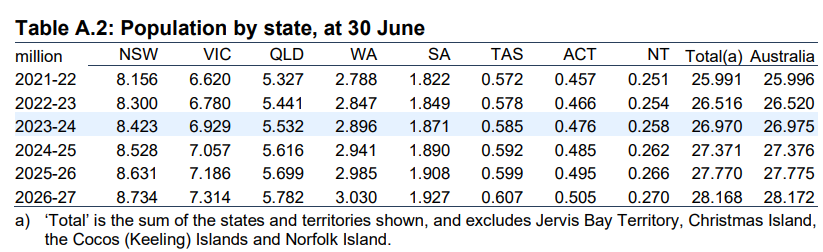
The absurdity of Australia’s housing predicament is encapsulated by the Federal Budget’s population forecasts, which shown in the table below:
Source: 2023 Federal Budget
Australia’s population is officially projected to increase by 2.18 million people in the five years to 2026-27, or by an average of 435,200 people each year.
This population increase will be driven by net overseas migration of 300,000 a year over the same period, according to the federal budget.
To put this projected population increase into perspective, it is equivalent to adding five Canberra’s or one Perth’s worth of people to Australia’s current population in only five years.
Such an unprecedented increase in population is an insurmountable task under the very best housing conditions.
It is even more insurmountable when the entire residential home building industry is suffering widespread insolvencies amid soaring materials prices and financing (interest rate) costs.
The next chart plots dwelling completions against actual and projected population growth, as set out in the 2023 federal budget:
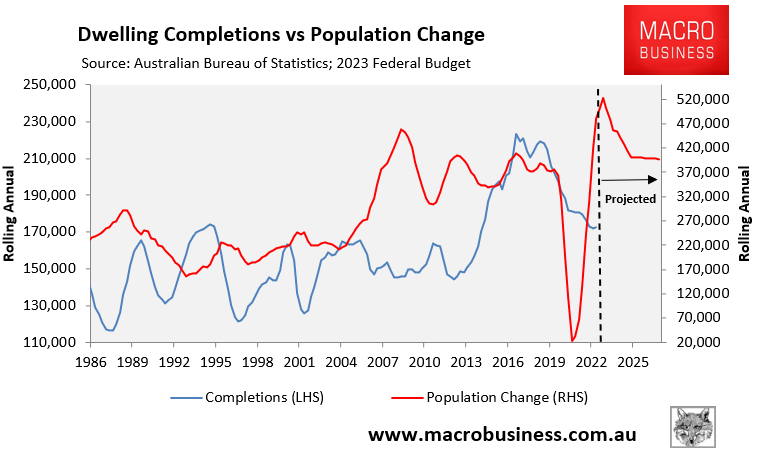
Australia failed to build enough homes in the 15 years of ‘Big Australia” immigration leading up to the pandemic.
So clearly, the housing shortage will deteriorate given actual construction levels are falling at the same time as Australia’s population is projected to grow by between 400,000 and 500,000 people a year.
If the Albanese Government genuinely wanted to end Australia’s housing shortage, it would run an immigration intake significantly below the growth of the overall dwelling stock, not the reverse.
Australia will never build enough homes as long as its population grows by 400,000 or more people a year.
Australia’s housing shortage is first and foremost the result of excessive levels of immigration.
