
The Australian Prudential Regulatory Authority (APRA) lowered the mortgage repayment buffer in July 2019, reducing the requirement for lenders to evaluate borrowers at a 7% mortgage rate with a 2.5% buffer over the loan’s interest rate.
APRA’s lowering of the mortgage serviceability buffer came after intense lobbying from the banking sector. For example, ANZ chief executive Shayne Elliott argued that the 7% requirement forced the bank to turn away one in five loan applications.
The decision to lower the buffer was also celebrated by then Treasurer Josh Frydenberg, who described the decision as “a positive development” that would “spur lending growth”.
APRA subsequently increased the mortgage repayment buffer to 3.0% in October 2021 in response to “growing financial stability risks from ADIs’ residential mortgage lending” and fast rising property values.
Home lending nearly doubled between the time the floor was abolished in mid-2019 and when the buffer was raised to 3% in October 2021.
Ten interest rate hikes from the Reserve Bank of Australia (RBA) has seen the official cash rate – and most variable mortgage rates – increase by 3.5%.
This means that most mortgage rates are currently 1% higher than the serviceability buffers at which many borrowers were assessed during the pandemic.
First home buyers, in particular, are now struggling to meet their mortgage repayments.
And many such borrowers are also failing today’s lending rules, making it impossible for them to acquire a better rate from a rival lender.
Former head of credit risk at APRA, Glenn Homan, has told The ABC that removing the original 7% mortgage serviceability buffer has led to “bad outcomes” for many Australian borrowers who had purchased during the pandemic property boom and now face financial hardship as interest rates returned to historical levels.
“It was designed to not have people over-gear themselves too much”, Homan said.
“The borrowing public needs some form of hedge against rising rates … they need some sort of protection”.
“I think people have been encouraged [by lenders] to really try [to] borrow the supposed maximum they can afford against the serviceability model that any particular organisation uses”, he said.
Homan also told The ABC that during his time at APRA (which ended in 2016) he ran up against many senior bankers that believed “anything that APRA did that got in the way of lending was inherently a bad idea”.
Lowering the mortgage serviceability buffer was the key policy manoeuvre that pulled house prices out of the Hayne Royal Commission swan dive.
Now it is coming back to bite following the sharpest increase in mortgage rates in the nation’s history.
Borrowers that took out fixed rate mortgages at around 2% over the pandemic are especially exposed, as are those that borrowed to their maximum limit.
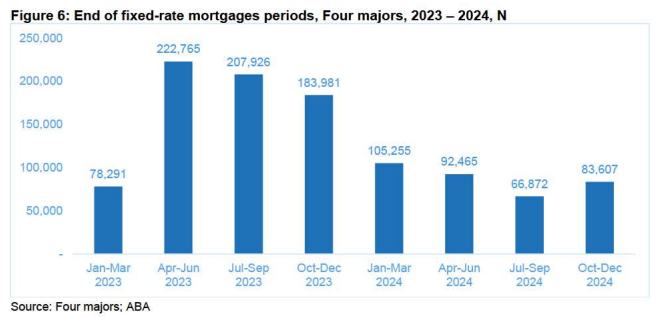
According to Australian Bankers Association data, more than 600,000 borrowers will switch from ultra cheap ~2% fixed rate loans originated over the pandemic to variable mortgages with rates around 6% over the final three quarters of 2023:
This means that thousands of Australians are facing a vicious increase in mortgage repayments, and some will inevitably default.
Pressure will also build on APRA to lower the mortgage serviceability buffer again to help borrowers refinance.
