
Criminal gas cartel to rocket AUD, plunge house prices
Credit Agricole has a note that needs correcting.
AUD: budget adds marginally more pressure on the RBA to hike rates
As expected, the Australian government delivered its first budget surplus in 15 years. At just AUD4bn or 0.2% of GDP it was small, however.
Since the October 2022 budget, a stronger-than-expected labour market, higher-than-expected commodity prices and lower-than-expected interest payments on debt increased the Australian government’s revenue by AUD146bn.
On a net basis, the government has spent AUD20.6bn (about 0.8% of GDP) of this windfall and banked the rest.
Much of this spending will be spread out over the coming four years and so will not hinder the RBA’s fight against inflation all that much.
Indeed, the Australian Treasurer, Jim Chalmers, claims the total budget package will take 0.75ppt off inflation. This claim is unlikely to be realised.
While power bill discounts for low income earners and caps on gas and coal prices will technically drag on inflation in the short term, they will also be handing money back to low-income households that will likely spend it and add to demand.
So the government’s forecast for inflation to fall from 6% this financial year to 2.75% in 2024-25, is more optimistic than the RBA’s forecast return to the top of its 2-3% target band.
The economy will easily absorb this extra demand as GDP growth is forecast by the Treasury and the RBA to slow from 3.25% this year to 1.5% next year.
Other spending initiatives that will add to household consumption will be an AUD4.9bn boost to the dole, AUD2.4bn for a 15% increase to rental assistance, AUD1.9bn for single parents and AUD1.2bn for lowering the cost of medical prescriptions for low income earners.
The good news is that pessimistic commodity price forecasts mean that the forecast deficits into the future risk surprising to the upside and even recording to some surpluses.
This together with gross public debt forecast to peak at 36.3% of GDP in 2026-27 and then decline will leave Australia’s AAA credit rating intact.
The budget also puts only marginally more pressure on the RBA to hike rates.
That may be the case overall but not if it hinges on energy rebates failing. They are structured as a joint venture with states to lower bills, not as cashback to consumers.
The lower bills will directly reduce inflation. There may be some minor uptick in demand from the money that households have as a result of not paying higher bills but it is unlikely to offset the disinflationary utilities.
The larger problem for energy inflation is that the gas cartel is criminally violating national price caps again and that is driving up wholesale power prices:
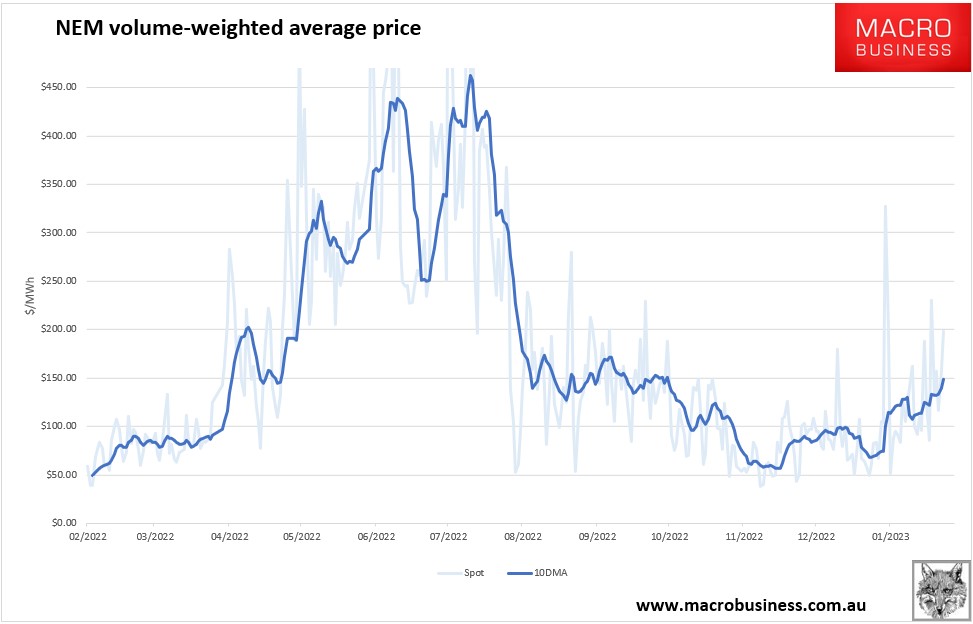
So the power bill subsidies will be fighting skyrocketing input costs within a quarter.
Current wholesale power prices will not only wipe out the electricity bill subsidies but add another 50% gain. That will add 3-4% to inflation with spillovers in due course.
In short, the gas cartel will drive interest rates and the AUD higher at the worst possible moment which will, in turn, deliver a second round house price crash.
