I noted last week how property investors were coming under increasing financial strain following the Reserve Bank of Australia’s (RBA) 3.50% increase in official interest rates.
The associated increase in mortgage repayments has easily offset the double-digit rise in rents across the major capital cities, as illustrated in the table below:
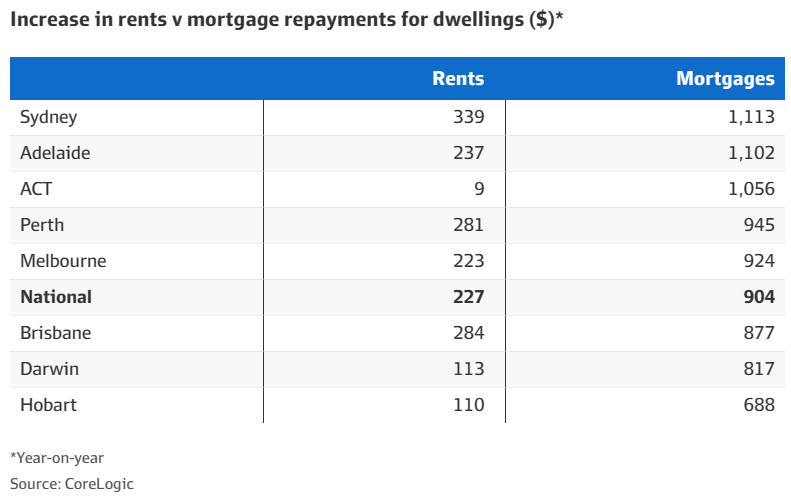
For example, in Sydney, rental income has increased by $339 per month over the past year, versus a $1,113 increase in mortgage repayments on a $500,000 loan.
In Melbourne, rental income has increased by $223 per month over the past year, versus a $924 increase in mortgage repayments.
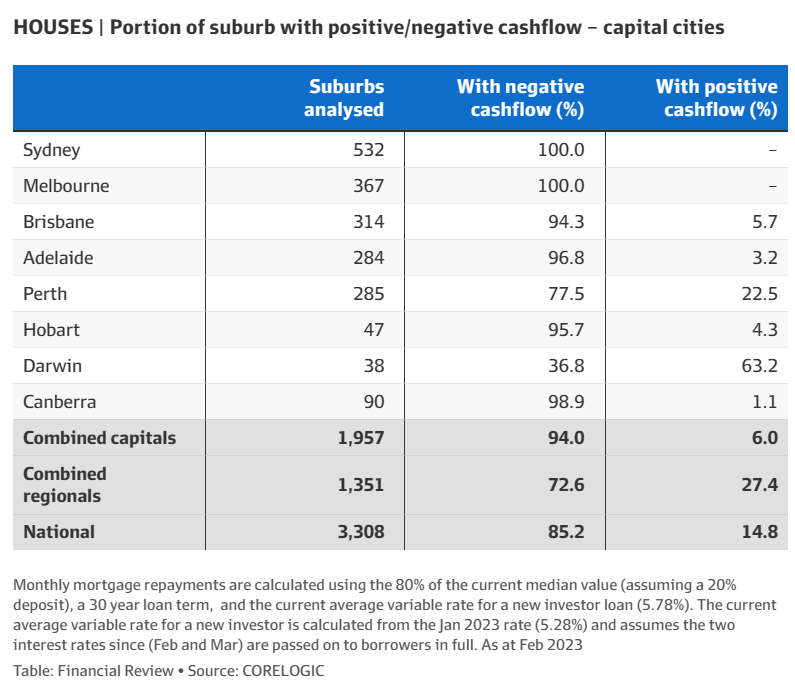
As a result, every suburb with house rental markets and more than 97% of suburbs with unit markets in Melbourne and Sydney are now cashflow negative, according to CoreLogic:
According to new research from CoreLogic, Melbourne investors are selling their properties at a higher rate than usual, with investors comprising 30.8% of all property listings in Greater Melbourne in March, up from the 10-year average of 25.2%.
CoreLogic’s head of Australian research, Eliza Owen, said mortgage rates “have gone up faster than rents even though rents have gone up to record levels. This may prompt investors to sell”.
“Most investors are negatively geared anyway. The current period is exacerbating the losses investors would be copping”.
Michelle Chick, the principal of Ray White Werribee, said her investor clients were selling because they could no longer afford their mortgages.
“The increase in interest rates and the cost of living has put a lot of pressure on families. So they’re just selling off a property or two in order to keep the family home”, she said.
When interest rates are falling and prices are rising, borrowing to invest in real estate makes financial sense.
But when the opposite happens, as it has recently, investing in real estate can become a financial black hole.
That said, the situation facing real estate investors should improve later this year.
The Reserve Bank will likely begin lowering interest rates towards the end of this year, which will slash mortgage costs and lift the value of housing.
Given record immigration and falling new home construction, rental growth should also remain strong.
Therefore, while 2023 is presenting difficulties for real estate investors, 2024 is shaping up to be much brighter as the boom returns.
Sadly, this also means that tenants will continue to suffer from soaring rents amid record tight supply.